The Shabbat prior to Purim is called the “Shabbat of Remembrance” (Shabbat “Zachor”) from the book of Esther with the command to “remember the Amalekites” and what they did to Israel during their forty years of wandering in the wilderness: “17 Remember what the Amalekites did to you as you were coming out of Egypt? 18 They found you on the road when you were all worn out, and they attacked those who had fallen behind and were isolated and defenseless. They showed no fear of God. 19 When you’re in a position to punish them for this, when all of your other enemies are defeated and you’re living peacefully in the land that the Eternal your God is giving you to live in, then wipe out every trace of the Amalekites under the sky. Don’t forget!” Deut. 25:17-19
Remember means to bring to mind; don’t forget means to act upon it.
There are different ways in which we can interpret this command. For example, is the importance to learn from our mistakes. The mistake of the Israelites when they first entered the wilderness was to neglect to protect the weak and vulnerable who lagged behind making them a prime target for the enemy. The Israelites later organised themselves in tribal groupings to address this problem. Don’t forget!
Spiritually, Scripture urges us to avoid making ourselves vulnerable and providing the enemy a foothold in our lives through any manner of traps and stumbling blocks strewn across our path.
From a different perspective we might question that to remember the deeds of our enemies rather than forgive them as Scripture commands, is a contradiction? (i.e., “Love your neighbour as yourself”; And in Matt. 5, Yeshua Himself said: “43 You have been taught to love your neighbour and hate your enemy. 44 But I tell you this: love your enemies. Pray for those who torment you and persecute you— 45 in so doing, you become children of your Father in heaven.” Also Ps. 51 + Luke 10
From a rabbinic perspective,
- Amalek is the enemy who will never reconcile and so to show mercy foolishly to one wholly dedicated to the destruction of Israel is forbidden (cf., Prov. 12). Rather than tolerate evil we fight against it with every part of our being because to be a spectator is to condone and be as guilty as those who are actually committing the offences. (Holocaust; end-time nations) Rather than be spectators, we actively demonstrate our love towards victims of evil in different ways demolishing every manifestation of evil through the weapons of our warfare that God has supplied us with.
All the tragedies which Israel suffered are directly illustrated by this one hostile act of Amalek. And embedded within these manifestations and hostilities throughout the ages lies the demonic spirit of anti-Semitism. This is the reason why on Holocaust Day we say: “We will never forget!”
(2) The command to “remember” is also to recall our own evil actions against others and be reconciled. This command is for all generations that is rooted in forgiveness. Let’s remember and not forget – all these things we do when we celebrate Purim.
PARASHAH TERUMAH – Ex.25:1–27:19; 1 Kings 5:26–6:13; Heb 9:1–28
“Adonai said to Moshe, 2 “Tell the people of Isra’el to take up a collection for me — accept a free will offering (terumah) from anyone who wholeheartedly wants to give.’” (Ex. 25:1–2)
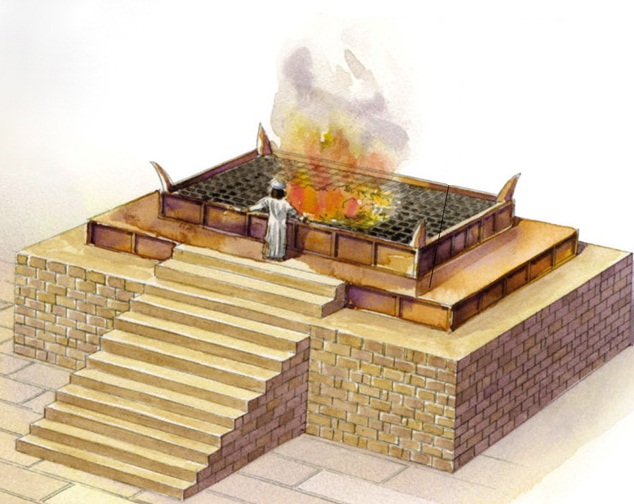
From this parasha to the end of the book of Exodus the Torah describes in minute detail the construction of the Mishkan, the first collective house of worship of the Jewish people. In this week’s section, the Lord commands Moses to take up a free will offering from the Israelites to build the Tabernacle (‘Mishkan’). What price are we willing to pay to have God’s Shekinah Glory manifested in our lives?
The account of the Tabernacle’s construction echoes the creation story in Genesis chapters 1-2, providing us with a key to better understanding things.
Genesis began with an act of Divine creation. Exodus ends with an act of human creation with establishment of the Tabernacle.
The Tabernacle represented a miniature universe constructed with the same precision, Divine wisdom and order as the universe itself. God spoke His creation into existence and the Tabernacle was formed in accordance with His spoken instructions and became a place amid the chaos in the wilderness of the human heart.
The dimensions of the universe are precise, mathematically exact. Had they differed in even the slightest degree the universe, or life, would not exist. It was the same for Noah’s Ark and now with the Tabernacle. Anything less than perfection is tainted with sin and morphs into something counterfeit and perverted.
Rabbi Jonathan Sacks, former Chief Rabbi of the UK described it this way: “The misplacement of even a few of the 3.1 billion letters in the human genome can lead to devastating genetic conditions. The famous “butterfly effect” – the beating of a butterfly’s wing somewhere may cause a tsunami elsewhere, thousands of miles away – tells us that small actions can have large consequences. That is the message the Tabernacle was intended to convey.”
The description of God’s creation in Genesis is organised around the number of sevens, representing divine perfection. For example, there are seven days of creation. The word “good” appears seven times, the word “God” 35 times, and the word “earth” 21 times. The opening verse of Genesis contains seven words, the second fourteen, and the three concluding verses 35 words. The complete text is 469 (7×67) words.
And we see how the account of the construction of the Tabernacle is also built around the number seven. For example, the word “heart” appears seven times in Ex. 35:5-29, regarding the materials used in the Tabernacle’s construction and the word ‘terumah’, appears seven times in this section.
“So too with the creation account in Genesis which is organised around the number seven, eg,. seven days of creation. The word “good” appears seven times, the word “God” thirty-five times, and the word “earth” twenty-one times. The opening verse of Genesis contains seven words, the second fourteen, and the three concluding verses 35 words. The complete text is 469 (7×67) words.” (J. Sacks)
From this we learn that when we align ourselves to the perfect will of God we will experience the full measure of His blessings because we are enfolded in the garments of His glory.
As with God’s creation, no physical space, however large, is big enough to contain Him and no space is too small that can conceal Him. Neither life nor death, nor principalities, things present nor things to come; neither height nor death nor any created thing can ever separate us from the Love of God in Messiah Yeshua our Lord! (Rom. 8:37-39)
The Tabernacle was a visible reminder of God’s presence within the camp, the same person who occupies the entire universe which He has created. It was Israel’s first creative achievement signalling that we can become a home for His Divine presence, His Shekinah glory, Christ in us, our hope and glory – for “…the Word became flesh and Tabernacled in us and we saw His Shekinah, the Shekinah of the Father’s only Son, full of grace and truth.” (John 1:14)
Why is it that when we read the account of Creation in Genesis, it contains just 34 verses compared to 100’s of verses with the construction of the Mishkan? The universe is infinite in size compared to the smallness of the Mishkan.
The length of any passage in Scripture is a guide to determine its significance to any episode or law. So why does the Torah devote so much time to the Mishkan? The sages explain that it’s not difficult for God to make a home for humanity. What is difficult is for humanity to make a home for God.
One thing that I find amazing throughout the Israelites wanderings was that there was never a moment when the Shekinah glory departed from them throughout their 40-year sojourn. Despite constant murmurings and rebellion, the Israelites followed wherever the Shekinah led them. Yeshua has given His disciples a promise: “ I will never leave nor forsake you” (through thick and thin…)
Up to this point in Israel’s history, the Israelites had received many miracles of provision from God but here for the first time they were given the opportunity to give back something to Him.
How can we ever begin to repay the Lord for sending us His most precious gift of all: His dearly beloved Son, Yeshua? (John 3:16) But, how many times do we ever ask Him, “Lord what can I give You?”
In Jewish Law, a person’s giving known as ‘tzedekah’ is considered an essential part of life. Even the poorest person can give to charity because there are always others who are worse off than themselves. We see this throughout Scripture such as with the NT account of the widow’s mite (Mark 12:41-44 – the lowest valued coin equivalent to a R10 cents coin).
The Terumah offering ensured that everyone could contribute something, however small: precious metals and stones, fine linens, animal skins, wood, oil for the lamps, and fragrant spices for the incense. Yeshua invites us to offer up our lives as a ‘living sacrifice’ as a free-will offering unto Him. Your best is good enough for Him.
It is better to give a little whole-heartedly than much begrudgingly. 2Cor. 9 – “God loves a cheerful giver.” It is not how much we give but the manner we do so that is of primary importance to God.
The Tabernacle was established entirely out of voluntary offerings. Unlike the golden calf that was a counterfeit offering, we do not worship anything that is created but rather the Creator Himself. Idolatry is anything we give preference to in place of the Creator. The Tabernacle represents the signature of a person’s life who is wholeheartedly and voluntarily submitted to the One who ‘tabernacles’ in us.
In Judaism, this very idea of creating a physical “home” for “God’s glory,” is a puzzle. How can God who is beyond space reside in a confined space? Yet, we read in John 1 that , “…the Word became flesh and tabernacled among us. We looked upon His glory, the glory of the one and only from the Father, full of grace and truth.”
Yeshua desires to reign within us because He alone can make ‘all things new’ and it comes in the form of an offering, a ‘terumah’ (free will offering). What greater offering can we give in response to this other than the totality of our lives?
The Tabernacle became the turning point in Jewish history. Even the poorest of the poor could contribute with their ‘widows mite.’ We survive by what we are given, but we achieve dignity by what we give.
The mishkan became the abiding place of the Divine presence because it was built out of voluntary contributions. When we invite God into our lives without coercion, manipulation or ulterior motives, we begin to understand one of the profoundest messages concerning the principle of giving. Up to this point in Israel’s history, they had received many miracles of provision from God but here we see for the first time the opportunity for the Israelites to give back something to God.
Here we glimpse the logic behind the Mishkan; this was where the Shekinah glory abided in fullness within the Holy of Holies without concealment. John states that “1 In the beginning was the Word… 14 And the Word became flesh and tabernacled among us. We looked upon His glory, the glory of the one and only from the Father, full of grace and truth .”
The incredible truth of Scripture for every believer is that through Yeshua: “19 …we now have boldness to enter the Holiest by the blood of Jesus, 20 by a new and living way which He consecrated for us, through the veil, that is, His flesh!” (Heb 10)
And those who ’dwell (tabernacle) in the secret place of the Most High’ shall abide under the shadow of the Almighty!’ (Ps.91).
God has provided for us the greatest of all gifts in Yeshua, with the invitation to give Him our ‘terumah’ the ‘freewill offering of our lives to Him.
Raphael ben Levi www.mekudeshet.co.za