“Say to the Israelites, Truly you shall keep My Sabbaths, for it is a sign! between Me and you throughout your generations, that you may know! that I, the Lord, set you apart for Myself.”
“The Sabbath day, therefore, became to the spiritually enlightened in! Israel chiefly a symbol and pledge of God’s promised rest to His people,! and to the earth in the future, and to this day in xtheir ‘mizmorim’ or! hymns sung in every pious Jewish home on Friday evenings, at the! ushering in of the Sabbath, there are touching references to the future! glorious time when, under Messiah’s sway, the earth shall find rest, and to the blessed day “which shall be all Sabbath”—in allusion to the very ancient Jewish division of the course of time into a week of! millenniums, viz., two thousand years “without law,” two thousand years under the law; two thousand years the days of Messiah; and the last the seventh as earth’s Sabbath.”
INTRODUCTION
The Jewish Sabbath (‘Shabbat’) is an integral part of the calendar embraced each week by Jews throughout the world. The early Church (Gk: ’ekklesia’—‘called out ones’) that is incorrectly translated as ‘Church’ in most bible translations observed Shabbat from Friday sundown to Saturday sundown for a period even after Christianity was made the official religion of the Roman Empire in 324AD.
The Emperor Constantine made a decree that Shabbat be changed to Sunday. This effectively separated the Church from the ‘accursed Jews’ who God had supposedly forsaken and replaced with Christians as His chosen people. So, became firmly established the erroneous teaching known as ‘Replacement Theology’ propagated by some influential figures in the first 3-4 centuries AD. Here are a few examples:
Justin Martyr (100-165 AD)—Claimed that God’s covenant with Israel was no longer valid and that the Gentiles had replaced the Jews.
Irenaeus (ca 130-202 AD)—Declared that the Jews were disinherited from the grace of God.
Tertullian (ca 155-230 AD)—Blamed the Jews for the death of!
Yeshua and argued they had been rejected by God.
Origen (185-254 AD)—Fuelled much anti-semitism, all of which was! based on his assertion that the Jews were responsible for killing Yeshua.
The Council of Nicea (325 AD in Turkey)—Changed the celebration of the resurrection from the Jewish feast of First Fruits to Easter in an attempt to disassociate it from Jewish feasts. The Council stated: “For it is unbecoming beyond measure that on this holiest of festivals we should follow the customs of the Jews. Henceforth let us have! nothing in common with this odious people . . .”
Eusebius (ca 275-339 AD)—Taught that the promises of Scripture were meant for the Gentiles and the curses were meant for the Jews. He insisted that the Church was the ‘true Israel.’
John Chrysostom (349-407 AD)—Preached a series of sermons against the Jews in which he stated, “The synagogue is not only a brothel and a theatre, it is also a den of robbers and lodging place for! wild beasts . . . Jews are inveterate murderers possessed by the Devil. Their debauchery and drunkenness gives the manners of a pig.” He denied that Jews could ever receive forgiveness. He claimed it was a duty to hate Jews because they worshiped Satan.
Jerome (ca 347-420 AD)—Described the Jews as “. . . serpents! wearing the image of Judas. Their psalms and prayers are the braying of donkeys . . . They are incapable of understanding Scripture . . .” This was the same person largely responsible for the translation of the Bible into Latin, known as the ‘Vulgate’ in the late 4th-century as commissioned by Pope Damascus. This became a key source for the translation of the Bible into English initiated by King James, and known as the ‘King James’ or ‘Authorised’ Version, in 1611.
St. Augustine (354-430 AD)—Asserted that the Jews deserved death but were destined to wander the earth to witness the victory of the Church over the synagogue.”
THE HEBREW CALENDAR
The word, ‘Shabbat’ is derived from the Hebrew word, ‘to rest.’ It is the only day of the week that is called by name; all the others are identified in their numerical order (i.e. Day 1, Day 2, etc). Shabbat begins each Friday from sunset until the next evening. Why would one celebrate a twenty-four hour period over two days (i.e.Friday and Saturday)? In the past, many cultures formed their own calendars. This included great civilisations such as Egypt, Greece, China and Babylon (from which the Hebrew months were named after Israel’s exile around 586BC) that devised their own method to calculate the days, weeks, months and years.
The current Gregorian calendar is based around the sun (solar) and is generally recognised worldwide. It was established in the year 1592AD and introduced by Pope Gregory X111. However, the Hebrew calendar has its months determined by the moon (lunar) and its years by the sun. The twenty-four hour period of Shabbat therefore, covers a two-day period with the Gregorian calendar.
The Hebrew calendar has twelve months, each of twenty-nine or thirty days in length. It has a leap year every second or third year (instead of every four years). This ensures that the three annual pilgrim feasts (Pesach, {Passover} Shavuot {Pentecost} and Sukkot {Tabernacles}) remain constantly within their proper season of spring, summer and autumn respectively (as in the Northern Hemisphere). These three feasts are also characterised by days of Shabbat rest.
Moses and Aaron introduced the first calendar used by Israel before their exodus from Egypt. This month was called ‘Nisan’ or ‘Aviv’ (Spring) celebrated around the Gregorian equivalent of March/ April. It became adopted as the first of months in the religious year to remind us of the primacy of redemption through the celebration of Pesach, the pivotal event in history and a shadow of future things to come. Later a civil new year became established in the seventh month of Tishri marked by Yom Teruah (Day of Blowing) commonly known as Rosh Ha Shanah (‘Head of the Year’). Four new years were eventually incorporated into the Hebrew calendar; these were identified by the Mishna in the 2nd century, AD as:
A] Nisan 1—The new year for kings and the festivals;
B] Elul 1—The new year for tithing cattle;
C] Tishri 1—The new year for counting years;
D] Shevat 15—The new year for trees.
The Jewish sages have calculated the years of the Hebrew calendar from God’s creation of Adam. We read that after God had finished His work of creation, He rested on the seventh day (Shabbat) and separated it as holy. God modelled something of great significance for the Hebrew people; on this day they would rest in body, soul and spirit, a point that was later reinforced in their desert wanderings.
THE BLESSING OF SHABBAT
Shabbat presents us with a prophetic picture of what it means to enter into spiritual rest. It provides us with a taste of our future eternal inheritance, declared in Psalm 92, which was recited by the Levites each Shabbat in the Temple.
Shabbat is the only day in the week which is accompanied by a formal blessing both for Jew and Gentile:
“Observe justice, do what is right, for My salvation is close to coming, and My righteousness to being revealed. Happy is the person who does this, anyone who grasps it firmly, who keeps Shabbat and does not! profane it, and keeps himself from doing any evil. A foreigner joining Adonai should not say, “Adonai will separate me from His people.” Likewise the eunuch should not say, “I am only a dried up tree.” For here is what Adonai says: “As for the eunuchs who keep My Shabbats, who choose what pleases Me and hold fast to My covenant; in My house within My walls, I will give them power and a name greater than sons or daughters; I will give them an everlasting name that will not be cut off. The foreigners who join themselves to Adonai to serve Him, to love the name of Adonai, and to be His workers, all who keep Shabbat and do not profane it, and hold fast to My covenant, I will bring them to My holy mountain and make them joyful in My house of prayer; their burnt offerings and sacrifices will be accepted on My altar; for My house will be called a house of prayer for all peoples.”
In bygone times only the rich and privileged could afford to break the seven-day week work cycle, but the Jewish people have been an exception. Even when enmeshed in dire need and poverty, traditional Jewish families gathered, often in secret to preserve their safety, to celebrate Shabbat.
WHY OBSERVE SHABBAT?
Both in Leviticus chapter 23 (regarding the major Jewish feasts) and Exodus chapter 20 (pertaining to the Ten Commandments) more is said about Shabbat than any other feast. Clearly this is significant. Failure for any Israelite to observe it was a capital offence, contrasted with neglecting the dietary laws, which was considered only a minor infringement, with one or two exceptions.
According to the prophet Jeremiah, the Jewish people were exiled to Babylon (for seventy years) due to their violation of the sabbatical year seventy times (490 out of their 850 years in the land):
“The (Jewish) survivors were taken to Babylonia as prisoners, where they were slaves of the king and his sons, until Persia became a powerful nation. (The land of) Judah was an empty desert, and it stayed that way for seventy years, to make up for all the years it was not allowed to rest. These things happened just as Jeremiah the Lord’s prophet had said.” (2Chron 36:20-21)
“And this whole land shall be a desolation and a horror, and these nations shall! serve the king of Babylon seventy years.” (Jer. 25:11). “For thus says the Lord, ‘When seventy years have been completed for! Babylon, I will visit you and fulfil My good word to you, to bring you!back to this place.’” (Jer. 29: 10)
It is clear from the above passages, that God had a specific reason behind the deportation of Judah to Babylon for seventy years consequent in part to their violation of Shabbat.
Yeshua celebrated every feast of Israel, so what He spoke out against was not its observance, but how it was being observed. What God had intended as a blessing had deteriorated for many people into a legalistic stranglehold.
SHABBAT OBSERVANCE
How Jewish people traditionally observe Shabbat is varied. Some, spend Shabbat morning until sundown attending synagogue services, studying Torah and generally relaxing with family. Others within the secular community observe very little if any of these things. Some do a bit of both. Those within orthodox Jewish circles observe strict prohibitions in an attempt to honour Shabbat fully. What this means is not comprehensively defined in the Torah and left to the Jewish sages to interpret.
As sunset arrives, the Havdalah (‘separation’) or closing of Shabbat is! observed by many to welcome in a new week. At least four Havdalah prayers are recited with blessings. This represents a deeply held cherished belief that the One who keeps Israel will sustain His people in His tender love and care.
WHAT DOES IT MEAN TO OBSERVE SHABBAT AS A SPECIAL DAY OF REST?
- Shabbat is two commandments: to remember and to observe which involves abstaining from ones normal work routine.
Scripture has some very specific instructions for Shabbat such as:
•Remember and keep the Shabbat – Ex. 20:8; 31:13; Deut. 5:12 To remember what? God is our Sovereign Creator:
•Come together for Holy a convocation – Lev. 23:3
•Call Shabbat a delight and honorable – Isa 58:13-14
•Do not pursue your business interests on Shabbat – Isa 58:13 (Some versions use the term pleasures which is a poor translation as this verse refers to business interests while fasting.)
•Do not cook – Ex. 16:23
•Do not kindle a fire – Ex. 35:3
•Do not participate in commerce – Neh. 10:31; Jer. 17:21-22
•Do not carry (gathering) a burden – Ex. 16:29; Jer. 17:21-22
•No ploughing or harvesting – Ex. 34:21
There are 39 prohibitions in Judaism which identify categories of work (‘Melachah’) on Shabbat. Ex. 20:9-10; but what is or is not defined as ‘work’?
PRINCIPLES AND GUIDELINES
1. How an individual observes shabbat is to a large part a matter of the heart as led by the Holy Spirit. Even the work of the Mishkan ceased on Shabbat as a model to determinewhether an activity could wait until Shabbat ends.
2. Do not criticise how others observe Shabbat.
3. Yeshua Himself is Lord of the Shabbat and stated that “The Shabbat was made for man and not man for the Shabbat”, therefore “Do good on Shabbat” Matt. 12:12 and remember that Shabbat is about our love for God and our fellow man.
AN EXAMPLE LITURGY
Kindling the Shabbat Lights (traditionally 18 minutes before sundown)
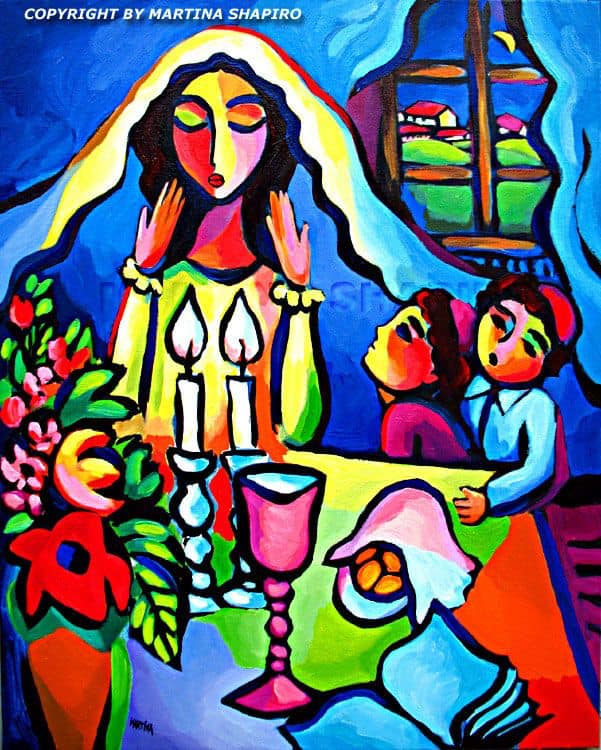
Jewish tradition gives the responsibility for the lighting of the Shabbat candles to the woman because it was Eve who extinguished the light of man’s soul in the Garden of Eden. This action is seen as a form of restoration.
Two candles are normally lit: one to remember Shabbat and one to guard Shabbat. (God spoke both of these in one breath, during the Ten Commandments)
The following Messianic blessing may be used:
Baruch atah Adonai Eloheynu Melech Ha Olam
Asher Kidshanu B’ Mits Vo Tav
Ve Natan Lanu Yeshua Ha Mashiach, Or Ha Olam.
“Blessed are You, Lord our God King of the universe, who sanctified us with His commandments and gave us Yeshua Ha Mashiach, Light of the world.”
The one who lights the candles may also pray:
“May it be Your will, Lord my God and God of my fathers, to be gracious to us and to all our families; grant us and all Israel prosperity and long life; remember us for good; bless us with great blessings; make our households complete, crowning our homes with the knowledge of Your Divine Presence dwelling among us.”
Draw us ever closer to You, that we may always reflect Your goodness and Love. Please hear our prayers, even as You inclined Your ear to Sarah, Rebecca, Rachel, Leah; may our lives shine ever brighter for Your glory. Amen.”
Now we take time to share together the many blessings He gives us as Scripture exhorts us:
“Bless the Lord O my soul and all that is within me bless His holy name! Bless the Lord O my soul and forget not all His benefits.” Psalm 103 verses 1-2
Psalms for Shabbat:
Psalm 96 O sing unto the Lord a new song: sing unto the Lord all the earth. Sing unto the Lord, bless his name: proclaim his salvation from day to day. Recount His glory among the nations, His wondrous works among all the peoples. For great is the Lord, and exceedingly
to be praised: He is to be revered above all gods.
Psalm 98: O sing unto the Lord a new song; for He has done marvellous things: His right hand and His holy arm have wrought salvation for Him. The Lord has made known His salvation: His righteousness has He revealed in the sight of the nations. He has remembered His loving kindness and His faithfulness towards the house of Israel: all the ends of the earth have seen the salvation of our God.
Like the bride, radiant and joyous, comes Shabbat. She brings blessings to our hearts, workday, thoughts and cares are put aside.
Song: L’echa Dodi, L’krat Kala, P’nei Shabbat N’kabla
“Come, my friend, to meet the bride, let us welcome the presence of Shabbat.”
Song: Shalom Aleichem
Shalom Aleichem Peace be unto you
Malachei Elyon, (x2) Messengers of the Most High
Mi Melech Malachei Ham’lachim Of the Supreme Sovereign King
HaKadosh Baruch Hu The Holy One, blessed be He
Hoachem L’shalom Enter in peace
Malachei Elyon (x2) Messengers of the Most High
Mi Melech Malachei Ham’lachim Messengers of the Supreme Sovereign King
Ha Kadosh Baruch Hu. The Holy One, blessed be He
Barchu-ri L’shalom Bless us with peace
Malachei Ha Shalom Messengers of peace
Malachei Elyon Messengers of the Most High
Mi Melech Malachei Ham’lachim Messengers of the Supreme Sovereign King
Ha Kadosh Baruch Hu The Holy One, blessed be He
Tzet Chem L’shalom Depart in peace
Malachei Ha Shalom Messengers of peace
Malachei Elyon. Messengers of the Most High
Mi Melech Malachei Ham’lachim Messengers of the Supreme Sovereign King
Ha Kadosh Baruch Hu The Holy One, blessed be He
Shema:
Shema Yis’rael Adonai Eloheynu Adonai echad.
Baruch shem k’vod malkhuto l’olam va’ed.
V’ahav’ta et Adonai Elohecha b’khol le-vav’cha uve’chol naf’sh’cha uve’chol me’odecha.
V’hayu had’varim ha’eleh asher anochi m’tzav’kha hayom al l’va-vecha.
V’shinan’tam l’vanecha v’dibar’ta bam b’shiv’t’cha b-veitecha
uv-lech’t’cha va’derech uv-shach-b’cha uv’kume-cha
Uk’shar’tam l’ot al yadecha v’hayu l’totafot bein eineycha.
Ukh’tav’tam al m’zuzot be’techa uvish’arecha.
Hear O Israel, the Lord our God, the Lord is One.
And you shall love the Lord your God with all your heart and with all your soul and with all your strength.
And these words, which I command you this day, shall be upon your heart.
And you shall teach them diligently unto your children
And shall talk of them when you sit in your house, and you walk by the way, and when you lie down and when you rise up.
And you shall bind them for a sign upon your hand and they shall be for frontlets between your eyes.
And you shall write them upon the doorposts of your house and upon your gates.
Shabbat Song: (choose)
Aaronic blessing of the father upon the children:
Blessing of the father upon his wife: Proverbs 31
Blessing of the wife upon her husband: Psalm 1
Kiddush
Baruch Ata Adonai Eloheinu Melech Ha Olam
Asher Kid Shanu B’ Mitz-vo-tav Vratsa Banu
B’Shevat Kodsho. B’Avahah U’vratson Hinchilanu Zikaron Le Maan
she B’resheet
Ki Hu yom Techilah L’Mikrei Kodesh, Zecher L’tziat MitzTzriyim.
Ki’vanu vacharta Ve Otanu Lidashta MiKol Ha Amim
Ve Shabbat Kodshecha B’Avahah U’vratson Hinchilanu,
Baruch Ata Adonai M’Kadesh Ha Shabbat. Amen.
Blessed are You, Lord our God, King of the Universe, who has
sanctified us by Your commandments and taken pleasure in
us; and in love and favour has given us Your Holy Sabbath as
an inheritance, the memorial of the work of creation. It is this day which is first among all the days of holy convocation, a remembrance of the exodus from Egypt. For You have chosen us; You have sanctified us from all peoples. In love and favour have you given us Your Holy Sabbath as an inheritance. Blessed are You Lord, who sanctifies Shabbat. Amen.
Prayer over the wine:
Baruch atah Adonai, Eloheinu, melech ha’olam borey p’ri hagafen (Amen)
Blessed are you, Lord, our God, sovereign of the universe who creates the fruit of the vine (Amen)
Netilat Yadayim
The process speaks of forgiveness. We are reminded that Yeshua has forgiven us all our sins through His sacrifice.
Each hand is covered with water three times (first left and then right hand). The washing of hands speaks symbolically that He has set us free.
Prayer over the washing of hands.
Baruch Ata Adonai Eloheinu Melech Ha Olam, Asher Kid Shanu B’ Mitz-vo-tav v’tzivanu Al Netilat Yadayim.
Blessed are You our Lord God, King of the Universe, who sanctified us with Your commandments and blessed us regarding the washing of hands.
Blessing of the Challah (Ha Motzi)
The challah represents the manna provided by the Lord to the Israelites in the desert (double portion for Shabbat) reminding us to keep Shabbat, and that Yeshua is our ‘Lechem Ha Hayim’ (bread of life)
The two loaves also represent the two tablets of the Law of Moses that he received from the Lord on Mount Sinai.
The challah is braided and represents folded arms for rest and that we are entwined in His love and has a sweet taste reminding us of the sweetness of His love.
Salt is sprinkled on a broken piece of challah and distributed around the table after the blessing reminding us of the temple sacrifice on the altar.
Prayer over the challah:
Baruch Ata Adonai Eloheinu Melech Ha Olam, Ha Motzi lechem Min Ha Aretz. Amen.
THE LORD’S PRAYER ’T’FILAT HA’ADON’(shortened version of the Amidah – Matthew 6:9-13)
Avinu Shebashamayim yidkadesh shimcha.
Tavo malchut’cha Ye’aseh rezoncha ke-va-shamayim, ken ba’aretz
Et lechem chukeynu ten lanu hayom U-se-lach lanu al chata’einu,
K’fi she-solchim gam anachnu la-chotim’lanu.
V’al te-vi’enu lidei nisayon, ki im chaltzenu min hara Ki’lecha ha-mam’lachah, v’ha-ge’vurah, V’ha-tif’eret, l’olmei-olamim
Amein
Our Father who is in heaven, may your name be sanctified, may you continue establishing your kingship, may your will be accomplished in heaven and on earth. Give us today the food that is necessary to sustain us. Forgive us for our sins just as we also have forgiven those who have sinned against us. Do not place us in a trial [that would be more than we could withstand], but help us overcome our inclination to evil.
Shabbat Shalom!