PARASHA TERUMAH – Ex.25:1–27:19; 1 Kings 5:26–6:13; Heb 9:1–28
By Raphael ben Levi
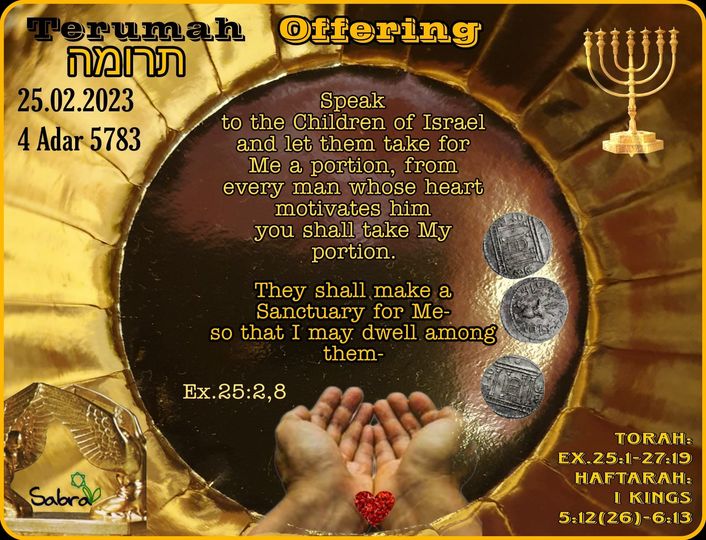
“Adonai said to Moshe, 2 “Tell the people of Isra’el to take up a collection for me — accept a free will offering (terumah) from anyone who wholeheartedly wants to give.’” (Ex.25:1–2)
In Ps.50:10-12 we read God declaring that, “…every beast of the forest is mine, and the cattle upon a thousand hills. I know all the fowls of the mountains: and the wild beasts of the field are mine. If I were hungry, I would not tell thee: for the world is mine, and the fulness thereof.” Everything in creation belongs to God because He is the Creator, He is the altogether Other to whom everything within creation must bow the knee. And the extent to which we are willing voluntarily to offer up our lives to Him (Rom.11:1-2) is the measure to which we will be blessed as His custodians of the things He has loaned to us. The only thing that belongs exclusively to us and us alone is our free will. This is why the Parasha is known as Terumah (A Freewill offering). This is immensely important for us to understand particularly in this day and age in our me, myself, and I world we are living in. And Scripture teaches us emphatically to go against the flow (“Do not be conformed to this world…” Rom.11.2). But, this week’s Torah portion contains many other things that should gain our attention.
Terumah begins the longest single passage in the book of Exodus taking us to the end of the book where it describes in minute detail instructions for the construction of the Mishkan (Tabernacle) that was to become first collective house of worship of the Jewish people. It was there the Lord commanded Moses to take up a freewill offering (a terumah) from the Israelites. This offering was entirely voluntary for establishing this place of worship where God Himself would reside. And amazingly, the response was overwhelming and wholehearted where everyone gave according to their means that resulted in an overflow which is always the case when we choose to give God our best!
The account of the Tabernacle’s construction is mirrored in the creation story from Gen.1-2. which began with an act of Divine creation compared to Exodus which ends with an act of human creation here with the establishment of the Tabernacle.
And we see how the Tabernacle portrayed a miniature universe constructed with the same precision, Divine wisdom and order as the universe itself. God spoke His creation into existence and the Tabernacle was formed in accordance with His spoken instructions that became His dwelling place. And later in history God made His dwelling place with man in the person of Yeshua as recorded in John 1:14: “And the Word became flesh and tabernacled among us. We looked upon His glory, the glory of the one and only from the Father, full of grace and truth.”
The dimensions of the universe are mathematically exact. Had they differed in the slightest degree it would be impossible for life to exist. Anything less than perfection cannot originate from God and will ultimately morph into something counterfeit.
The late Jonathan Sacks observed that: “…the misplacement of even a few of the 3.1 billion letters in the human genome can lead to devastating genetic conditions. The famous “butterfly effect” – the beating of a butterfly’s wing somewhere may cause a tsunami elsewhere, thousands of miles away – tells us that small actions can have large consequences. That is the message the Tabernacle conveys.” If a pilot’s compass reading is even one degree incorrect, the plane’s destination could be thousands of miles astray.
The description of God’s creation in Genesis is organised around the number of sevens the Gematria for Divine perfection. For example, there are 7 days of creation. The word “good” appears 7 times, the word “God” 35 times, and the word “earth” 21 times. The opening verse of Genesis contains 7 words, the second 14, and the 3 concluding verses 35 words. The complete text is 469 (7×67) words.
And we see how the account of the construction of the Tabernacle is also built around the number 7. For example, the word “heart” appears 7 times in Ex. 35:5-29, regarding the materials used in the Tabernacle’s construction and the word ‘terumah’ also appears 7 times in this section.
When we choose to align ourselves to the perfect will of God as represented by the number 7 only then can we experience the full measure of His blessings.
Nothing in God’s creation, no physical space, however large, is big enough to contain Him and no space is too small that can conceal Him. Neither life nor death, nor principalities, things present nor things to come; neither height nor death nor any created thing can ever separate us from the Love of God in Messiah Yeshua our Lord! (Rom.8:37-39) and yet God chose to abide in the Tabernacle! In the same way, His Holy Spirit abides in the heart of every believer who chooses to make him Saviour and Lord and our bodies become a Temple pure and holy for His habitation!
So too, the Tabernacle was a visible reminder of God’s presence within the camp, the same person who occupies the entire universe He created. It was Israel’s first creative achievement signalling the amazing reality that we can become a home for His Divine presence.
Why is it that when we read the account of Creation in Genesis, it contains just 34 verses compared to 100’s of verses with the construction of the Mishkan? The universe is infinite in size compared to the smallness of the Mishkan!
The length of any passage in Scripture is a guide to determine its significance. So why does the Torah devote so much time to the Mishkan? The sages explain that it’s not difficult for God to make a home for humanity. What is difficult is for humanity to make a home for God. What place does God’s habitation have for our lives?
This week’s parsha is entitled: Terumah meaning “a voluntary contribution” but it literally means something you lift up by dedicating it to something or someone. When you “lift it up”, then you in turn will be lifted up. This has profound implications for us as believers. Early in John’s gospel, Yeshua said, “Just as Moses lifted up the snake in the wilderness, so the Son of Man must be lifted up, that everyone who believes may have eternal life in him” (John 3:14–15). The bronze snake is a shadow and type of Yeshua’s crucifixion. As the bronze snake on Moses’ staff was raised up to offer deliverance and healing, so, too, Yeshua was lifted up on a crucifixion stake to offer eternal life for both Jew and Gentile. “Yeshua demonstrated His love towards us that whilst we were still sinners, Yeshua died for us. (Was lifted up)” Yeshua said, in John.13: “13 No one has greater love [nor stronger commitment] than to lay down his own life for his friends. 14 You are my friends if you keep on doing what I command you. 15 I do not call you servants any longer, for the servant does not know what his master is doing; but I have called you [My] friends, because I have revealed to you everything that I have heard from My Father.”
At the cross, we encounter God’s justice through the judgment of sin, God’s love and mercy through the forgiveness of sinners, and God’s power through His defeat of Satan (Rom.3:21–26;Colos.1:13). At the cross, Yeshua brings salvation to those who believe and judgment to those who refuse to believe. In God’s wisdom and holiness, the cross opens the only way to the Father for sinful humanity (John.14:6). At the cross, Yeshua sets us free from the chains of sin. The lifting up of Yeshua on the cross is the greatest gift in life that draws us to Him.
Up to this point in Israel’s history, the Israelites had received many miracles of provision from God but here for the first time they were given the opportunity to give back something to Him – a terumah – a freewill offering. God is not concerned about the quantity of our giving but the quality. (Rabbi who throws up offering). Yeshua well illustrated the principle of giving in Mark 12:41-44 with the story of the widow’s mite (the lowest valued coin equivalent to 10 cents of R1).Close to the temple treasury were the Terumah offering boxes, long narrow shaped receptacles that were broad at the top and were designed so that when people dropped in their offering it made a loud clanging noise according to the amount you gave.
The court of women held thirteen such receptacles, and people could cast their money in as they walked by. Rich people made an open show of the huge sums they gave. But the widow gave in faith sacrificially with a pure heart. The rich gave out of their abundance, but she, in her poverty, put in everything she had to live on.
How can we ever begin to repay the Lord for sending us His most precious gift of all: His dearly beloved Son, Yeshua? (John 3:16) But, how many times do we ever ask Him, “Lord what can I give You that is precious in Your sight?”
In Jewish Law, a person’s giving, (‘tzedekah’), becomes an essential part of life. Even the poorest person can give (as with the Israelites) knowing that however sacrificial their contribution may be and paltry it may appear, there are always others more dire circumstances than themselves. God searches our hearts not our pockets. And this principle is consistently reflected in Scripture as with the account of the widow’s mite in (Mark.12:41-44.
The Terumah offering ensured that everyone could contribute something: precious metals and stones, fine linens, animal skins, wood, oil for the lamps, and fragrant spices for the incense. And so, Yeshua invites us to offer Him our lives as a ‘living sacrifice’ as a “terumah” unto Him. Our best will always good enough. This is a great leveller as the parable of the Talents well illustrates.
So the Tabernacle was established entirely out of voluntary offerings. Unlike the golden calf that was a counterfeit offering, we worship the Creator of the universe not anything which is created. Idolatry is what we give preference to in place of the Creator. The Tabernacle represents the signature of a person’s life who is wholeheartedly and voluntarily submitted to the One who ‘tabernacles’ in us.
In Judaism, this very idea of creating a physical “home” for “God’s glory,” is a puzzle. How can God who is beyond space reside in a confined space? The secret resides in the Gospel of Yeshua who desires to reign within us and it comes packaged in the form of an offering, a ‘terumah’ a ‘bracha’ (a Divine blessing brought to us on bended knee). What less can we give in response other than the totality of our lives?
The Tabernacle became the turning point in Jewish history.The Israelites understood that we survive by what we are given, but we achieve dignity by what we give.
The mishkan became the abiding place of the Divine presence because it was constructed out of voluntary contributions. When we invite God into our lives we begin to understand one of the profoundest messages concerning the principle of giving.
And in this parasha, we glimpse the logic behind the Mishkan where the Shekinah glory abided within the Holy of Holies without concealment. And through Yeshua “…we now have boldness to enter the Holiest by His blood, by a new and living way which He consecrated for us, through the veil, that is, His flesh!” (Heb.10:19-20)
And those who dwell (tabernacle) in the secret place of the Most High shall abide under the shadow of the Almighty!’ (Ps.91).
God has provided for us the greatest of all gifts in Yeshua, with the invitation to give Him our ‘terumah’ in the knowledge that the most we can ever give Him is the least He deserves!