COUNTING THE OMER – by Raphael ben Levi
This Shabbat is a very special one known as “Shabbat Chol Ha-mo’ed-Pesach” or “The intermediate Shabbat of Pesach” (CH”M). I send out to everyone a sheet containing the intermediate readings during Pesach for information I hope you all received? I would just like to quickly pick out two noteworthy biblical references to Pesach contained in the Haftarah.
The first is from Josh.5:2-6 describing the historic Passover that the Israelites observed at Gilgal after they had crossed the Jordan River. Although we’re not specifically told if Israel observed the Passover in the 40-year period they were in the wilderness, the evidence would suggest that they didn’t. Most likely this was the first occasion that Pesach was celebrated after they arrived in Canaan since their exodus from Egypt. Two interesting points: In preparation for Passover all the Israelite males were circumcised. They then ate the first matzot made from wheat farmed in the land.
The second occasion can be found in 2Kings.23:1-9 under King Josiah in the 18th year of his reign. “…Josiah (to the people): 21 The covenant book that was found in the temple says we must observe the Passover and rejoice in the Eternal One our God, who led us out of bondage in Egypt. 22 The Passover had not been observed from the time when the judges judged Israel, even throughout all the generations of Israel’s kings and Judah’s kings. 23 But during King Josiah’s 18th year, the Passover was celebrated in honor of the Eternal One in Jerusalem.” 2Kings 23:22
Passover was only observed sporadically from its inauguration until tis point contrary to the command in Ex.12:25-26: “When you come to the land which Adonai will give you, as he promised, you are to observe this ceremony. When your children ask you, ‘What do you mean by this ceremony?’ say, ‘It is the sacrifice of Adonai’s Pesach because the Lord passed over the houses of the people of Israel in Egypt, when he killed the Egyptians but spared our houses.’”
Only after the exiles had returned from Babylonian captivity under Ezra and Nehemiah in the 4th century BC did it become established as an annual celebration. Passover was celebrated and passed down by word of mouth from generation to generation but the first ‘liturgy’ (Haggadah) was only introduced around 300AD. We celebrate it all this week and continually in our hearts!
Today I would like to share with you a biblical event that generally goes unnoticed, because it’s overshadowed by Pesach, known as “Counting the Omer” that holds great significance for us.
But let me first share some connections between time and space and counting, and its relationship between Pesach, Shavuot and this in-between period known as “Counting of the Omer”. Let me begin with some awe inspiring statistics concerning the human body that defy space and time no less impressive than the creation of the universe. For a simple example, scientists have confirmed there are as many stars in the universe as there are grains of sand on the earth. And from macro to micro, we now know that the human body contains 100 trillion cells. Within each cell is a nucleus. Within each nucleus is a double copy of the human genome. Each genome contains 3.1 billion letters of genetic code, enough if transcribed to fill a library of 5000 books. Each cell contains a blueprint of the entire body of which it is a part. We now know to what extent the microcosm is a map of the microcosm. From a single cell, one is able to reconstruct an entire organism. That is something mind blowing that will take eternity for us to fully appreciate!
Rabbi Sacks made the statement that, “…In Judaism, priestly time is cyclical. Each part of the day, the week and the year has its specific sacrifice, unaffected by what is happening in the world of events.” Though all things may change, the Torah never changes because it is the Word of God and, therefore, represents eternity in the midst of time. He continues, “Time is not a series of moments traced on the face of a watch, always moving yet always the same. Instead it is a journey with a starting point and a destination, or a story with a beginning, middle and end. Each moment has a meaning, which can only be grasped if we understand where we have come from and where we are going to. This is time not as it is in nature but as it is in history. The Hebrew prophets were the first to see God in history.”
An example of this can be found in the Talmud. Rabbi Akiva was walking with his disciples on Mount Scopus when they saw the ruins of the Temple. They wept at the sight but he smiled. When they questioned him about his reaction he replied:
“Now that I have seen the realisation of the prophecies of destruction, shall I not believe in the prophecies of restoration?” (Phi. 1:6)
We frequently bind ourselves to the present but God sees the future-in-the-present specifically in covenant history. Here we face a paradox whereby God’s eternal purposes are simultaneously determined by our choices yet that were established long before within eternity – the paradox of free choice and predestination.
Pesach and Shavuot celebrate historic events that contain many shadows and types yet it is also cyclical and so too with counting the Omer. On the one hand, it is cyclical. Each day of counting by the priests day by day was an action containing blessings in the form of new grain the best which was waved before the Lord.
But it also contained an historical perspective representing the journey from Egypt to Sinai, (40 years) where the Israelites became established as a covenant nation with the giving of Torah. And, again we see here types and shadows in these things fulfilled in Yeshua as treasures to explore and experience for ourselves.
The 49 days of Omer represent an ongoing, ordered sequence of events counting off seven full weeks without any gaps in-between.
There is the Word of God for all time, and the Word of God for this time and it is the interplay of the two, rightly divided, that is essential for us to interpret particularly in these end times where we are warned about the exponential increase of deception throughout the church. We must differentiate between the music of covenant and the noise of events that attempts to distort our (biblical) knowledge of its shape, meaning and truth.
And this is true for all God’s commands that we must take seriously even in what appear to be minor commands such as with the counting of the Omer as we retrace our journey from Egypt to Sinai, Pesach to Shavuot. Let’s explore this further.
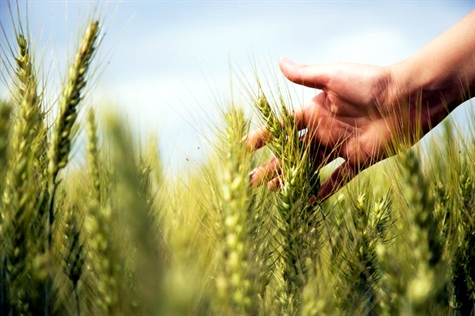
The omer was a measurement used for gathering together a sheaf of barley (one tenth of an ephah around two quarts) that was the first cereal crop to be harvested at Pesach.
During the Counting of the Omer from Pesach to Shavuot both days and weeks are counted when we remember the journey from the depths of slavery in Egypt to the heights of entering God’s presence through covenant relationship at Mt. Sinai. For us as believers it’s a picture of our redemption from captivity to the slavery of sin to freedom and liberty vis a vis a living relationship with God through Yeshua.
During Temple times on the second day of Unleavened Bread following Pesach known as ‘Reshit Katzir’ (the beginning of the harvest) an omer of barley was cut down and brought to the Temple as a special offering and waved by the priest before the Lord in all directions. A lamb was then sacrificed as a burnt offering with unleavened bread mixed with oil, and wine (Lev.23:13) – a beautiful picture of Yeshua the Lamb of God slain for our sins.
Only after the wave offering was offered were people permitted to harvest their crops. This ordering of events illustrates how humanity have only the possibility to partake in the resurrected Life of Messiah following His sacrificial offering not before
Nowhere in the entire Torah is the date of Shavuot mentioned but leading up to it is marked by the counting of the omer. Without the omer there can be no Shavuot because we cannot migrate from Pesach to Shavuot without the in-between, otherwise we simply mirror the five foolish maidens described in Yeshua’s parable.
The counting of the omer begins “from the day you bring the sheaf (omer), or bundle.” (Lev.23:10). Normally we count down towards any big event, but in the case of the omer, we count up ― from 1 to 50. This is significant. To understand, we must look back to the exodus of the Israelites from Egypt. God waited 50 days before the giving of the Torah because it was an important time of preparation for the Israelites following their miracle of deliverance. The Israelites had been immersed in pagan culture for hundreds of years and needed to grow in spiritual maturity, so God took them through the long route through the wilderness (40 years) rather than the short one (12 days).
To make full sense of Shavuot, we must prepare each day as we count the omer, drawing near to Him, earnestly seeking His face.The pouring out of Ruach ha Kodesh upon our lives can easily be squandered, misused or abused should we treat it lightly when we seek to be entertained rather than transformed.
So let’s take a look at the correlation and sequence of events that link Yeshua with the counting of the omer.
On the same day that Caiaphas interrogated Yeshua, three elders from the Sanhedrin went out to a barley field not far from Jerusalem. As the Romans bound and crucified Yeshua, these same elders bound up the standing barley into bundles or sheafs to make it easier to reap.
As the harvest began, the reapers gathered the barley and carried it in baskets to the Temple. The baskets contained more than enough grain to constitute a full sheaf’s worth (an omer, עמר) to fulfil the command of (Lev 23:10–11) to “…bring in the omer of the first fruits of your harvest to the priest (and) wave the omer before the LORD…”
That same night (Saturday) and throughout the night, the priests in the Temple threshed, roasted, and ground the barley into flour. In the period that the priests refined the freshly milled flour, sifting it through thirteen sieves, Yeshua was raised from the dead.
The next day on Sunday morning, while the women discovered the empty tomb, the high priest was busy mixing the barley flour with oil and frankincense to prepare it as a bread offering. The priests mixed the flour into dough with olive oil and incense. Caiaphas took the batch of dough in his hands and waved it before the LORD as a wave offering.
After the morning sacrifice and the additional Pesach sacrifices (described in Num,28:24), Caiaphas offered a portion of grain offering on the altar as a memorial portion and concluded the ceremony by sacrificing a single male lamb as a burnt offering to accompany the new grain. That day began the 50-day count to the festival of Shavuot (Pentecost).
There is some debate about when exactly the wave offering was conducted because of the ambiguity of the phrase, ‘the day after the shabbat.’ (Lev.23:11)
However, historical records reveal that the Pharisaic tradition was the correct one, as observed by Yeshua, the Early Church, and later adopted within Judaism.
God designed things so that the ritual of offering the first fruit of the barley omer in the Temple coincided with the resurrection of Yeshua! The apostle Paul connected the two events: “Messiah has been raised from the dead, the first fruits of those who are asleep” (1Cor. 5:20).
During the 50-day period of the omer, Yeshua:
1. Preached to the spirits that were imprisoned:
“He was put to death in the flesh but brought to life by the Spirit; and in this form he made a proclamation to the imprisoned spirits, to those who were disobedient long ago, in the days of Noach, when God waited patiently during the building of the ark…” (1Pet 3; 18-20)
Who were the imprisoned spirits? Many scholars refer them to the Nephalim which was why Yeshua proclaimed (made a formal announcement) to them rather than preached. Implied in this is that their fall, though unnecessary, was final: “For God did not spare the angels who sinned; on the contrary, he put them in gloomy dungeons lower than Sheol to be held for judgement.” The Greek word used here is ‘Tartarus’, the residence of fallen angels and an underworld for demons: “And the angels that did not keep within their original authority, but abandoned their proper sphere, he has kept in darkness, bound with everlasting chains for the judgement of the Great Day.” (Jude 6)
According to Scripture, “Having disarmed principalities and powers, He made a public spectacle of them, triumphing over them in it.” (Col. 2:15)
2. Yeshua was resurrected on the third day (First fruits) following his crucifixion: He is the First Fruit and we are His first fruits. In the Book of James 1:18 “…(Yeshua) Having made his decision, gave birth to us through a Word that can be relied upon, in order that we should be a kind of first fruits of all that he created.”
In Matt 27:52-53 we read something amazing: “Also the graves were opened, and the bodies of many holy people who had died were raised to life; and after Yeshua rose, they came out of the graves and went into the holy city, where many people saw them.”
These puzzling verses now become clear, illustrating how Yeshua offered unto His Father the First Fruits offering. His resurrection was a type of wave offering presented to the Father that was a type of a first fruits offering unto Him. Yeshua offered to the Father the ‘early crops’ of what will culminate in an incredible harvest on the Day of the Lord.
3. Yeshua appeared in his resurrected body before many witnesses over a 40- day period before returning to Heaven to sit at the right hand of the Father. Yeshua appeared to his disciples at the end of this period and told them to tarry awhile and ’wait for what the Father promised,” (Acts 1:4). At the end of this time, (ie.day 50), Ruach ha Kodesh was sent to those who were actively waiting (Acts 2).
At the end of the 1st day of the omer, Yeshua rose and appeared to Mary and two of the disciples while they travelled to Emmaus, and also to Peter. On the 2nd day of the omer He appeared among the Twelve. On the 9th day of the omer, He appeared to the disciples again including Thomas. During the counting, He appeared to a further 500 believers and later to James.
During the 49 days of counting the omer, Yeshua appeared to 7 of His disciples while they fished on the sea. On the 40th day of the omer, He led His disciples out to a hill near Bethany, and they saw Him ascend to heaven. Before He ascended, He commanded them not to leave Jerusalem but to reside there awaiting the promise of the Father. They waited and counted the days, so that when the day of Shavuot arrived they were all together in one place.
What is the primary message of this period known as counting the omer for us in these end time as the second hand is fast approaching midnight? Scripture exhorts us to throw aside every encumbrance and those things that impede that we might run the race well unto the end with no encumbrances and our eyes fixed upon Yeshua the Author and Finisher of our faith! Our hearts filled with steadfast joy and wholehearted love for the One who is our all in all!
God is inviting each one of us today to come to Him just as we are; “Just as I am, without one plea, But that Thy blood was shed for me, And that Thou bidst me come to Thee, O Lamb of God, I come, I come.”
“Whom have I in heaven [but You]? And besides You, I desire nothing on earth. My flesh and my heart may fail, But God is the rock and strength of my heart and my portion forever.” (Ps.73:25-26)