VA’ERA (And I Appeared) Ex 6:2–9:35; Ezek 28:25–29:21, Matt 12:1–14
By Raphael ben Levi
In this week’s Torah portion (Ex.6:2–9:35) Moses, the displaced Jew, who is disconnected from his nation and people, a prince of Egypt, reduced to a common shepherd of a Midianite’s flock, is now commissioned by the living God to lead his people from captivity to freedom. Outwardly he was a most unlikely choice but it was God’s perfect choice. The one who was separated from his people for 40 years in Egypt at birth, then exiled for a further 40 among the pagan Midianite nation suddenly becomes reconnected in the most staggering Divine encounter.
God reiterated His covenant promises to Yosef for the Jewish people and now we see something similar happening through Moses when He told him, “Therefore, say to the people of Israel, ‘I will free you from the forced labour of the Egyptians, rescue you from their oppression, and redeem you with an outstretched arm and with great judgments. I will take you as my people, and I will be your God. I will bring you into the land which I swore to give to Abraham, Isaac and Jacob – I will give it to you as your inheritance. I am Adonai.” (Ex.6:6-8)
The outlook was humanly speaking hopeless for Moses – one man against Pharaoh; to trust God took great courage and faith. Those who have struggled with challenges in their lives where it appears that God has abandoned them and things are not working out as they had thought are in good company! Moses took on the mantle of God’s commission yet everything seemed in the beginning to go wrong. Even his fellow Israelites turned against him: “Moses shared God’s promises spoken to him with the people of Israel. But they would not listen to him, because they were so discouraged, and their slavery was so cruel.” (v. 9)
The Israelites complained to Pharaoh, then they complained to Moses, then Moses complained to God. “Why have you brought trouble to this people? Why did you send me?” What was going on? Everything appeared to be going terribly wrong. Had God not promised that He would free the Israelites from Egyptian slavery? When we experience hard knocks in life and we cannot see the wood for the trees, and the promises from Scripture that God will supply all our needs is just not materialising, we get a taste for what Moses was experiencing at that moment. Moses in the face of rejection could easily have thrown the towel in and told God to find someone else to do HIs bidding. But had he done so he would have forfeited his role in what would amount to the greatest event in Jewish history.
In this parasha we cover the first 7 plagues of 10 which God sent the Egyptians and the gematria of ten is highly significant in Scripture. In order to understand, we need to read Gen.1 with the biblical description of creation. Each of God’s creative acts in Genesis find its negative counterpart in the plagues, which shows us that God loves Israel enough to temporarily undo creation in order to rescue His covenant people from bondage.
God’s words to Pharaoh show us why there had to be ten plagues: The ten plagues recall the ten words that God’s powerful voice uttered at creation. Gen.1 uses the Hebrew word (va’yomer;“And [God] said…”) a total of ten times so for each creative word that God spoke to create the earth, He uttered a destructive word against Egypt as we see found in this portion. God was willing to bring down His works of creation upon Egypt as the price paid when Pharaoh would not let God’s people go free.
We see this principle occurring whenever a nation curses Israel. Their blessing is removed and replaced with His judgment through a Sovereign act frequently manifested in nature time and time again throughout history.
This places upon us a great task in these end times, as God’s witnesses to stand in the gap as watchmen on the walls of Jerusalem for the Jewish people and the more so for everyone who needs to know the love of God through Yeshua. We cannot afford to remain in our comfort zones, any more than Moses was allowed to continue in his quiet and uncomplicated life as a shepherd in the Midian desert. Had he rejected the destiny upon his life, God would simply have chosen someone else instead and history would have told a different story.
Like Moses, when we step out in faith in obedience to God our lives will always be contested by Satan. It is in these times that God allows us to be tested. As it has been said, “A diamond is just a piece of charcoal that has borne well under exceptional pressure over a sustained period of time!”
God’s dealings with each and every person is unique and He can use anyone or anything to fulfil His purposes. He desires to transform the raw material into something unimaginably beautiful. Whether we be kings, princes, beggars or homeless: weak or strong: rich or poor: young or old: oppressed or free: God is a God of miracles and the same yesterday, today and forever!
With each confrontation God judged Pharaoh and on each occasion it impacted the entire Egyptian nation. With each plague, God’s judgement became increasingly severe as Pharaoh hardened his heart and refused to release the Israelites. Can we see parallels here with Hamas in the past 12 months or so over the hostages as we see the story unfolding before our eyes? Will the end of Hamas be the same as with the Egyptians? God is not mocked!
Here for the first time in Scripture God invaded history to set apart His covenant people from all other nations to become uniquely His. The fulfilment of a covenant established with the patriarchs was now finally unravelling for everyone to see. And it was all set in motion when God revealed Himself to Moses within a common thorn bush considered useless and worthless.
God chose to reveal His presence to Moses within a thorn bush considered useless by the heathen even for carving their wooden idols, illustrating something of great importance – the Creator of the universe revealed Himself clothed in humility. And it was this event that changed Moses’ life forever and transformed him into a man of God more humble than anyone who walked the earth (Num 12:3).
The Creator of the Universe didn’t reveal Himself within the magnificence of His creation but through things the world despises. This is the God we serve who comes to us bearing gifts on bended knee, something defying imagination. And in the fullness of time God would reveal His greatest gift to us of His only Son – God made man – clothed in humility to offer His life as a sin-offering for the whosoever. And it was clothed in humility that He triumphed over all the pride and arrogance of the world. The Roman soldiers crushed a crown of thorns on His head fashioned from a worthless thorn bush – the One who “…Like a lamb led to the slaughter, like a sheep before its shearers is silent, did not open His mouth” (Isa.53:7) but willingly paid the price for our sin. God offered us a gift on bended knee in absolute humility. He demonstrated His love for us that while we were yet sinners Messiah Yeshua died for us. And, “…He was pierced because of our transgressions, crushed because of our iniquities. The chastisement for our shalom was upon Him, and by His stripes we are healed.” (Isa.53:5)
Satan’s contempt and scorn against the Redeemer reached its peak when he considered for a fleeting moment that which was his greatest triumph. Yet a moment later it became his greatest and irrevocable defeat that sealed his eternal doom.
Yeshua hung on the Cross and suffered unimaginable agony in order to bear the penalty of our sin, and Heaven held its breath as the Divine act of redemption lay before all to see. Through His sacrifice an irrevocable shift occurred as God gave Him a Name that’s above all names – God incarnate – Yeshua who through His unfathomable love humbled Himself even unto death and paid the cost greater than our ability ever to repay.
What was it that changed Moses’ life from morphing into a passive shepherd with a speech impediment to one who God transformed into a fearless lion? It was the incident at the burning bush which shattered his life into a million fragments of new beginnings because no-one can remain untouched who has once encountered the living God in the burning bush of their lives.
And God has made His name known throughout all creation. Yud-He-Vav-He in human form, the Incarnation – Yeshua the perfect and complete expression of humility, who humbled Himself even unto death on a crucifix stake, and paid the price higher than eternity can fathom.
Moses was humble, more so than anyone on the face of the earth (Num.12:3) demonstrating that humility is the partner of one who walks in spiritual authority even as pride is the partner of tyrants. What was it that changed Moses’ life from a common shepherd with a speech impediment to become Israel’s greatest leader? It was his encounter at the burning bush – God’s staggering humility shattered his life completely.
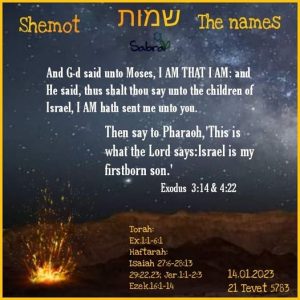
When Moses asked God for His name He replied, ‘Ehyeh asher Ehyeh’ in the future tense meaning “I will be who and how I choose to be” – I am the God of freedom. God is outside of time but His plan of salvation necessitated Him entering it at the perfect moment that was always just beyond the visible horizon 1500 years later, when God once more invaded time and sent His only begotten Son, Yeshua our Saviour and Lord. He is not only the God of eternity past and eternity present but the God of eternity future: “I will be who I will be” and “I am who I am”; ‘Ehyeh asher Ehyeh’
It’s difficult to hear God’s message if our spirit is broken and our labour harsh. And yet although tempted to blame God for our circumstances, a true believer fights through it because he understands that true freedom is not freedom from our persecutors or freedom from the worst physical deprivations and torture ever designed by man. We dare not miss the urgency of the moment and allow Satan to paralyse our future because the more hopeless our situation may appear, the sweeter the victory!
As we have noted, when Moses confronted Pharaoh, his initial efforts met with failure. Pharaoh refused to release the Israelites. Instead he made their working conditions worse causing the Israelites to place the blame upon Moses. As slaves, their primary objective was simply to survive. Every last glimmer of hope had evaporated following a display of failed promises. Imagine the overwhelming emotions flooding Moses as he faced one of the lowest moments in his life. He was caught between a cleft and a rock. Whether God encouraged Moses or maintained His silence, all we know is that Moses never gave up although at this initial stage of his ministry he may well have been sorely tempted.
It’s difficult to hear God’s message if our spirit is broken and our labour harsh. And yet although tempted to blame God for our circumstances, a true believer fights through it because he understands that true freedom is not freedom from our persecutors or freedom from the worst physical deprivations and torture ever designed by man. We dare not miss the urgency of the moment and allow Satan to paralyse our future because the more hopeless our situation may appear, the sweeter will be our victory.
Some believers suffer from spiritual myopia (short-sightedness) when we have yet to experience the full picture and look to the facts rather than the reality. God came to set the Israelites free but He did so on His own terms – “I will be who and how I choose to be” (‘Ehyeh asher Ehyeh’)
As we translate this parasha to our current times, we face great challenges with the choice whether to remain silent within the barrenness of the Midianite desert or not. The cost is high and we must face the reality of rejection even as Moses did. God is seeking for Himself a remnant willing to stand in the gap as His watchmen who refuse to remain silent against unrighteousness and every manner of evil and ungodliness.
And here we are faced with a paradox because alongside this we are also called to love our enemies (some people find difficulty even loving their friends!) and this is impossible until we recognise that the most evil person in the world is not in any more need of God’s grace than we are ourselves! This is the measure how we come before God’s throne. – “for I am Lord the greatest among sinners, wretched and in need of Your grace.”
How then should we stand against the pharaohs of this world and demon possessed humanity like those who participated in the Oct. 7th massacre? This is a difficult question that goes beyond merely good theology yet something we all have to face at some stage in our lives. The principle of hating sin but loving the sinner may appeared cliched but it is nonetheless the truth no more so as it reflects perfectly who we. Our only hope is Yeshua the Author and Finisher of our faith as we examine the life He lived and the way He responded to those who hated and rejected Him.
When we follow the life-giving teachings of Yeshua, He will set us free from yesterday’s pain and the ugliness of sin that stains our lives, and free us from the life-crippling burden of unforgiveness. To love as He loved us is to receive and share the reward of such love.
God has modelled for us how to love our enemies and why we must love them. There is no other alternative for one who knows such love in one’s own life; There are no escape clauses. And this I believe is how we learn to triumph against our enemies. David wrote: “You make me know the path of life; In your presence is fullness of joy, in your right-hand eternal delight.” Ps.16:11
I want to make it clear that what I am referring to has nothing to do with pacifism which incidentally I strongly disagree with and is a whole different discussion. Yeshua never tells us to submit to evil, but rather to refuse to oppose it on its own terms or let the opponent dictate the methods of our opposition.
Moses understood very quickly, following his commissioning, that the straight and narrow paths can often be filled with curve balls. Not only this but life can be filled with detours should we wrongly pursue things which, however good and noble are not part of His plan for our lives. We need to discern rightly between the two. This is why God desires us to pause long enough to read, reflect, and carefully follow His signposts through His Word. We may at times stumble or take a wrong turn, but He remains faithful to keep those who truly love Him safe in the palm of His hands (Ps.37:24). His grace is sufficient and His strength made perfect amid our own imperfections. This is the nature of the Master potter who loves us with an everlasting love and transforms us into His likeness from glory to glory.
As we press forward, Heaven beckons, and even the most attractive things on earth become dull and unappealing! As Paul declared, “…whatever I used to count as my greatest accomplishments, I’ve written them off as a loss because of Messiah. And more so, I now realise that all I gained and thought was important was nothing but yesterday’s garbage compared to knowing Yeshua my Lord. For Him I have thrown everything aside—it’s nothing but a pile of waste—so that I may gain Him.” (Phil 3:7-8.)
Many are called but few are chosen because few are willing to choose the narrow path. So, let’s be prepared – and having done all, to stand – as we await the soon return of our Lord, engaged in the service of the King of Kings as His bride without spot or blemish! It is only then we will be given the capacity to do the impossible and love our enemies as Yeshua commanded. And I speak to you as a child of Holocaust survivors who lost almost all my family and relatives in concentration camps. But God…
Jewish faith as a whole consists of just two words: ‘na’aseh v’nishma’, (“we will do and we will hear”) (Ex.24:7) which means we “Shema” – that is to hear and obey. And through obedience comes understanding. And the only way to understand this as a way of life is to risk living it. When we see things through this lens, Yeshua’s command to love one’s enemies becomes transformed into something possible – tangible and attainable.
In these days, where nations are in an uproar and kingdoms conspire against those who uphold godliness, righteousness and justice, can there be anything better for us than to experience the depths and the riches of Immanu-EL! When we allow Him access into every area of our lives, we discover that no matter where we find ourselves, whatever our predicament, He is our unshakeable rock, our Immanu-El, our God who is ‘more-than-enough.’
God reveals His loving care in multifarious ways that are often characterised by unexpected twists and turns, because His love is as surprising as it is infinite, and His ways are not always our ways, nor His timings our timings. Through it all, Immanu-El is our covering against every weapon formed against us, keeping us safe in that secret place as we abide under the shadow of the Almighty.
The word ‘Immanu-El’ should be posted on the door of every believer’s heart as a prophetic statement; our proclamation, our war cry that pierces the airwaves – not with the blood-curdling threats of Mediaeval crusaders, nor with airs of aggressive self righteousness or false piety backed by religious hierarchies – Immanu-El is not with any of these distortions, nor with the torrid manipulations of others seeking their own self interests.
Immanu-El is the fruit of those who wholeheartedly serve the King of Kings and walk in His ways with unconditional obedience, humility and love that’s completely His initiative, so our boast is in Him not ourselves. In all of it He whispers to us, “I will never leave nor forsake you,” our Immanu-El, our Yeshua!