Parsha Yitro – Ex.18:1-20:23; Isai.6:1-7:6; 9:5-6 Matt.5:8-20
by Raphael ben Levi
Parasha Yitro (Jethro) describes the giving of the 10 Commandments to the Israelites an event that was a turning point in separating the Israelites from the pagan nations that is foundational for understanding the covenant relationship between God and His chosen people, Israel.
In Ex.19 we read how the mountain was enveloped in smoke, accompanied by thunder and lightning, signifying God’s holy presence and He instructed Moses to set boundaries around the mountain to prevent the people from approaching. We receive a graphic description of this in verses 18-19 ” 18 Now Mount Sinai was wrapped in smoke, because the Lord had descended upon it in fire; the smoke went up like the smoke of a kiln, while the whole mountain shook violently. 19 As the blast of the trumpet grew louder and louder, Moses would speak and God would answer him in thunder. 20 When the Lord descended upon Mount Sinai, to the top of the mountain, the Lord summoned Moses to the top of the mountain, and Moses went up.” Joseph Shulam observed that: “…the giving of the Torah was not a private event, nor was it a private revelation, the whole nation was sanctified… Three days before God spoke from the Mountain the nation as a whole, including the Mixed Multitude of Gentiles that came out of Egypt together with the children of Israel, were all there and there was no discrimination, all heard God’s voices and saw the Mountain shake and smoke and the fire. The most wonderful and dramatic event where a whole nation of 600,000 men between the age of 20-50, their wives and children, their hand maids and servants, the Gentile nations that accompanied them out of Egypt, …all had the same privilege to hear God audibly, to see the flames of fire, and each according to his own language.”
For believers, there is a direct parallel between the celebration of Shavuot (Pentecost) with the giving of the Law to the Israelites on Mt. Sinai and the Acts 2 event when the disciples were filled with the Holy Spirit and flames of fire descended upon them, the same Holy Spirit who dwells within us today.
Moses went up the mountain to receive the commandments where God made a promise for Moses to share with the Israelites: “Now if you will pay careful attention to what I say and keep my covenant, then you will be my own treasure from among all peoples, for all the earth is mine; and you will be a kingdom of cohanim for me, a nation set apart.” (Ex.19:5-6)
God made a promise that He would embrace them as His special treasure. In Hebrew, the word for treasure is ‘segulah,’ from the word ‘sagol,’ meaning purple representing the colour of royalty.: “For the LORD has chosen Jacob for himself, Israel as his own possession (segullah).” Ps.135:4 Israel is God’s special treasure, his precious possession which sets her apart from the other nations of the world.
The word segullah can also apply to every true believer in Messiah. Paul wrote in Tit.2:14: “[Yeshua] gave himself for us to redeem us from all lawlessness and to purify for himself a people for his own possession who are zealous for good works.”
And Peter, referring to Ex.19, states that: “…(we)are a chosen race, a royal priesthood, a holy nation, a people for his own possession, that you may proclaim the excellencies of him who called you out of darkness into his marvellous light.” 1Pet. 2:9). In other words, segullah embraces everyone who attaches themselves to the God of Israel and His Son, Yeshua. Through faith in Messiah, Gentiles share in this identity and become part of the ‘commonwealth’ of God’s people, grafted in and partakers of the covenants through Messiah. In Him, Jew and Gentile form one Body, comprised of God’s treasured possession who are His pure and spotless Bride.
The 10 commandments which God gave to Moses to share with the Israelites can be divided into three groups of three. The first three are about God: (There is one God; We should have no other God; Do not take God’s name in vain)
The second set are about HIs creation: (Keep Shabbat; Honour parents; Do not murder) Shabbat reminds us of the birth of the universe. Our parents brought us into being and murder is forbidden because we are all created in God’s image (Gen.9:6).
The third three (Don’t commit adultery, Don’t steal, Don’t bear false witness) speak of establishing a godly society.
Where then would the tenth command fit into these sets? In Hebrew thought the last item of a list is generally a summary of the all other ones. The tenth commandment is recognised as the most important because all the others are physical acts of ‘dos’ and don’ts’ but the 10th commandment is an attitude of the heart. The Psalmist expresses it beautifully in Ps.73:25-26: “Whom have I in heaven but You? and there is none upon earth that I desire beside You. My flesh and my heart fails: but God is the strength of my heart, and my portion for ever.”
So to repeat, God told the Israelites, “Now if you will pay careful attention to what I say and keep my covenant, then you will be my own treasure from among all peoples, for all the earth is mine; and you will be a kingdom of cohanim for me, a nation set apart” (Ex.19:5-6). When the Israelites kept God’s covenant they would be richly blessed, but when they rebelled they would still remain His treasured possession but minus the blessings. Instead, they would be cursed in accordance with the choices God made available to them in Deut.28.
The Israelites responded with enthusiasm: “Everything Adonai has said, we will do!” (19:7) So what went wrong? The fact remains that we can only stand when we choose to follow the Lord unconditionally. Enthusiasm alone is insufficient. The Haftarah portion from Isa.6 builds upon this by emphasising the importance of holiness. It highlights the true character and nature of God’s absolute holiness: “But as he which hath called you is holy, so be ye holy …; Because it is written, Be ye holy; for I am holy..” (1Pet.1:15 from Lev. 20:7)
But there is still more, something which Yeshua highlighted who said: “If you love me you will obey my commandments.” In other words when we are rooted in the love of Yeshua we will be motivated to seek God’s holiness and seek to do His will according to His Word as led by the Holy Spirit. No matter what the cost, the salvation won for us through Yeshua far exceeds the price we pay. As Paul could boast, “I count everything as loss (family, friends, riches, status, reputation, – all these things I lay done) compared to the priceless privilege and supreme advantage of knowing Yeshua Ha Mashiach my Lord [and of growing more deeply and thoroughly acquainted with Him—a joy unequaled]. For His sake I have lost everything, and I consider it all garbage, so that I may gain Him…” (Phil. 3:8)
Yeshua has provided us with the means to come into His presence with boldness. But, His ‘consuming fire’ of judgment – that same consuming fire described in Exodus becomes a means of purification that cleanses us from sin rather than destroying us. Yes, our God is ‘a consuming fire’ (Deut.4:24).
Another event described in this parasha was when Moses sent for his wife Tziporah and his two sons Gershom (foreigner) and Eliezer (my God helps), accompanied by Jethro. Moses offered him hospitality in accordance to the Jewish customs of that day. Then, we read something interesting:
14 When Moses’ father-in-law saw all that he did for the people, he said, “What’s this you’re doing to the people? Why sit by yourself, alone, with all the people standing around from morning until evening?”
15 Moses answered his father-in-law, “It’s because the people come to me to inquire of God. 16 When they have an issue, it comes to me, and I judge between a man and his neighbour, so I make them understand God’s statutes and His laws.”
17 But Moses’ father-in-law said to him, “What you’re doing is no good. “”
Jethro’s point was clear. Up to this point Moses had none of his immediate family to consider, but now his wife and sons were returned to him. The principle applies to each one of us. Should we choose to neglect our family there will invariably be negative and long-term consequences especially for those believers who fall into the trap where ministry takes precedence. It has been the mistake of countless believers zealous for the Lord, “24 So Moses listened to his father-in-law (a Midianite – the enemies of Israel) and did everything he said.”
The Midianites were descended from Abraham and his concubine Keturah, and for the most part they were antagonistic towards Israel. But here we see something very different. Jethro, a Midianite priest, had offered Moses safe refuge for a period of 40 years after he had fled the Egyptians, and additionally blessed Moses with a wife, Zipporah who was his own daughter, displaying honour and favour according to the culture of the times. And now, God’s blessing upon Jethro’s treatment of Moses was reciprocated. Moses embraced him into the family of God where Jethro discovered a place of belonging and honour among God’s chosen people. His past as a pagan priest was behind him, the promise of a sure hope and future lay before him! The Egyptians who had cursed and abused Israel were destroyed, but Jethro who blessed Israel received God’s blessings and favour! (Gen.12:3)
Here we see clearly illustrated how we must avoid making generalisations about people or nations. Jethro was clearly a lover of the Israelites.
January 20th, just a few weeks back marked the 83rd anniversary of the Wannsee conference when the Nazis conceived and implemented the Final Solution – racism at its most violent expression ever devised – the plan to exterminate 11m. Jews from the face of the map of Europe. It was inconceivable that such a thing could ever have been implemented by a nation considered as the most civilised country in the world, yet we must beware of labelling all Germans as Nazis as also true with regard to the “Midianites.”
Moses’ two children were named after special events in his life – Gershom for the fact that Moses had been “a stranger in a foreign land,” while Eliezer represents God’s deliverance from Egypt: “The God of my father was my help and saved me from the sword of Pharaoh.”
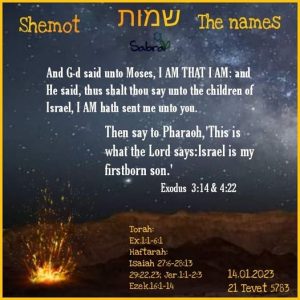
Gershom’s name is mentioned in Ex.18:3-4 , one of only a few times we ever hear of him. It first appears earlier in Ex.4 at his circumcision which mattered because he was raised as a Midianite not as an Israelite, but his identity was changed in a moment and he became identified as one of the Hebrew people because of the visible blood sign of his circumcision. The implications of this is enormous when seen alongside the 10th plague when God’s judgement was poured out upon Egypts firstborn sons and other pagan nations residing in Egypt. Gershom’s circumcision, therefore, was a matter of urgency, otherwise he would also die. In Ex.4.21-24, the Lord said to Moses, “When you go back to Egypt, see that you perform before Pharaoh all the wonders that I have put in your power; but I will harden his heart, so that he will not let the people go. 22 Then you shall say to Pharaoh, ‘Thus says the Lord: Israel is my firstborn son. 23 I said to you, “Let my son go that he may worship me.” But you refused to let him go; now I will kill your firstborn son.’”
24 On the way, at a place where they spent the night, the Lord met him and tried to kill him. (24 Now it happened at the lodging place, that the Lord met Moses and sought to kill him [making him deathly ill because he had not circumcised one of his sons] AMP) 25 But Zipporah took a flint and cut off her son’s foreskin, and touched Moses’’ feet with it, and said, “Truly you are a bridegroom of blood to me!” 26 So he let him alone. It was then she said, “A bridegroom of blood by circumcision.” Now we can better understand the direct connection with the blood that the Israelites were commanded to place on the lintels of their homes.
Eleazar the second son was responsible for carrying the oil for the lamp-stand, the sweet incense, the daily grain offering and the anointing oil, and also for oversight of the carriage of the Ark of the Covenant, table for showbread, altar and other Tabernacle fittings transported by the Kohathites. As for Eliezer, his only mention is within the imaginations of those who wonder what happened to him?
Yet, here in the names of the two sons we can see hidden in plain sight something of great importance. The name ‘Gershom’ (foreigner) speaks of something beyond the fact that he was born in the land of Midian. The name ‘Eliezar’ means ‘my God helps’ and when they are brought together, something significant is revealed as a type and shadow.
The two Midianite ‘foreigners’, Gershon and Eliezar, both qualified to enter into covenant relationship with God. The children who were half Jew and Gentile through their parents (Moses and Zipporah) serve as a prophetic illustration when 1500 years later both Jew and Gentile, would be united through Yeshua as prophesied in Hos.1:10, “Once you were “not a people,” but now you are “God’s people.” You were shown “no mercy,” but now you have been shown “mercy.” Through Yeshua the unthinkable became a reality and things never remained the same ever since.
We are indeed blessed from the inside out, Jew and Gentile, as we bathe in His Divine love which changes every perspective wherever we are and whatever situation we may find ourselves in.
First love is just the beginning of the journey not the end; the aperitif not the main course; an initial introduction rather than the sum of it. And this knowledge spurs us to enter the fullness of His love, the fathomless depths of His riches and eternal glory of His manifest presence! First love is the initial baby steps that set our course. This is why it is called, ‘first love’ because there is so much more yet to anticipate. Without it, we cannot begin to run the race.
We are warned that the antithesis to ‘first love’ is baseless hatred that Judaism claims is the reason why the Second Temple was destroyed, equivalent to the three transgressions which caused the destruction of the 1st Temple: idol worship, immorality and bloodshed. (Ibn Ezra on Lev.19:17) Loving the Lord with all our heart, soul and strength and our neighbour increases the presence of the Holy Spirit within us – we who are God’s Temple, instead of the reverse if baseless hatred should ever take a hold.
Lord, our hearts are bursting as we race forwards, and even though we may limp, and even though our eyes are blurred and our mouths dry, yet we can hear the sound of eternity in our ears and so we 6 6rejoice with exceeding joy!