TU B’SHEVAT – by Raphael ben Levi
Tu B’Shevat (15th Shevet) fell this year two days ago on Thursday and is the fourth of four new years in the Jewish calendar. The Sages observed that it takes 45 days for a seed to become rooted into the earth and there are 45 days from Tu B’Shevat until the Hebrew month of Nisan, the 1st of 12 months when we celebrate Pesach the feast of redemption.
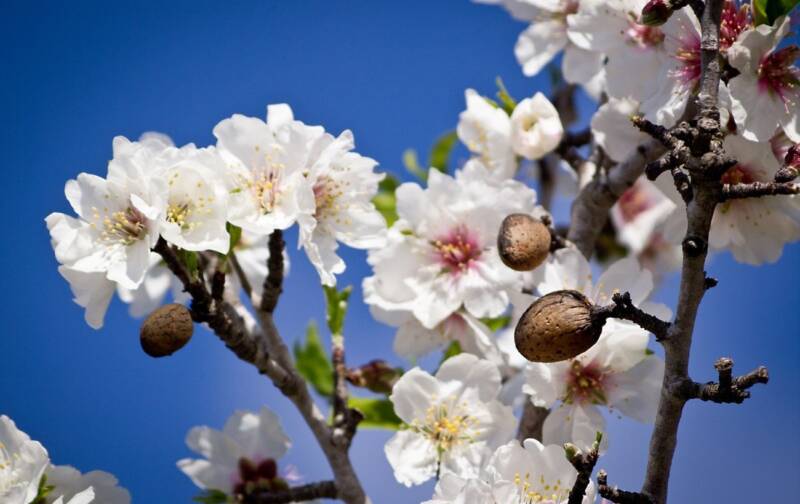
The Bible has many things to say about trees and their associations and another key feature of Tu B’Shevat is the planting of trees that’s specifically connected with the almond tree, the first tree that blossoms in Israel around this season. The almond tree is resilient, and its gnarled and leafless appearance is transformed into something beautiful with the fragrant pinkish-white flowers that blossom at this time. It represents the ugliness and ravages caused by sin in all of humanity whose appearance is transformed into a vessel filled with God’s fragrance whenever a person yields their lives to Yeshua. It’s a beautiful picture illustrating a person who is born-again and becomes God’s “segullah” (treasured possession).
The pinkish-white almond blossom has five petals with the gematria of five reminding us of God’s grace and the colours represent our holy walk with God and of Yeshua’s bride who is pure and spotless.
The menorah (7-branched candlestick) is the symbol of the Jewish nation and as a messianic symbol it pictures for us Yeshua who is ‘Light of the World.’ The Book of Exodus describes the menorah as: “Three cups made like almond blossoms, each with a knob and a flower on one branch, and three cups made like almond blossoms on the other branch with a knob and a flower; so for the six branches coming out of the lamp stand; on the centre shaft itself you shall make four cups like almond blossoms with their knobs and their flowers.”
The lamp of oil rests on the fruit, showing a relationship between the oil and menorah which is shaped like a flower of the almond tree. It is the oil from the ‘flower’ that lit up the Holy of Holies continually even as Yeshua is a “lamp to our feet and a light to our path.”
The almond tree also reminds us of the miracle of Aaron’s budding staff. In Jewish tradition, the rod of Aaron bore sweet almonds on one side and bitter ones on the other. The predominance of either the sweet almonds or bitter ones would be determined by whether the Israelites followed the Lord faithfully.
Every Shabbat, the wife praises her husband by reading to him Ps.1 declaring him to be a righteous person who bears good fruit: “How blessed are those who reject the advice of the wicked, don’t stand on the way of sinners or sit where scoffers sit. Their delight is in Adonai’s Torah; on his Torah they meditate day and night. They are like trees planted by streams—they bear their fruit in season, their leaves never wither, everything they do succeeds.” Righteousness is a precious quality and a rare commodity and like a tree is recognised by its fruit: “… the fruit of the Holy Spirit is love, joy, peace, patience, kindness, goodness, faithfulness, gentleness, and self-control.” (Gal. 5:22-23)
With no Temple in Jerusalem where fruit offerings can be made, Tu B’Shevat has come to represent the return to the Land that God gave the Jewish people for an everlasting possession. “The whole land of Canaan, where you now reside as a foreigner, I will give as an everlasting possession to you and your descendants after you; and I will be their God.” (Gen.17:8;48:4)
And finally, the blossoming of the almond tree is prophetic of the future awaited restoration of His covenant people. “Then I will pour out on the house of David and the inhabitants of Jerusalem a spirit of grace and supplication, when they will look toward Me whom they pierced. They will mourn for him as one mourns for an only son and grieve bitterly for him, as one grieves for a firstborn. “ (Zech.12:10)
www.mekudeshet.co.za