Did you know that Moses was a musician? The Bible reveals three songs he composed out of probably many more of which the best known is aptly named, “The Song of Moses,” from Deut.32. The other two appear in Ex.15 and Ps.90.
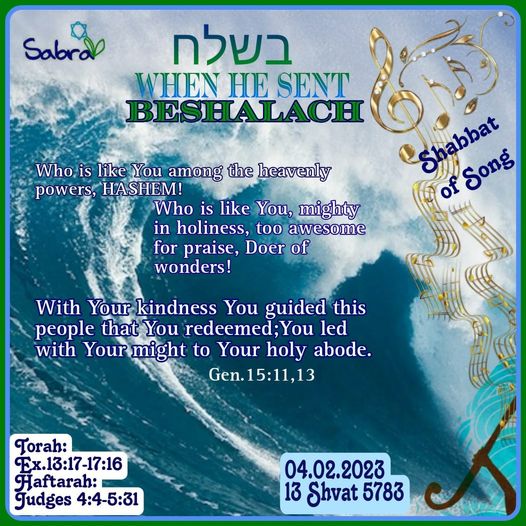
After God rescued the Israelites from the Egyptians, they spontaneously sang the Song of Moses. From it, this Sabbath gets its name “Shabbat Shira” – the Sabbath song.
This is the first time a song of praise to God appears in Scripture. The Amplified commentary adds that, “It was natural enough to create and sing a song of celebration to the Lord at this point, but the song, with all its detail, undoubtedly served as a memory device as well, a way to embed the account of the miracle in the minds of the people of Israel.”
And in Rev.15 the redeemed of the Lord, Jew and Gentile will once again sing the Song of Moses around the throne of God: “Great and marvelous are Your works, Lord God Almighty! Just and true are Your ways, O King of the saints! 4 Who shall not fear You, O Lord, and glorify Your name? For You alone are holy. For all nations shall come and worship before You, For Your judgments have been manifested.”
Deborah sang after Israel’s victory over the forces of Sisera Judges.5. Hannah sang when she had a child 1Sam. 2. When Saul was depressed, David would play for him and his spirit would be restored 1Sam.16 and was known as the “sweet singer of Israel” 2Sam. 23:1. Elisha called for a harpist to play so that the prophetic spirit could rest upon him 2Kings 3:15. The Levites sang in the Temple. And today we sing unto the Lord, the King of Kings because He has redeemed us from the slavery of sin through Yeshua who is worthy of all praise, honour and dominion! Worship is a language which the soul understands that will only be fully articulated when we see Him face to face in the fullness of time!
This is the season in Israel where the desert blossoms like a rose, a period shortly before Pesach. I used to live in a small desert town close to Beersheva called Arad. Every year around this period, the desert was transformed from a barren wasteland into a carpet of colour after the latter rains descended upon the parched sands; beautiful flowers sprung up seemingly from nowhere. Yet, within a couple of days, the scorching sun caused these same flowers to wither and die as if they had never ever existed, until the next year when the cycle was repeated. It was truly an amazing thing that is indelibly etched upon my memory.
The promises in Scripture are like the flowers that seem to appear from nowhere because so often they are fulfilled in God’s perfect moment not our own. The desert transformed into a type of Garden of Eden is described with prolific poetic imagery as the glory of God is placed on full display.
Isa. 35 speaks about this – of a future time when the desert will blossom and this has already been partially fulfilled when the land of Israel was transformed from a parched desert and malaria-ridden swampland into a paradise yielding an abundance that in our modern times has become the envy of nations. But the completion has yet to be fulfilled:
“And the redeemed of the Lord will return, And come with singing to Zion (with shouts of jubilation), And everlasting joy will be upon their heads; They will find joy and gladness, And sorrow and sighing will flee away.” (Isa.35:10)
During the millennium period, people will dwell in complete security and peace, for the Lord Himself will rule from out of Jerusalem. There will be unprecedented abundance and unparalleled joy with songs of praise and worship to our God as the revelation of His glory fills the whole earth!
Often, what is hidden underneath the surface in our lives is what contains the true substance like the flowers of Arad in springtime. In the fullness of time, at just the right moment, our lives will be filled with an explosion of colour with unprecedented blessings that cannot wither or die!
For as long as that last generation could remember, the Israelites had been slaves living embittered lives under a cruel regime. But God heard their cries and acted decisively to rescue them. Now it was time to go home, to a land of promise promise as free people.
B’Shalach (When He Let Go) Ex 13:17–17:16; Judges 4:4–5:31; Matt 5; Rev 19:1-20;6. By Raphael ben Levi
“Then it came to pass, when Pharaoh had let the people go, (B’Shalach) that God did not lead them by way of the land of the Philistines, although that was near; for God said, ‘Lest perhaps the people change their minds when they see war, and return to Egypt.’” (Ex.13:17)
This opening verse of the Torah portion speaks volumes regarding God’s fatherly concern for the Israelites and how His ways are not always our ways! No doubt we, like the Israelites, prefer shortcuts in life, but whenever God’s ways differ from our own there is always good reason.
Let’s recap for a moment on an event included in the opening section of this week’s parasha. The situation facing the Israelites after their exodus from slavery was still fraught with danger. After Pharaoh released the Israelites after the tenth and final plague following the death of the first-born, he regretted his decision (14:5 – God hardened his heart again – his resolve was strengthened) and Pharaoh prepared his army to pursue the Israelites with the intention to enslave them once more as before.
A fool is not someone who makes a mistake but somebody who keeps repeating it again and again. Albert Einstein made the famous statement that “Insanity is doing the same thing over and over again and expecting different results.” Pharaoh was so blinded by pride and arrogance that in his insanity he made the choice to pursue his folly and through this the Israelites would experience their greatest moment in history to remember and celebrate throughout all generations.
The Israelites had reached a place called Pi-harioth with the Egyptian army in one direction and their backs to the Red Sea in the other.
The situation was hopeless for the Israelites despite the fact that God had already forewarned them about it: “Now the Lord spoke to Moses, saying, … Pharaoh will say of the Israelites, ‘They are wandering aimlessly in the land; the wilderness has shut them in.’ 4 I will harden (make stubborn, defiant) Pharaoh’s heart, so that he will pursue them; and I will be glorified and honoured through Pharaoh and all his army, and the Egyptians shall know [without any doubt] and acknowledge that I am the Lord.” (Ex.14:2-4)
Despite God’s assurances, the promises of God to the Israelites were forgotten against the backdrop of their circumstances but rather reinforced their logic of despair. Everyone agreed that it would have been better to serve the Egyptians because now they faced certain death in the desert (Ex.14:11-12) So, they turned to Moses in despair and asked him, ’What then shall we do?’ The Jewish sages tell us that Moses replied, “You shall bless, praise, extol, adore and glorify Him that is the Lord of war!” (Ps.34: “I will bless the Lord at all times, His praise shall continually be in my mouth….”). Praise and worship is the antidote for despairing unbelief! (“The weapons of our warfare are not carnal but mighty unto God….”).
As a response, God commanded Moses to stretch out his rod over the sea, an action that appeared outwardly pointless! But, because Moses obeyed God history was made and the Israelites experienced something of such great enormity that it will be celebrated throughout eternity.
God calls us to stretch out our ‘rod’ of His authority against any obstacle we may face that threatens to block our walk with God. All of His pathways are illuminated by His presence (Ps.119:105).
The Israelites had started really well, filled with wonder and delight at the incredible way in which after 400 years of slavery, God came through for them. Yet, after only a few days, the harshness of their circumstances with Pharaoh’s army running close on their heels radically changed their perspective on things.
When oppression and adversity with all its different shapes and sizes comes chasing after us how well prepared are we to cope with it all? Will we keep our eyes focused on the promises of God or capitulate to the fears and enslavement of the past? Nothing that God ever does of significance in our lives will go uncontested because the enemy seeks to steal and destroy that which God has redeemed.
The Shekinah Glory was manifest at this point for a period of 40 years throughout their time in the wilderness until they entered the Promised Land. (Ex.13:21-22). And despite their constant unfaithfulness God never abandoned them but remained true to His word. Although the Israelites throughout much of their time in the wilderness complained and threatened to return to Egypt, at the end of the day no-one ever actually did. Although the Israelites often argued against God, rebelled, disobeyed or ignored Him, they knew that it was impossible to live without Him! And this has been true throughout history. Perhaps that is why even today the staunchest Jewish atheist always attends synagogue on Yom Kippur.
For us as believers we learn that we cannot place our confidence on past experiences or build our spiritual life upon anything other than a direct relationship with God. Nothing else can substitute: revival meetings, ministry from others, and many other good and legitimate things can never in themselves fill the heart shaped vacuum of our being; only Messiah Jesus can do this.
The Israelites were awestruck at the incredible way in which God came through for them from their exodus to the parting of the Red Sea and celebrated with great joy these miracles. Yet, after only three days things changed dramatically.
It is in moments when we are faced with adversity that we have opportunity in real time to embrace the promises of God. The Israelites found themselves stuck in the desert without water to drink, and when they finally arrived at an oasis called ‘Mara’ the water was bitter and undrinkable! It tested the hearts of the people and exposed how much their friendship with Him was at this point superficial and conditional based upon their terms. Moses was the only person who remained unfazed and interceded before God who turned the bitter waters into sweet. That was miracle number 3 that demonstrated the power of intercession! God’s hand of mercy to the Israelites was not based upon merit but upon His Divine mercy and compassion: “It is because of the Lord’s loving kindnesses that we are not consumed, Because His [tender] compassions never fail. They are new every morning; Great and beyond measure is Your faithfulness.” (Lamen.3:22-23)
Shortly afterwards, another challenge faced the Israelites: “…on the 15th day of the 2nd month after leaving the land of Egypt, there in the desert the whole community of the people of Israel grumbled against Moses and Aaron.” (16:1) ‘If only we had died by the hand of Adonai in the land of Egypt, when we sat by pots of meat, when we ate bread until we were full. But you have brought us into the wilderness, to kill this entire congregation with hunger.’”
First they were dying from thirst and now they were starving for the flesh pots of Egypt! Man can live 40 days without food, 3 days without water, 5 minutes without air to breathe, but not even a moment without God. And here we discover how they began to fantasise about the conditions in Egypt concluding that enslavement was preferable to freedom.
And yet, in these early stages, because Israel as a collective group were still spiritual infants, God held them to a low level of accountability comparable to an indulgent father, overlooking their complaining. Instead, He sent them manna, described in Ps.8 as “Angels Food.” And later on He supplied them with quails. In Ps.106 laments: “How quickly they forgot His works, and would not wait for His counsel! 14 In the wilderness they craved ravenously, in the desert they tested God. 15 So He gave them what they asked for, but sent a wasting disease among them.” (Leanness to their souls)
Following these two incidents, the Israelite’s accountability was ratcheted up a notch. God initiated laws and regulations for them to live by. Now the manner in which God supplied their needs would be conditional upon their faithfulness and obedience: “If you will listen intently to the voice of Adonai your God, do what he considers right, pay attention to his mitzvoth and observe his laws, I will not afflict you with any of the diseases I brought on the Egyptians because I am Adonai your healer.” (15:26) It was here that God introduced a level of accountability that until now was absent.
Jer.17:22-23 makes it clear what these commandments were: “For I spake not unto your fathers, nor commanded them in the day that I brought them out of the land of Egypt, concerning burnt-offerings or sacrifices: but this thing commanded I them, saying, Obey my voice, and I will be your God, and ye shall be my people; walk ye in all the ways that I have commanded you, that it may be well unto you.”
Now let’s break this down to consider the implications of these directives. In Ps.51, the psalm written by David following his sin with Bathsheba, he cried out to God, “16 You are not pleased by sacrifices, or I would give them. You don’t want burnt offerings [Lev.1:1–17] The sacrifice God wants is a broken spirit. God, you will not reject [despise] a heart that is broken and sorry for sin [contrite;
“He has told you, O man, what is good; And what does the Lord require of you Except to be just, and to love [and to diligently practice] kindness (compassion), And to walk humbly with your God [setting aside any overblown sense of importance or self-righteousness]. Mic. 6:6–8].
God desires above everything to see genuine brokenness over our sin. The first step towards reconciliation is when we agree with Him how serious sin is, not by going through the motions and saying the right things. That is simply like someone who is religious yet empty insides were many within the religious hierarchy of Yeshua’s day.
The prophet Micah summed things up well: “With what shall I come before the Lord [to honor Him] And bow myself before God on high? Shall I come before Him with burnt offerings, With yearling calves? 7 Will the Lord be delighted with thousands of rams, Or with ten thousand rivers of oil? Shall I present my firstborn for my acts of rebellion, The fruit of my body for the sin of my soul? 8 He has told you, O man, what is good; And what does the Lord require of you Except to be just, and to love [and to diligently practice] kindness (compassion), And to walk humbly with your God [setting aside any overblown sense of importance or self-righteousness]? (Micah 6:6-8)
These things bear much relevance for us in these end times. Many people have faced crises in recent days but the true measure of a person is revealed within God’s purifying fire when all our good theology is put to the test. How we respond to situations when the waters at the oasis of ‘Mara’ are bitter.
God frequently reminded the Israelites who was in control of their welfare even when the facts presented were different from the reality. One can easily ascribe greatness to God after the event even as the Israelites did following their deliverance from the Egyptians through the Red Sea; (“I will sing unto the Lord for He has triumphed gloriously..”). But how many us have the faith, courage and determination to do so in every circumstance? This was a problem for the Israelites and maybe it’s the same for us too?
All of us yearn to receive the fullness of God but are not always to do what it takes and pay the price! God is looking for those who unreservedly place their full trust in Him in “quietness and confidence” for therein lies strength. (Isa.30:15)
The word for quietness in Hebrew is ’shakat’ (שָׁקַט) meaning, to be calm, relaxed, free from all anxiety; to be still, to lie down with support underneath. One of the best biblical examples of ‘shakat’ is linked to Shabbat, designed by God to provide us with quietness and rest amid all the turmoil and busyness of life the other six days of the week. The Book of Hebrews, urges us to “…strive to enter our Sabbath rest” the only place in Scripture where the word, “strive” is employed to convey something needful and desirable to pursue – such as in the pursuit of sabbath rest.
The entire chapter of Ex.16 focuses upon Shabbat. It was presented to the Israelites as a distinctive to set them apart from the other nations and was among the first commands the Israelites received on leaving Egypt that symbolised freedom from slavery.
The following is a beautiful description of Shabbat by the late Jonathan Sacks: “In Moshe’s day it meant freedom from slavery to Pharaoh. In the Ninetenth and early twentieth century it meant freedom from exhausting working conditions of long hours for little pay. In ours, it means freedom from phones, social media, and the demands of 24/7 availability.
Not only was Shabbat culturally ground-breaking. Conceptually, it was so as well. Throughout history people have dreamed of an ideal world. We call such visions ‘utopias’, from the Greek ou meaning “no” and topos meaning “place”. They are called that because no such dream has ever come true, except in one instance, namely Shabbat. Shabbat is “utopia now,” because on it we create, for 25 hours a week, a world in which there are no hierarchies, no employers and employees, no buyers and sellers, no inequalities of wealth or power, no production, no traffic, no din of the factory or clamour of the marketplace. Shabbat is utopia, not as it will be at the end of time but rather, as we rehearse for it now in the midst of time.
So God gave the people Shabbat in this week’s parsha. He wanted Bnai Yisrael to begin their one-day-in-seven rehearsal of freedom almost as soon as they left Egypt, because real freedom, of the seven-days-in-seven kind, takes time, centuries, millennia.
Shabbat is the time for things that are important but not urgent: family, friends, community, a sense of sanctity, prayer in which we thank God for the good things in our life, and Torah reading in which we retell the long, dramatic story of our people and our journey.”
Shabbat is a shadow of the eternal rest every true believer in Yeshua but is something we can experience in real time in the here and now. God introduced the Sabbath as a rehearsal (Micra) for what life will be like when Yeshua returns and restores life for us in the Millennium period. It will be a time of active rest where we can relax in the knowledge that He has wrested all authority from Satan. No longer will there be any need for spiritual warfare against evil because“…he shall rule them with a rod of iron, as the vessels of the potter are broken to pieces…” (Rev. 2:27)
Observing Shabbat was something the Greek mind-set could not fathom or understand. That God made the universe in six days, made more sense than He did so in seven. For them, the seventh day, was an empty vacuum which held no meaning. Because of this, the Greeks accused the Jews as being lazy.
God’s desire is for us to experience the reality and fullness of His peace and rest which is highlighted by Shabbat yet something we can experience the entire 7 days of the week. This is why the writer of Hebrews urges us to, “Strive to enter into your Shabbat rest.” It is something active which we should wholeheartedly pursue.
Humanity seeks Divine rest but generally seek it in all the wrong places. It is like a deep and refreshing slumber for those who can embrace it. Spiritual insomnia holds serious consequences, but God made His Divine rest available for the whosoever through Yeshua who invites all those who hunger and thirst: “Come unto me all those who are burdened and weary and I will give you rest..”
“So there remains a [full and complete] Sabbath rest for the people of God. For the one who has once entered His rest has also rested from [the weariness and pain of] his [human] labours, just as God rested from [those labours uniquely] His own. Let us therefore make every effort to enter that rest [of God, to know and experience it for ourselves], so that no one will fall by following the same example of disobedience [as those who died in the wilderness].” (Heb. 4:9-11)
All of God’s pathways are illuminated by His presence (Lamp to feet and light to path) God invites us to ’Walk in His Light.’
God provided the Israelites with His Shekinah Glory (manifest presence) throughout their time until their entrance into the Promised Land of Canaan: “The Eternal went on ahead to guide them during the day in a cloud shaped like a pillar; at night He appeared to them in a fire shaped like a pillar to light their way. So they were able to travel by day and by night. 22 The Eternal did not remove the cloud pillar or the fire pillar; by day and by night it continued to go ahead of the people.” Ex 13:21-22
God’s faithfulness is revealed here but one thing we can be encouraged by is this: even though the Israelites time in the desert was punctuated by failures throughout the 40 period:
- God never abandoned them
- Whenever His manifest presence moved, they would follow because even if they only ever understood one thing of importance which was non-negotiable it was to know that without Him, they had less than nothing. Even though they constantly complained and threatened to return to Egypt, at the end of the day, no-one ever actually did so.
Yet, it is in the fellowship of His sufferings that our spiritual growth and relationship with Him is deepened. (“I want to know Him and ….”)
In the Book of Hebrews we are urged not to “…throw away our confidence which has a great reward. For (we) have need of endurance, so that when (we) have done the will of God, (we) may receive what was promised.” (Heb.10:35-36).