TZAV (Command!) by Raphael ben Levi
“The LORD said to Moses: ‘Command Aaron and his sons, saying: This is the law of the burnt-offering.’” (Lev. 6:8–9)
Last week’s Torah portion fell immediately before Pesach and is known as “Shabbat Ha Gadol” so this shabbat is the Intermediate Sabbath of Passover known as Chol HaMoed Pesach.
God told the Israelites, “Speak to the community of Israel and say that on the tenth of this month each of them shall take a lamb for their father’s house, one lamb per household.” (Ex.12:3) When God commanded the Israelites to take the sheep in defiance of the Egyptians and to slaughter it before their eyes the Egyptians would have viewed it as a desecration of their pagan deity Khnum represented by the head of a ram. So then, why would God have commanded the Israelites to take this action and specifically with a lamb?
The Jewish sage Rashi, explained that the use of a lamb as a sacrifice to God was intended to wean them off Egyptian paganism because the Israelites, having lived in Egypt for centuries were completely steeped in idolatry.
On this Shabbat the Israelites expressed their defiance against the Egyptians, risking everything and chose to place their full trust in God their Deliverer. They were instructed to prepare the lamb for sacrifice and for its meat to be consumed at the first-ever Seder night. The Egyptians had already endured nine plagues from God who had by this time made Himself amply known via these judgements. Consequently, the Egyptians would have feared that should they dare turn against the Israelites, God’s retribution would be catastrophic and so held their peace. But it was too late. Things had reached the point whereby shortly afterwards God slaughtered every Egyptian first born in the 10th and final plague.
Why may ask why the need to vanquish the sheep deity known as Khnum? The answer is as simple as it is profound but only makes sense when viewed through a Messianic lens as a type and shadow of our future Messiah, the lamb of God who was victorious over sin and death and every evil principality and power – the lamb of God who takes away our sin and every pagan influence through His sinless sacrifice.
Although sheep were revered by the Egyptians as gods, they considered a shepherd to be the most despised occupation, alone reserved for the Israelites. And this leads us to another point. When Moses fled to Midian from Egypt he occupied the very position he had been taught to disdain the most. Yet, it was through losing all status as a prince of Egypt and learning humility as a shepherd, that God began working in him in preparation to lead the Israelites through the most significant chapter of their history.
Moses proved his suitability as God’s chosen person to become the leader of the Israelites by the manner he tended the flocks of sheep under his care during the 40-year period he dwelt in the wilderness of Midian. It was there that God worked in him the qualities necessary to become the shepherd of His people. God does not appoint anyone to a high office in His Kingdom until he has been tested in small things, because it is faithfulness in the small details that demonstrate the true character of a person. Although it may be hidden from public view nothing is hidden from God. Big problems arise when we ignore the small details in our spiritual walk with God – it’s the smallest foxes which spoil the vineyard…
Moses, and many centuries later King David, were each apprenticed as shepherds until in the fullness of time God equipped them to be shepherds of His people. Godliness is not instantaneous and those who rush ahead of God easily fall prey to Satan’s traps. The apostle Peter is a classic example of this and yet his shortcomings were all part of God’s preparation to mould him for that time when he too would become a shepherd of the early Church. This is true for every believer. We all have shortcomings, but God takes us just as we are as the precious hymn states, “Just as I am, without one plea, But that Thy blood was shed for me, And that Thou bidst me come to Thee, O Lamb of God, I come, I come.”
All of this is that “…good work that He has begun…” (Phil.1:5)
It took forty years for God to prepare Moses in the barren wilderness of Midian for the task ahead; to remove Egypt from within him and replace it with humility, patience and a servant-heart. Even Moses was overwhelmed with the task that lay ahead at the end of this 40-year period when he was commissioned by God, yet God had His perfect way in Moses’ life as so too He will do with each person whose life is surrendered to Him.
The Holy Spirit searches the deepest thoughts and intentions of our hearts, to remove those things which lie buried that are contrary to His ways. For Moses it took 40 years and although we can take this time period literally, it is also true that in biblical gematria the number 40 in Scripture represents a complete time of probation. God has His perfect timing for our lives within His eternal purposes.
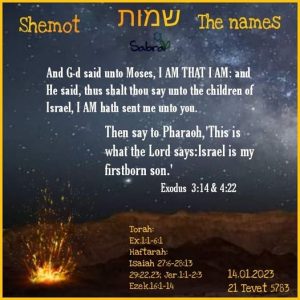
And so it was in the fullness of time that God appeared to Moses in the midst of a burning thorn bush. Why would God chose to reveal Himself in something that was considered worthless and useless? But, here we see that it was God’s intention to provide us with a perfect illustration of His humility. Nothing is redundant in God’s creation. He has designed everything to have a unique and Divine purpose and if this is true, how much more so with us! And here we see how the Almighty God chose to reveal Himself to Moses via what man considered to be a common, worthless thorn bush not from a lofty mountain peak. Yet, although the common thorn bush was considered the lowliest among all trees, it was the only variety of wood that was undefiled and unused by the heathen for making their idols. But at a later stage in history God descended again from Heaven in the likeness of man and that same worthless thorn bush was used by the Roman soldiers not to fashion any kind of pagan deity but rather to fashion a crown of thorns which they crushed upon Yeshua’s head to mock Him whilst they flogged Him, and spat in His face whilst His precious blood poured down from His head staining His garments.
The innocent ‘Lamb of God’ the One pure and undefiled, became the means of Redemption for every person who yields their life to HIm. God arranged everything in His perfect timing in a manner that not even Satan and the entire realm of Hell understood. Yet, it was all there in plain sight to see.
“He was despised and rejected by men, a man of sorrows, acquainted with grief,
One from whom people hide their faces. He was despised, and we did not esteem Him. Surely He has borne our griefs and carried our pains. Yet we esteemed Him stricken, struck by God, and afflicted. But He was pierced because of our transgressions, crushed because of our iniquities. The chastisement for our shalom was upon Him, and by His stripes we are healed. We all like sheep have gone astray. Each of us turned to his own way. So Adonai has laid on Him the iniquity of us all. He was oppressed and He was afflicted yet He did not open His mouth. Like a lamb led to the slaughter, like a sheep before its shearers is silent, so He did not open His mouth.”
The apostle John saw the Lamb of God who stood alive and well even though He had been sacrificed as a sin offering on the altar. Death could not conquer the One who is the King of Kings. John described Him as having seven horns and seven eyes, representing perfect power and wisdom to rule the entire universe and beyond. His work was completed just as at the end of the sixth day of Creation. And so, Yeshua entered the realm of the ‘Great Sabbath Rest,’ as He had done on the seventh day of Creation. But, this time, a full cycle had turned. Sin had entered the world through Adam but now the price for man’s sin had been paid. “So, as one man’s sin brought about condemnation and punishment for all people, so one man’s act of faithfulness makes all of us right with God and brings us to new life. 19 Just as through one man’s defiant disobedience every one of us were made sinners, so through the willing obedience of the one man many of us will be made right.” Rom.5:18
The prophetic fulfilment of ‘Shabbat Ha Gadol’ is found in Yeshua. This is something that until this point, the Jewish people have failed to comprehend. The Israelites sprinkled the blood of an innocent lamb on the lintels of their homes protecting them from the Angel of Death, so the blood of Yeshua has redeemed us from death and bought us eternal life and freedom from every bondage and slavery to sin. Here is how Shabbat Ha Gadol links with the Great Sabbath Rest. For “…there still remains a place of rest, a true Sabbath, for the people of God because those who enter into salvation’s rest lay down their labours in the same way that God entered into a Sabbath rest from His.” (Heb.4:9-10) Herein is the incredible sacrifice that God provided for us by sending His only begotten Son into the world that whosoever believes in Him might not perish but have everlasting Life.
The priests were responsible to keep the Temple fires on the altar of the burnt offering (Korban olah) burning day and night. Each morning the priests shovelled out the ashes and kindled wood to keep it alight which is a beautiful illustration of what our spiritual lives should be. The expression to be ‘on fire for the Lord’ has its roots in the ‘Korban Olah’ as we offer our lives as a living sacrifice unto God. There were 5 types of Temple sacrifice which the Israelites offered which all held types and shadows for us as believers:
1. Burnt Offering: ‘Korban Olah’ This offering was offered voluntarily that was completely burnt and not eaten, and speaks of the completeness of God’s forgiveness.
2. Meal Offering: ‘Minchah’ was where grain offerings were presented. During their time in the wilderness, grain was a rare and precious commodity more valuable even than livestock. The choicest flour was mixed with oil and salt to make a cake, but could not contain leaven or honey. “Although honey has a pleasant smell when it boils, it smells bitter and unpleasant when it burns. The offering was to be sweet smelling, as was the incense offered with it. Additionally, salt and leaven represent two entirely different things: salt preserves things, while leaven is usually associated with sin, pride, hypocrisy, false teaching and worldliness. (1Cor.5:6–8, Lk .2:1, Gal 5:9, Mk. 8:15)
3. Peace Offering – Sh’lamim – The Peace offering is related to the word shalom and was a voluntary offering expressing thanksgiving and restoration. (Gen.31:54)
4. Sin Offering – Chatat – This sacrifice was offered for unintentional sins (Lev.4), or sins of omission such as withholding testimony or violating an oath.
5. Trespass Offering – Asham – The trespass offering was presented for a variety of sins relating to fraud. In addition to sacrificing a ram, the offender was responsible to make restitution with an additional 20% tagged on.
The 5 Temple sacrifices point to God’s provision for sin, but also how we as believers can best respond to God’s initiative of salvation.
God deemed it worthwhile to sacrifice His only begotten Son, the “Lamb of God” and “…demonstrated His love for us that we while we were yet sinners, Messiah Yeshua died for us!” This is the incomparable measure of Divine love. To respond any less than by laying down our lives for the One who gave Himself so freely for us only reveals a lack of understanding concerning the true meaning of Divine redemption. The most we can ever give Him is the least He deserves! God is searching for 100 percenters in these days, for those who are wholehearted!
Do you know something really sad? According to Jewish tradition, only one-fifth of the Israelites left Egypt 400 years into captivity, because they liked it there. So too following the Babylonian exile in 586BC with the return of the exiles to Jerusalem 70 years later. Only a small remnant returned and it was only 80 years later that under Ezra and Nehemiah the Jewish exiles returned and the walls of Jerusalem were rebuilt. The slave mentality was so ingrained within them that they no longer hungered for freedom.
In America, after slavery was abolished, how many people really wanted to be free? Many wanted to go back right away to being a slave, because although everybody talks about freedom, they knew that it’s a very heavy responsibility to be free. This was the mindset of many Jews in exile both in the physical and spiritual sense.
There is a deep application here regarding Satan’s tactics against born-again believers about our self-worth. He loves attempting to make every believer feel small with little or nothing to offer but this is not how God views us! It is the very things that the world scorns and squanders that God desires to take and fashion into something beautiful for Him. All He requests from us is to offer ourselves and allow Him to change us into His likeness from glory to glory.
God invites us today to come to Him just as we are, to be released from the cosiness of spiritual assimilation and to follow Him. The Jewish sages tell us that the best way to live our lives is as though the entire world were held in the balance, and any one thing we do could tip the scales. This presents us with a calling to a unique lifestyle! There are countless examples of heroes, many who remain nameless and faceless, who outwardly contributed in small, seemingly insignificant ways which may have just kept the scales from tipping.
There was once an old, frail man praying fervently at the Western Wall in Jerusalem who had survived years of incarceration in a concentration camp and subsequently made Aliya. He had clearly suffered much; that was apparent from his broken appearance. When questioned, he said that the thing he drew strength from above everything was his decision to worship God unconditionally, wholeheartedly and consistently in the midst of every circumstance he faced.
Then, there is a story about the extraordinary episode of fifty Hungarian orthodox Jewish youth transported to Auschwitz in 1944 who were immediately selected for the gas chambers. They were herded into the ‘showers’ and knew that this signified the end. However, they were determined to make their stand even in the face of death. One of them stood up and inspired the others to sing and dance unto God as they prepared to die. The guard who overheard all of this summoned the camp commandant. He was filled with fury at his inability to quell the celebration. The youths were lost in worship, spurred on by the knowledge of the eternal hope that lay before them. In a fit of rage, the camp commandant cancelled the gassing and decided to torture them one by one, savouring the thought of imposing an even more agonising death. He removed them from the gas chamber and placed them in a holding block. However, the next morning a high ranking Nazi officer arrived at Auschwitz to acquire slave labour workers, and just happened to pass by the barracks where the fifty youths were being held. Immediately he had them requisitioned and placed onto the waiting truck. God intervened to spare each one of these young men from certain torture and death, and all survived the war to tell their tale.
The author, David Kossoff, in his forward to, ‘The Book of Witnesses’, wrote the following extract about an incident which left an indelible impression upon him:
“This book is for my father, who died long ago. Once, when I was small, about eight, I was with my father, who was a loving man, in a narrow street in the East End (of London). A huge labourer suddenly roared down at us that we had killed Jesus. My father asked him why he was so unhappy, and the fist lowered and the shouting stopped and he began to cry. We took him with us to my aunt for tea. This book is for my father, who was a loving man.”
Spiritual truth without transformation is an empty shell resulting in deadness. Transformation comes at a great personal cost, and most people choose sameness in preference to allowing the pain of God’s scorching light to burn up the impurities. Yet, it is this concealed gift which allows His life to shine more brightly within us. This is the mark of one who tips the scales. – the heroic small acts that go largely unnoticed by everyone except God.