We are currently on Day 27 of the Omer counting which is three weeks and six days. We as believers use this time to reflect upon different aspects and implications for our lives regarding the salvation that Yeshua won for us at Pesach nearly 2000 years ago. From Pesach to Shavuot is 50 days when God gave the Israelites the Law at Mt. Sinai and Yeshua’s disciples were filled with the Holy Spirit. This is why we count up not down because our life as believers always move forwards, never backwards. So this 50-day period is a very focused time of thanksgiving and anticipation for all we have received from God, past and present, and for all that the future holds for us.
Blessing: barukh ata, Adonai eloheynu, melekh ha-y’kum, sh-hat-sadik otanu be’emuna b’yeshua hamashiakh v’tsi-vah aleynu b’nogea lisfirat haomer.
Blessed are You, our God, King of the Universe, Who has justified us by faith in Yeshua the Messiah and commanded us concerning the counting of the Omer.
Verse: “The love of money’s the root of all evil;…“But you, O man of God, must flee from these things; and strive for uprightness, godliness, good faith, love, fortitude, and a forgiving temper.” 1Tim.6:10-11 To accumulate wealth as a primary objective is simply another form of starvation.
This week’s focus is on endurance – to continue steadfastly in the love of God. Scripture reminds us that the person who endures to the end will be saved and one component of this is the Shavuot fire of God – we need His fire. Some thoughts related to this – Sometimes, in life it may appear that all we have left are the ashes and our fire appears to be burnt out – the origin of the term to be “burnt out.” Too many people have been discouraged at this point so it’s essential to know where to rekindle the fire of the Holy Spirit who dwells within us in these times with the knowledge that the embers lie directly beneath the ashes! God is always closer than we think!
Yeshua sent His fire at Shavuot which broke the stranglehold of tradition. Some people were released to serve in His kingdom but others remained behind and became the ashes of a legalistic Levitical system. The fire of God loosened a force that changed the course of history.
Those who welcome the fire of God into the deepest recesses of their lives embrace the Lord’s intentions for us. God desires to dwell in close intimacy with Him, but it takes His fire to accomplish it. Many are called but few are chosen because few choose.
Those who truly love Him are not fearful of being destroyed by the fire, but allow Him to purify, correct and cleanse from every hindrance and stumbling. God’s fire produces first love which is a bridal identifier of those who truly belong to Him. In the Talmud (Gen R 32:3) we read that a potter does not test cracked vessels, for he need only knock upon them once and they break; but if he tests sound vessels, he can knock them many times without them breaking.
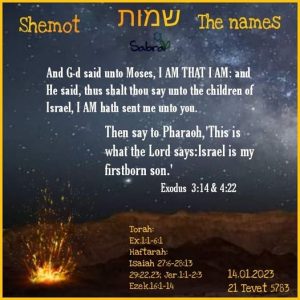
God revealed Himself in fire on several occasions. For example, in Ex.2:2-4: “The angel of Adonai appeared to (Moses) in a fire blazing from the middle of a bush. He looked and saw that although the bush was flaming with fire, yet the bush was not being burned up. 3 Moses said, “I’m going to go over and see this amazing sight and find out why the bush isn’t being burned up.” 4 When Adonai saw that he had gone over to see, God called to him from the middle of the bush, “Moses! Moses!” He answered, “Here I am.”
The late Rabbi Louis Ginsburg, reflected how “… Moses was taught that there is nothing in nature, not even the insignificant thorn bush, that can exist without Him. To give Moses an illustration of His humility, God descended from the exalted heavens and spoke to him from a lowly thorn bush instead of the summit of a lofty mountain or the top of a stately cedar tree.
The thorn bush may be taken as the symbol for Israel in several respects. As the thorn bush is the lowliest of all species of tree, so the condition of Israel in the exile is the lowliest as compared with that of all the other nations. But, as the thorn bush releases no bird that alights upon it without lacerating its wings, so the nations that persecute Israel will be punished. Also as a garden hedge is made of the thorn bush, so Israel forms the hedge for the world the garden of God, for without Israel the world could not endure.
And the thorn bush, the leaf which consists of 5 leaflets, was to indicate to Moses that God had resolved to redeem Israel by His grace. The numbers represented by the letters composing the Hebrew word for thorn bush (‘Seneh’) add up to 120, to convey that Moses would live unto 120.“ (Legends of the Jews Vol.2)
Prayer: Heavenly Father, help us to rely on You at all times with the strength and fortitude to endure whatever comes our way. Amen. God has provided us with His gift of joy and the joy of the Lord is our strength, so let’s take it in both hands and offer unto Him our sacrifice of praise and worship.
Parasha Acherei Mot/Kedoshim (Holy People)
Lev.19:1- 20:27 ;1Sam 20:18-42 ; Matt.4:43-48
By Raphael ben Levi
The Hebrew word “kadosh,” meaning “holy” speaks of someone or something that is set apart. The priests were set apart from the rest of the Israelite nation and had no share in the land because the Lord was their great prize and inheritance. (“Whom do I have in Heaven..?) Their whole sphere of focus was the Tabernacle/Temple, the place where the Shekinah glory resided. So the priests lived in the very epicentre of the Divine Presence and as God’s ministers kept themselves pure as “Kedoshim”.
Until now, holiness was a special feature that separated a priest from the remaining nation of Israel. But now in our parasha for this week, “…the Lord said to Moses, “Speak to the entire assembly of Israel and say to them: Be holy because I, the Lord your God, am holy.” Holiness became an expectation for the entire nation. (Lev.9:1-2)
Likewise, every believer grafted into the Vine is commanded to be holy: distinctive, set apart, held to a higher standard. It is not an optional extra or something for only a few but an essential feature of every person’s walk with God that holds profound implications for our present and future destinies.
Until now, the Book of Leviticus has been centred around the theme of sacrifices, purity, the Mishkan (Tabernacle), and the Priesthood. Things were focused around a holy place, holy offerings, and a holy people, specifically Aaron and his descendants who God chose to be the custodians of the Mishkan. But now suddenly in the beginning of ch.19 we see a paradigm shift where the focus is broadened. This is the first and the only instance in Leviticus that such an inclusive command is found where the entire nation is explicitly commanded to be holy.
Holiness is defined in this Torah portion in ways that does not separate between the secular and the sacred – from the mundane such as instructions how to make clothes and plants its fields; how justice should be administered, how workers are paid and business conducted – to things that focus upon the vulnerable: the deaf, the blind, the elderly, and the stranger all were to be given special protection. All of life is presented as being an expression of walking in a right relationship with God that’s embedded within this framework of holiness. No wonder Yeshua criticised the religious hierarchy who had a form of religion which they scrupulously adhered to but denied the power thereof. Paul wrote in 2 Tim.3:5 that such people “…hold to a form of godliness although they have denied its power”
But now the Israelites as a nation were called to be holy and as such every individual held a greater accountability. So too with every true believer. Peter urges us to “ …set your hope completely on the grace that will be brought to you at the revelation of Yeshua the Messiah. 14 Like obedient children, do not be shaped by the cravings you had formerly in your ignorance. 15 Instead, just like the Holy One who called you, be holy yourselves also in everything you do. 16 For it is written, “Kedoshim you shall be, for I am kadosh.” (1Pet.13-16)
Yeshua said: “Blessed are the pure in heart for they shall see God,” and Heb 12:14 further states that “…without holiness no one will see the Lord”.
To be holy is to be set apart from this world and stand out and be different. The Sages have said that a “mamzer talmid chacham,” a Torah scholar of illegitimate birth, is greater than an “am ha’aretz Kohen Gadol,” an ignorant High Priest. What are they saying? To walk in obedience and reverence to the Word of God in this world is far greater than one who simply masquerades as a religious person whether they be a King or a pauper.
What are the implications of this? What does it mean in practice? We are provided in Scripture with another word used throughout Tanakh in relation to the priest – the verb “Badal” meaning to divide, set apart, separate, distinguish. This is what we who are believers and serve Him as priests of God are called to do – to differentiate between what is unclean and clean” (Lev.11:47). This is something that distinguishes a believer (va-avdil) from an unbeliever. (Lev.20:26)
This can be seen as both a command and a warning that by living a holy life unto God He has equipped us with Divine discernment to filter through everything that is fake, and preserve us from Satan’s many forms of deception. There is one other place in Scripture where “badal “ is used as a key word, occurring 5 times in the story of creation found in Gen.1. God separates light and dark, day and night, upper and lower waters and for the next three days places in each domain appropriate objects or life-forms. God fashions order out of chaos and as His last act of creation, He makes man after His “image and likeness.” Genesis states that God breathed His (“neshima”) into Adam and Eve a soul (“neshama”), that breath being the very essence of God. Since God made each of us within the depths of His fathomless love, it follows that if we wish to wholeheartedly participate in His life we will seek holiness. It has been said that the pursuit of holiness is based on the vision of creation as God’s work of love that will surround every life we touch – our neighbour and the stranger – as in the image of God, and because of this we are commanded to love them as ourselves. (Lev.19:18)
God intervenes in our messy lives when we allow Him to but here is the thing – Yeshua focused His attention primarily on the tax collectors and ‘sinners’ and cynically told the religious hierarchy, “It is not the healthy who need a doctor, but the sick. I have not come to call the (self) righteous, but sinners.” Mk 2:17.
This is beautifully illustrated in Jn.8 with the story of the woman caught in adultery: “The Torah scholars and Pharisees bring in a woman who had been caught in adultery. After putting her in the middle, 4 they say to Yeshua, “Teacher, this woman has been caught in the act of committing adultery. 5 In the Torah, Moses commanded us to stone such women. So what do You say?”
In this incident, Yeshua was challenged with a point of Torah involving a woman who was used as a scapegoat, merely a pawn entrapped within a conspiracy. Yeshua was confronted with a carefully conceived ruse that seemed foolproof. Had He sanctioned death by stoning according to Torah, He would have been in breach of the civil (Roman) law since only a sovereign state held the authority to exercise capital punishment. However, by supporting the civil law, He would have then transgressed Torah.
Yeshua completely outmanoeuvred His opponents. He responded to their question by writing in the dust, maybe from Lev.5:1: “If someone is privy to a ‘crime’ yet does not speak out against all concerned (thereby diluting the evidence) he must confess his guilt and bring an offering to the Temple as compensation.”
Yeshua’s’ answer made immediate sense to those who questioned Him: “He who is without sin should cast the first stone.”
It simply addressed the issue, exposing the hypocrisy of the woman’s accusers that recalled the law in Leviticus for adultery, requiring death by stoning for both the adulterer and the adulteress. Only one guilty party had been brought to Yeshua. The adulterer was conspicuously absent, and this, therefore, tainted their witness. According to Torah, by condemning the woman they would be simultaneously accusing themselves. When confronted with this, their true motives were exposed and the accusers became the accused through their own words and actions.
Yeshua’s conversation with the adulteress revealed His heart. Her accusers (witnesses) had disappeared, and since in Torah two or more witnesses were needed to uphold an accusation, He could not have legally condemned her even had He chosen to. But, neither could He overlook the gravity of her sin, because love not only forgives but holds us accountable. He set her free, yet also warned her to ‘sin’ no more. There is a subtle but profound difference between being judgmental and judging correctly. Today, we are surrounded by more than a few believers who promote unbiblical lifestyles and behaviour, claiming that God’s grace ‘covers all.’ They conclude that to challenge ungodly behaviour is being ‘judgmental’ and use this line of thought to avoid dealing with issues that grieve the Holy Spirit.
Immediately after the incident, Yehsua referred to Himself as, ‘The Light of the World’ where He exposes all darkness. There is a parable from the Jewish sages of a person who is standing in darkness. When he starts out to walk, he meets with a stone and stumbles over it; he meets with a drain and falls into it, striking his face against the ground. Why does he do this? Because he has no lamp in his hand. They, on the other hand, who live in close relationship with God may be standing in darkness but have a lamp in their hands. When they see a stone they do not stumble over it, or a drain they will not fall into it.
As believers, all of us without exception, are fully dependant upon Yeshua who is ‘a lamp to our feet and a light to our path.’ (Ps.119:105) This not only keeps us humble and fully dependant upon Him but ensures that we are travelling in the right direction that keeps us from falling over obstacles: “Now to the One who is able to keep you from stumbling, and to present you blameless before the presence of His glory with great joy, to the only God our Savior, through Yeshua the Messiah our Lord, be glory, majesty, power, and authority, before all time, both now and forever. Amen.” (Jude 24-25)
So, should we ever take our eyes off Him and find ourselves examining our bruises, God has provided us with Yeshua who rekindles our lamps – and when we look up we will see that Yeshua is kneeling close by writing in the dust. And He say to us, “I forgive you, go your way and sin no more.”
Walking in God’s ways carries a high price tab that only a very few are willing to pay. In the Talmud is written something very deep: “There is not a single bird more persecuted than the dove yet God has chosen her to be offered upon the altar. The bull is hunted by the lion, the sheep by the wolf, and the goat by the tiger.’ God said: ‘Bring me a sacrifice, not from them that persecute, but from them that are persecuted.”
What is that sacrifice that the Talmud is referring to? For us as believers it is walking in the footsteps of Yeshua who taught us how to love our neighbour as commanded in Lev.19:18.
The 1st century sage, Hillel made the famous statement regarding this commandment that, “This is the entire Torah; all the rest is commentary.”
Yeshua, was a Torah observant Jew and well aware of the centrality of this biblical instruction and added something revolutionary, “A new command I give you: Love one another. As I have loved you, so you must love one another. By this everyone will know that you are my disciples, if you love one another.” (Jn.13:34-35) This was only the starting point, because He knew that we are not too good at doing this. Rom.5:5 states that “God’s love has been poured out into our hearts through the Ruach HaKodesh, who has been given to us” so we have no excuse!
But once we have graduated from spiritual kindergarten, Yeshua presents us with something even more challenging in Matt.5, “43 “You have heard that it was said, ‘You shall love your neighbour (fellow man) and hate your enemy.’ 44 But I say to you, love your enemies and pray for those who persecute you, 45 so that you may [show yourselves to] be the children of your Father who is in heaven.”
Don’t let anyone provide you with escape clauses who say that keeping the Torah is no longer required, because God’s laws are so important that He has written them upon our hearts. (Jer.31:30–34) Loving one’s enemies is not something optional but a biblical imperative. But we respond, “Lord to do this is impossible!” And so, the psalmist writes, ”Doing Your will , My God, is my joy; Your Word is in my inmost being.” Ps.40:9
He bestows on us the ability to love even our enemies! If it were impossible He would never have commanded us to do it. We may gasp in wonder at the magnitude of this command yet Scripture is full of admonitions for us to do so single-mindedly and with all of our heart.
This is all part of what it means to follow in His footsteps. David’s overwhelming passion and wholehearted love even surprised God (metaphorically) and gained His rapt attention when in his impetuosity David made some poor choices and fell headlong into sin. This should certainly be an object lesson for those who treat sin lightly but it also illustrates how God views our imperfections with Divine compassion, mercy and ready forgiveness!
What is our primary motivation in our pursuit of God? Sometimes, it may be negative things such as a fear of punishment or by seeking the outward recognition and applause of men. Yet, even that is better than turning ones back on God. Yet, for David, his joy above all things was to walk in intimacy with God so even when he fell from grace, he allowed no obstacle to prevent him from clawing his way back into the presence and favour of God.
God desires to transform our lives into an overflowing abundance and discover His infinite treasures that far exceed anything else in this world. May we have the courage and vision to follow in His pathway that alone is a reward far above price and of infinite worth!
It is interesting that God gave the Israelites the Torah in the desert rather than in a fruitful place. This has fascinated the Jewish sages who have provided various suggestions. Some have said it is to illustrate that God’s Word is the only thing which can make our empty lives full and refreshed. (Ps.42-43) His Word gives life to the barrenness within us. In this regard, Yeshua is the Word who alone can transform our lives from a spiritual desert to one of rich abundance.
Maybe there have been times when you have felt downcast? Some people say that we must never talk about these things yet we read that Scripture never ducks the issue but instead talks about how we should deal with something which is the common experience of man. The psalmists sung about it on many occasions as part of their worship to God to express transparency within their deepest emotions in the spirit of reverential awe. According to the Jewish sage, Rashi, feeling downcast is not necessarily generated due to any sin committed but rather from a longing for more of God.
Sometimes, the questions that are posed in Scripture do not receive an answer, but the Word of God always provides us with a solution. Like many Divine ‘solutions’ they may be plain and simple, yet they are often challenging to implement such as to love one’s enemy! Perhaps that is a reason why God provides us with lots of practice? But one thing is sure enfolded in the knowledge of God’s faithfulness! His Holy Spirit empowers us to fulfil His commandments in every circumstance and we experience moment by moment what it means to be a ‘more than conqueror’ in Yeshua!