LAG B’OMER. The 33rd Day of the Omer – by Raphael ben Levi
Today throughout world Jewry people will be celebrating Lag B’Omer, the 33rd day of the counting of the Omer that according to a section in the Talmud (Yevamot 62b) relates to a tragic story about Rabbi Akiva one of the greatest Jewish sages. He had 24,000 students who died from a terrible plague during the Omer period. He believed that the plague was sent by God to punish the students for their deep-rooted divisions and disunity which ended on Lag B’Omer. I am reminded of current high profile Messianic leaders who are slandering each other who were once close and now are enemies, suing the other in the courts for defamation of character whilst the world stands by and laughs.
Should we ever allow Satan to sift us as wheat we will destroy each other as surely as a plague devastates people and nations. Satan would have us so busy protecting ourselves against each other that it becomes a destructive force that when manifested is no less devastating in the spiritual realm as in the physical. Why then, did God stop the plague on the 33rd day of Counting the Omer? The gematria 33 represents the Star of David – the One who is the ‘bright and Morning Star! In other words He did so for His name’s sake, the creator of Heaven and Earth who is given first mention in the opening verses of Gen.1 (Bereshit bara Elohim et ha shamayim ve’et ha’aretz). His name appears 33 times in the account of creation. 33 is also the gematria of the word “Amen.” (El melech na-aman – our covenant making God who is faithful to His promises! Ps.78 is read daily throughout the Omer counting that opens with the following words: “Beloved ones, listen to this instruction. Open your heart to the revelation of this mystery that I share with you. A parable and a proverb are hidden in what I say—an intriguing riddle from the past.”
The Hebrew word for “riddle” (‘chidah’) comes from the verb meaning “to tie a knot.” It is something that must be untied and unraveled by the Spirit of God. One of these riddles or wordplays is the name of Yeshua hidden in plain sight for us in v.22 where we read, “For they turned away from faith and walked away in fear; they failed to trust in his power to save them when he was near.”
Ps.78 chronicles an overview of the history of Israel that was punctuated with moral and spiritual failure caused by rebellion against God’s revealed will that was covered in a veneer of religiosity. All this led to a fractured relationship with God inevitably causing division between the people themselves. But when we get to the final verses from vs’ 65 we read something amazing: “Then all at once the Almighty awakened as though he had been asleep. Like a mighty man he arose, roaring into action! 66 He blasted into battle, driving back every foe, defeating them and disgracing them for time and eternity.” Despite our human frailties, God still remains faithful when we are unfaithful. (2Tim.2:13)
The 33rd time Jacob’s name is found in Scripture was where he promised to give a tenth of all he had to God following his vision of a ladder reaching to Heaven (Gen.28) and this is connected to the Counting of the Omer in the sense that he journeyed out as Jacob as one who was fleeing from a plague but returned as Israel restored and transformed. And what God did in the life of Jacob He can do for us. Whatever Satan seeks to steal, kill and destroy in our lives, there will always come a point where God will turn a bad situation into something good! “All things work together for good for those…” (Rom.8:28) This is what we celebrate at Lag B’Omer! So with these things in mind let’s worship the Lord with thanksgiving!
(Va Yikra) Lev.21:1–24:23; Ezek. 44:15–31; Lk.14:12–24; Gal.3:26-29
“Then the LORD said to Moses, ‘Say [emor] to the priests, the sons of Aaron…’”
In a quick summary of the chapters contained in Parashat Emor we find that it focuses on two kinds of holiness.
Chapter 21 relates to holy people: in particular the priesthood and the prescribed lifestyle they were called to lead.
Chapter 22 relates to laws concerning the community of Israelites, a call to holiness when they entered the Mishkan, to offer unblemished sacrifices.
Chapter 23 refers to the holiness of time, relating to the moedim (appointed times) celebrated during the annual cycle.
Chapter 24 refers to the Menorah, lit twice a day, representing the holy light of God and the Shew bread, which was renewed every week, representing Yeshua the Bread of Life who is without sin (leaven) and sustains our lives. The parasha ends with an extraordinary story – one of the only two in the book of Leviticus – about someone who cursed another person during a fight, representing the antithesis of holiness.
We could spend all our time on just one of these things contained in the four chapters in this parasha but today I would like to focus on an aspect of holiness where the priests as representatives of God’s people were commanded to be holy because we who are believers and described in Scripture as being ‘priests of God’ and it illustrates for us the importance and manner in which we are commanded to conduct our lives. Lev.11:44; 1 Pet.1:16)
Any priest serving in the Temple who was defiled whether intentionally or unintentionally, would be temporarily cut off from the community. God does not treat sin lightly and those who flirt with it will bear the consequences. And all the more so where our level of accountability for the choices we make are always under scrutiny in the world.
To compromise our walk with God always leads to chaos because compromise is a passive form of rebellion and rebellion is as the sin of witchcraft (“Rebellion is as sinful as witchcraft, and stubbornness as bad as worshiping idols.” 1Sam.15:23) It is a matter that too few people take with the seriousness it deserves.
The Levitical priesthood originated with Levi who was the third son of Leah and Jacob (Gen.9:34). Out of the nation of Israel God chose the tribe of Levi to serve Him and the sons of Aaron as priests in accordance with Jacob’s prophecy that Levi’s descendants would be scattered throughout Israel (Gen.49:7) as the priestly tribe who did not receive any land inheritance. Jacob’s prophecy was a blessing because Levi’s inheritance was better than land—it was God Himself. (Num.18:20)
Some Levites who did not serve as priests in the tabernacle held responsibility for the caretaking of the tabernacle and its furnishings (Num.3:21–26) and they also served as judges (Deut.17:8–13) and teachers of God’s law (Deut.3:10). This was an incredible privilege. Strangely, many believers today make it appear to be something onerous to pursue holiness instead of recognising it as the most amazing honour to represent Yeshua as His ambassadors.
The character of holiness manifests practically in various and sometimes what appear to be ways that are pointless. For example, Lev.21:12 forbade the priests to make bald patches and yet we discover that this was a pagan practice of the surrounding nations. Once, when Elisha was on his way to Bethel a crowd of youths ridiculed him and called him, ‘baldy.’ But the seriousness of their action went far beyond ridicule because they were basically accusing him of being a pagan.
We as believers are called to be separated from the world in the sense of being in the world but not of the world with immense pressure especially for our younger generation to conform to the world’s standards instead of God’s revealed will through His Word. (Rom.12:1-2)
Purity is a central theme in Leviticus, and extends well beyond ritual cleanliness. A priest was not allowed to serve in the sanctuary if he had any physical defects (Lev.21:17-23). These regulations were given to preserve and maintain the sanctity and purity required to serve a holy God.
Heb.14-16 describes Yeshua as being our great High Priest who passed through the heavens. Unlike the Levitical priests, who had to offer sacrifices for their own sins, Yeshua was sinless and offered Himself as the perfect sacrifice. The stringent regulations for priests in Leviticus highlights the insufficiency of the old system and the necessity of Yeshua’s perfect priesthood.
Establishing the Levitical priesthood was never God’s intention to be something that would be permanent (Heb.7:11). The voluntary and sacrificial death of Yeshua put an end to it as was evidenced by the rending of the temple veil (Matt.27:51). This ushered in a newer covenant where Yeshua Himself serves as the believer’s Great High Priest (Heb.4:14), called according to the order of Melchizedek not the Levitical priesthood Heb.7:11–17. Through His death and resurrection, we now have access to God’s presence, and fellowship with Him forever (Heb.6:19–20).
The covenant relationship between God and Israel is a major theme in this parasha. The regulations in Leviticus were part of the stipulations given at Sinai where God originally chose Israel to be His treasured possession, a kingdom of priests and a holy nation (Ex.19:5-6). As we have already seen, the laws in Leviticus were designed to set Israel apart from the surrounding nations and to reflect God’s holy character.
These regulations are closely linked to the manifestation of the presence of God through His shekinah glory. The tabernacle where the priests ministered was His dwelling place. In Lev.26:11-12 God made a promise to the Israelites: ”I will make my dwelling among you, and my soul shall not abhor you. And I will walk among you and will be your God, and you shall be my people.”
The holiness of the tabernacle and those who served in it was essential for maintaining God’s presence their midst. The many detailed instructions for the priests and offerings served to ensure that the tabernacle remained a holy place where God could dwell.
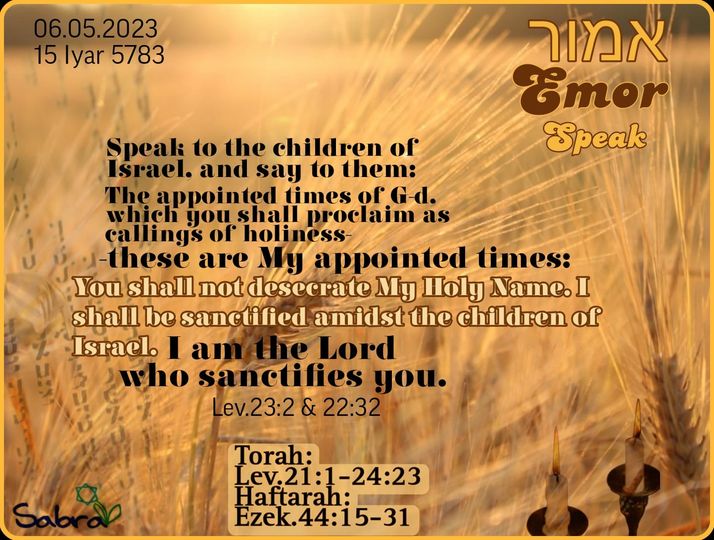
In Judaism, holiness is considered the most important command of the 613 mitzvot in the Torah. In Lev.2:32 God declared to the Israelites, “Do not profane My holy name, for I must be acknowledged as holy by the Israelites. I am the LORD, who made you holy.”
The word ‘holy’ is repeated 3 consecutive times in Scripture (HOLY, HOLY,HOLY) as a literary device to emphasise that holiness is an absolute imperative and not an optional extra that we must apply in our lives without compromise. But above everything, God desires that we choose the path of holiness because we love Him without any manipulation or ulterior motive. It is a choice we all have to make. Some people treat God’s laws as if they were irrelevant and have been replaced by God’s grace. Therefore, we are free to lead any kind of lifestyle however ungodly since God’s grace covers our sin. This is perhaps one of the most dangerous of all biblical distortions!
Where does this all place us? Although we are not in the business of pointing fingers at others, unrighteousness should always be exposed for what it is and we should stand up for truth and righteousness in the fierceness of God’s love. Should we fail to stand up and be counted and, as the sages have taught, to ‘sanctify the name of God’ then who will be left to represent Him? The concept of sanctifying the name of God (‘Kiddush Ha Shem’) is regarded as the highest purpose of the Jewish people (i.e. to represent Him well to the nations) and this is no less true for every believer in Yeshua.
In these exciting yet perilous days we need to occupy our time with the urgency that the season deserves, our lives underpinned by holiness. This is a double edged sword because included alongside the benefits is the cost factor, but the advantages far outweigh the disadvantages. So we gird ourselves with the armour of God, standing firm in the new life provided for us through the shed blood of Yeshua – to experience the reality of what it means to be an overcomer in the beauty of holiness and the power of His Spirit!
Holiness is something we choose both individually and together as a community of believers. Togetherness is a shared obligation. Putting our shoulders under the proverbial stretcher to carry those of our community in need is a godly expression of those who belong to Yeshua. Let me share something about godly unity. The opening verse of Ps.133 begins with the words: “How good and pleasant it is when brethren dwell together in harmony.” Harmony is one thing you cannot do on your own. One may sing beautifully but for harmony we need others.
When Joseph was ruler in Egypt and invited his brothers back for the second time Jacob instructed his sons to bring some gifts (mizmer-at HaAretz – ‘the best fruits of the land’ Gen.43:11) The Sages taught that when the brothers came to Joseph they were to sing him a song, and from this he would know in the fullest sense who they were and how his true identity lay entwined with theirs. Their history as a family punctuated with disharmony and every measure of disunity would be transformed through an amazing series of Divine interventions: darkness to light.
As we draw close to the dramatic conclusion, the sages tell us that when they appeared before Joseph, the brothers began to sing melodies to him in such beautiful harmonies that Joseph broke down completely overwhelmed and revealed his identity to his brothers. Something very startling and significant had occurred. The shattered harmony between the brothers that appeared irrevocable was suddenly restored in a moment. (Gen.45:4)
Here is a different story but it actually contains similar elements. Once when the late Rabbi Shlomo Carlebach was in the USA on a singing tour, a distinguished doctor approached him with a special request:
“I would like to conduct an experiment tomorrow in the mental institution where I am assigned. Can you come and do a concert for the patients? They have not spoken for a half a year and I’d like to see their reactions.”
It was a very sad occasion. He went there and sang some beautiful melodies but with no reaction. Afterwards, he told the doctor,
“You know something? If you don’t mind, would it be possible to pull down the shades to make it dark? Let’s just light one candle and sing,”
Then, something extraordinary happened. There was a girl sitting next to him who was one of the top singers in that part of the country. The doctor said that she hadn’t spoken since she had been admitted, not even a word. Anyway, he was singing next to her when after about seven minutes of darkness, the most unbelievable harmony came out of her. They couldn’t stop singing, it was so beautiful. It is out of the darkest moments in life that some of the most beautiful harmonies are made. But we cannot create them in isolation from others. This is the Gospel’s appeal for us to walk in togetherness.
And even though we as believers sometimes fall short of perfection, the fact remains that there’s no such word as ‘failure’ in God’s vocabulary. He regards us as His special possession not His special failures! That doesn’t mean we will never fail, but when we do so He picks us up and seeks to restore us! This is what it means to ‘fail well’ Failures? Never! More than Conquerors? Yes! Defeated? Never!
Scripture declares that we can do all things through Yeshua who is our strength! No circumstance is beyond the realm of impossibility when we wait upon the Lord and place our hope and confidence in Him. We will run and not be weary; we will walk and not faint as we scale every obstacle in the strength that He provides! Apprehending the love of God will always give us the edge over our enemies. There are people who wage battles through words and actions yet still lose the war. But when we submit ourselves in holiness to the One who is the King of Kings and Lord of Lords, our life is wrecked and we are forever changed! Here is a chassidic story to illustrate.
There were some Jewish parents whose child stubbornly refused to attend Yeshiva or participate in the religious life of the community despite every known coercion or persuasion. Finally in desperation, the parents brought him before a famous rebbe who was making a special visit at the time. The parents lamented their situation and sought his advice. The rebbe looked intently at the boy and in a severe tone of voice said, ‘Just leave him to me for a couple of hours and when you return you will see the difference.’
No-one knew what he did but after his encounter with the rebbe, the boy was transformed and went on himself to become a famous rebbe. Years later, when he was known as the greatest rebbe of his generation, his disciples would sit around him and ask, ‘You are such a great scholar. How did you get your deep insight into the Torah?’ He would simply reply, ‘When did I learn to study Torah? When did I truly learn to study the holy Torah? I learned everything when the great Rebbe, held me silently against his chest.”
What is our response to these things? This is no better illustrated than in another beautiful story from Scripture recorded in Matt.26:7-9 of the woman with an alabaster jar filled with very expensive perfume which she lovingly anointed Yeshua’s head with. Her actions symbolised how the alabaster jar of our lives must be broken to release the precious fragrance of our love for Him. The world is contemptuous of believers who are wholeheartedly committed to Yeshua, but the woman who was an outsider entered the company of Yeshua and became immortalised as a heroine for her selfless act of devotion. Her actions expressed something that words cannot adequately convey: “For all you have done for me I can do no less than give you my all in all just as You did for me.”
Now we can understand why at the beginning of a Jewish wedding, the groom covers his bride’s face. What is he telling her? He is saying, “I am giving over to you all of my love, even when you cannot see me, for I am your covering and I will never leave you nor forsake you.’” These are God’s words for each one of us who chooses to walk hand in hand in the footprints of our Messiah and allows the dust of His sandals to cover us.