We are currently on Day 20 of the Omer counting which is two weeks and six days. And as believers, we use this period of 49 days to reflect upon the events of 2000 years ago at Pesach when Yeshua won our salvation to Shavuot 50 days later when His holy Spirit fell upon the disciples. This is why we count up not down because our life as disciples of Yeshua always progresses forwards rather than backwards.
Blessing: barukh ata, yhva eloheynu, melekh ha-y’kum, sh’hat’sadik otanu be’emuna b’yeshua hamashiakh v’tsi’vah aleynu b’nogea lisfirat haomer.
Blessed are You, Lord God, King of the Universe, Who has justified us by faith in Yeshua the Messiah and commanded us concerning the counting of the Omer.
Verse: “Give unto the LORD the glory due unto his name; worship the LORD in the beauty of holiness.” Ps.29:2
Focus Challenge: Dwelling in unity with God by aligning ourselves to His purposes in love, humility, godliness, obedience and purity, a theme of this week’s parasha.
Prayer: Heavenly Father, help us always to walk in Your perfect ways in the beauty of holiness. Amen.
This week has been a time of great reflection. Tuesday evening commemorated Yom Ha’zikaron, a day of remembrance for Israeli soldiers who gave their lives to ensure the existence of Israel and for victims of terrorism. This year holds even greater solemnity with 59 Israelis still being held captive with a dwindling number still alive. And 24 hours later marked Yom Ha’Atzmaut when Israel’s tears of mourning turned to tears of joy as we celebrated the miracle of the rebirth of Israel on May 14th 1948. Rabbi Yosi Shulam wrote that, “…like everything throughout Jewish history, everything is a mixture of sadness and joy, of tragedy and victory. The men and women and who have fallen for the security and protection of the state of Israel and the survival of the Jewish nation are seen as sacrifices for the homeland that was given to the Jewish nation by the almighty God and creator of the universe Himself.
We have 24 hours of sadness, grief, and sorrow, and at the very end of these 24 hours the darkness and the cloud of grief and sadness lifts and the celebration of our independence breaks out from one end of this country to the other end. The music changes and the dancing in the streets starts. The celebration of the only homeland of the Jewish people on the face of this Earth and on the face of history – the Land of Israel promised to Abraham and given to Israel as an eternal possession by the Creator Himself.
This promise is repeated to Abraham several times, and Isaac, and Jacob. There is no promise of God repeated as many times in the Bible as the promise of the Creator to the people of Israel.
We are grateful and proud to live in Israel and to establish a beachhead not only for the physical restoration of Israel to the Land of Israel, but also for the return of King Messiah Yeshua. The building of the land of Israel and the restoration of the Jewish people back to the Land is a preparation of a homeland and a home for the returning Messiah, Yeshua Son of God, king of the Jews, and the saviour of mankind!”
Let me also share with you another beautiful thought. “The Torah predicted that the Jewish people would be exiled to all corners of the planet (Deut. 29) and also anticipated that, eventually, Jews would return to the land of Israel (Deut. 30). The prophet Isaiah described with prophetic and poetic words how this would take place. Addressing the Land of Israel, he said, “Your sons shall come from afar, and your daughters shall be carried on the shoulders [of their fathers]…”. In that context, he also said (60:8), There will be those who will [return] flying like clouds, and like doves to their nests
The Rabbi of Rehovot, Rabbi Simcha Kook, explained why Isaiah used these metaphors, “clouds” and “doves”, in his prophecy. Because clouds and doves represent two opposite extremes in terms of movement. Clouds are moved by the winds, they do not control their movements. If the wind blows from the north, the clouds will move south, and vice versa. And when the wind does not blow, the clouds would stay where they are.
Doves, on the other hand, have an extraordinary sense of location. Unique! A biological GPS that is still a mystery to science. No other bird possesses a similar orientation sense. It is an instinct that virtually forces them to return to their nest, flying back from anywhere in the world, even thousands of kilometers away. For thousands of years, pigeons were used to send messages from one place to another. When someone traveled from point A to point B, they carried pigeons that were born and raised in A. And then, when they wanted to send a note to A, they would just release that pigeon. And regardless of how far B was from A, the pigeons always found their way back to point A, their nest, and deliver the notes.
Now we can better understand what the prophet Yesha’yahu was saying and seeing in this extraordinary prophecy. When the people of Israel return to their land, there will be Jews who, like clouds, will “fly” (that was the verb incredibly used by Yesha’yahu!) to Israel moved by “winds”, all kinds of winds: political winds, financial winds, winds of anti-Semitism, etc. For Yesha’yahu, all these are “divine” winds that will bring the Jewish people, albeit somewhat ‘by force’, back to their land.
On the other hand, there will always be Jews who, like doves, will come to Israel guided by their internal GPS; they will fly to Israel like someone returning home to their nest. And while clouds are pushed by the winds, doves, in order to reach their nest, sometimes have to fly against the wind.
Eventually, God will help all of us to return to Israel. Some will be driven by the winds of history, while others will return “to their nest” guided by a strong sense of internal direction.” Yosef Bitton -the former Chief Rabbi of Uruguay “What did Isaiah see?”
But every disciple of Yeshua also yearns for the coming of our Messiah Yeshua who will gather us up both Jew and Gentile who will rule and reign with Him from Jerusalem in the Millennium age. Our exile will finally be over and we will be home! The old will be past and the new will begin! We will have finally returned to our nest!
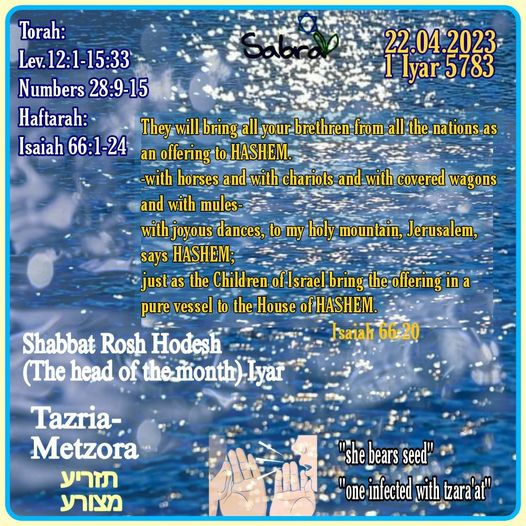
Tazria (She conceives) Lev12:1–15:33;
Lev 12:1–15:33; 2 Kings 4:42–5:19, 7:3–20; Matt.8:1–4, 11:2–6; Mk. 9:14–15
By Raphael ben Levi
This week’s double Torah portion is named “Tazria/Metzora” Tazria means “She conceives” from the root word ‘Zarah’ meaning, “sowing a seed.”
The Bible frequently refers to ‘sowing seed’ since Israel was an agricultural nation and the phrase, appears 22 times in the KJV which is significant. In Gal.6:7-9 and contains several meanings. The Hebrew alphabet is made up of 22 letters, which are used to compose the Word of God. We sow seed whenever we share the Word with others. Paul wrote, Paul wrote, “A man’s harvest in life will depend entirely on what he sows. If he sows for his own lower nature his harvest will be the decay and death of his own nature. But if he sows for the Spirit he will reap the harvest of everlasting life by that Spirit.”
In the Parable of the Sower, the ‘seed’ represents the Word of God which in Ps.119:105 is referred to as, ”… a lamp to our feet and a light to our path.”
God created 22 things in the six days of creation which He spoke into existence by His Word.
Although English translations list 39 books for the OT, the number of inspired books finalised originally by Ezra the prophet and the Great Assembly of 112 was 22. Yeshua quoted from 22 OT books. The last occasion was at His crucifixion as He was being crucified when He quoted from Ps.22 – The Word of God who was crucified for our sins who spoke out with His last breath, “It is finished.” (completed).
The word ‘sowing’ in Scripture is employed as an action rather than something passive.’ No wonder that Yeshua urged His disciples to be good ‘hearers’ (i.e., those who put His words to action – sowing seed). “Shema Israel…” “Hear O Israel” is an appeal for us to apply the words of Torah in our lives – to hear and do.
When Yeshua taught, “He that has ears, let him hear” it was based in those times on the understanding that knowledge of God’s Word came from careful listening, then be memorised and last but not least, put into practice.
The Parable of the Sower (Matt.13.) is about good news that is bad because it explains how one can articulate and present what is good yet still not be heard by others. The Word of God can easily be studiously ignored or misapplied and explains how Yeshua’s generation was so close to devastation even though He proclaimed and demonstrated that the Kingdom of God had arrived.
The main focus of the parable concerns what we must do to earn a place in the good soil. No-one is automatically born in the ‘good soil’, but rather a place we discover by choice. The good soil is where we can experience peace and joy through a living relationship with Yeshua when received by faith. And faith comes through hearing and hearing through the Word of God. (Rom.10:17)
This week’s parasha contain the laws of purity and impurity that remind us about something the church has studiously ignored concerning the Jewish heartbeat of God. From the opening chapters of the Gospel accounts we read how Mary went through the Jewish rite of purification (ritual Mikvah) for 7 days following the birth of Yeshua who was circumcised on the 8th day according to the Laws of Moses, and this was followed by 33 days of ritual purity – a period of isolation to allow for the bonding between mother and child. Here we are presented with a beautiful picture illustrating the principle of setting aside time alone with God.
The gematria of 33 represents the Star of David – the One who is the ‘bright and Morning Star! The name of Elohim is given first mention in the opening verse of Gen.1 (Bereshit bara Elohim et ha shamayim ve’et ha’aretz) that appears 33 times in the account of creation. 33 is also the numeric equivalent of the word “Amen.” (El melech na-aman).
As we know, with everything God creates, Satan seeks to counterfeit and there is another word connected to Tazria which is Tza-arat the name for a skin disease that afflicted people in addition to garments or homes. The most feared form of tsa-arat was leprosy which rotted the flesh and disfigured the body causing incredible pain and was no respecter of persons. A person who was afflicted with tza-arat was required to dwell alone in total isolation outside of the camp. Lev.13:45-46 clearly states that “… the leper in whom the plague is, his clothes shall be rent, and the hair of his head shall go loose, and he shall cover his upper lip, and shall cry: ‘Unclean, unclean [tameh, tameh].’ All the days wherein the plague is in him he shall be unclean; he is unclean; he shall dwell alone; without the camp shall his dwelling be.”
Leprosy was the only disease which rendered a person unclean. Anyone who contracted it would be isolated from the community, shunned and feared. (Lev. 13:45-46) Scripture states that sin is the most serious problem of all problems and compares it to tza-arat because it isolates us from God that ultimately results in death physically and spiritually. The prophet Isaiah lamented that “…All of us have become like one who is unclean, and all our righteous acts are like filthy rags; we all shrivel up like a leaf, and like the wind our sins sweep us away.” (Isa 64:6)
Only Yeshua can cleanse us from our sin. There is no other way. Even as He healed lepers and every other manner of sickness, He is able to save to the uttermost all who come to Him, and present us holy and without blemish to the Father (Heb.7:25) because He is the resurrection and the life!
The account of Miriam’s leprosy in Num.12 connects tza-arat with evil speech (lashon hara). In this passage, “…Miriam and Aaron began to talk against Moses because of his Cushite wife. ‘Has the LORD spoken only through Moses?’ they asked. ‘Hasn’t he also spoken through us?” (vs.1-2)
God’s anger was kindled against Miriam, and He afflicted her with this terrible disease, saying, “Why then were you not afraid to speak against My servant Moses?’ The anger of the LORD burned against Miriam. When the cloud lifted from above the tent, Miriam’s skin was leprous—it became as white as snow. Aaron turned towards her and saw that she had a defiling skin disease. (tza-arat)” (8–10)
Moses interceded for her: “EL na Rafa na la” (Lord heal her) but we must understand that he prayed it as a consequence of her sin. Scripture classifies slander as a type of “moral leprosy,” and the rabbis believed tza-arat to be an affliction from God as a punishment for all forms of destructive communication, (e.g., deception, half-truths, misrepresentation, negative gossip even though it might well be true) The account of Miriam’s leprosy is a cautionary example and warning for us against falling into the same trap ourselves.
In an entirely different context, the Talmud (Sanhedrin 98b) describes the Messiah as the ‘Leper in the house of study.’ It was believed that leprosy was one of the signs that the Messiah had come: “What is his (the Messiah’s) name? – The Rabbis said: His name is ‘the leper scholar,’ as it is written, surely he hath borne our grief, and carried our sorrows: yet we esteemed him a leper, smitten of God, and afflicted.” [Isa 53:4]
The sages claimed that the Messiah Himself would suffer the agonies of tza’arat by taking upon Himself the sins of His people. This ‘affliction’ is described vividly in Isa.53 as one of the worst kinds of torture ever invented – something which the Messiah would endure, so terrible that it was likened to leprosy.
The idea of a Saviour who was stricken with a form of this horrible disease may sound ridiculous! Yeshua healed others but why was He not able to heal Himself? Isa.53:4 provide us with the solution – He chose not to. The Amplified Bible reads: “Surely He has borne our griefs (sicknesses, weaknesses,) and carried our sorrows and pains [of punishment], yet we [ignorantly] considered Him stricken, smitten, and afflicted by God [as if with leprosy].”
We are so defiled by sin that even our righteousness is like filthy rags. “All of us have become like one who is unclean, and all our righteous acts are like filthy rags; we all shrivel up like a leaf, and like the wind our sins sweep us away.” (Isa 64:6) Only the blood of Yeshua, OUR Passover Lamb, can cleanse us from our sin. Just as Yeshua made the lepers pure and whole, He can also cleanse us and present us holy and without blemish to the Father.
When John the Baptist’s disciples came to Yeshua to ask Him if He was indeed the promised Messiah, He answered them with these words, “Go and show John again those things that you hear and see: the blind receive their sight, and the lame walk, the lepers are cleansed, and the deaf hear, the dead are raised up, and the poor have the good news preached to them and are acquitted. And blessed is he, who shall not be offended by Me.” (Mat.11: 4-5)
Our God is a God of miracles who sometimes uses those who the world considers are ‘lepers’ to be the very agents of good news and deliverance to others; the weak, the foolish, the insignificant, in order to demonstrate God’s sovereign power.
What caused the downfall of the world? Jewish sages claim it was two things. The first was that Eve ate, and gave Adam to eat, the forbidden fruit giving entrance to sin. Yet, they were not driven out from Paradise at that moment but when God asked Adam and Eve, ‘What’s going on here?’ Eve should have jumped up and said, ‘I’m sorry. It was all my fault.’ Adam should have said, ‘I’m sorry. It was my entire fault. I should have told her better.” If they had repented immediately instead of making excuses for their actions, how would God have responded?
The late rabbi Shlomo Carlebach posed a question, “What is the first sign of people loving each other? That they cover for each other. A house is a cover. Loving somebody is a cover. The beginning of a chupah, of a marriage, is that the husband covers the face of the bride. He is telling her, ‘I won’t be like Adam who said, “Eve did it.” I’ll cover for you.” Yom Kippur is the Day of Covering… “He who dwells under the shelter (chuppah) of the Most High shall abide under the shadow of (covering) of the Almighty.” (Ps.91)
The Bible describes the relationship between God and His people amid their ups and downs, successes and failures, victories and defeats – full of stops and starts, with One who intervenes to redeem a world from self destruction, because He is a God who has provided a covering for us through Yeshua. The word in Hebrew for ‘cover’ is ‘kaparah’ also translated as ‘atonement.’ We read in Ps. 32: “How blessed are those whose offence is forgiven, whose sin is covered!”
Even as the downfall of the world was caused by the entrance of sin, so it’s redemption was achieved by the One who was sinless, our precious redeemer and Lord who although “…knew no sin became sin for us that we might become the righteousness of God.” (2Cor.5:21)
In the fullness of time, God provided humanity with the solution to the pollution. Every person falls short of the glory of God because it is stained with its fingerprints within our DNA. But, just as Yeshua healed the lepers, so too He is able to heal that which appears unredeemable and save to the uttermost all who come to Him, and present us holy and without blemish to the Father. This is indeed a good place to be! Scripture describes it as a life changing event akin to being ‘concealed in the folds of God’s tent’ (tabernacle) where He provides us with a safe space alongside a sure hope that is like an anchor for our souls. And as we read in Isa.40:31: “…those who hope in Adonai (or,’wait upon the Lord’) will renew their strength, they will soar aloft with eagles’ wings; when they are running they won’t grow weary, when they are walking they won’t get tired.”
This verse has been a source of encouragement and inspiration for countless believers over the ages. When faced with insurmountable challenges and impossible situations, God provides this iron-clad promise which has stood the test of time.
When we consider the word ‘hope’ as it’s translated into English (or sometimes, to wait upon) it is easy to miss the true sense of the original Hebrew meaning (kove’ya) which provides us with something that’s active rather than passive.
Hope has a literal and figurative meaning as with many words in the English language. In the literal sense, it means, “to bind together like a cord” reminding us of Eccles. 4:12: “… a cord of three strands is not quickly broken.” In other words, kove’ya is literally being in complete union with the Lord.
Figuratively, kove’ya conveys to us the active sense of anticipation. What we have here is the potential for every believer to grow strong in the power of His might when one chooses to walks in His ways! This hope is substantial well beyond merely a set of ideas or propositions.
There are times in everyone’s lives when our strength needs to be renewed in God and is often HIs way of nudging us so that we can learn better to depend on Him in all things at all times. Sometimes, this can be painful as the apostle Paul experienced when he cried out to God at one point in despair whether by a physical affliction or something else, but God replied, “My grace is sufficient for you, for My strength is made perfect in (your) weakness.” (2 Cor.12:9)
But there is something else of importance in all of this. God tells us that He has His perfect plan for our lives in all things (All things work together for good…):
“For I know the plans I have for you,” says the Eternal, “plans for peace, not evil, to give you a future and hope—never forget that. 12 At that time, you will call out for Me, and I will hear. You will pray, and I will listen. 13 You will look for Me intently, and you will find Me. 14 Yes, I will be found by you,” says the Eternal, “and I will restore your fortunes and gather you from all the nations where you’ve been scattered—all the places where I have driven you. I will bring you back to the land that is your rightful home.” (Jer.29:11-14)
The prophet Jeremiah shared this beautiful promise for Israel given during a harsh season of Divine judgment that had sadly fallen on deaf ears. Who could have imagined that even in the darkest moments of exile through disobedience to God’s Torah, God gave him Him a prophecy to generate a message of immense comfort and encouragement? And who would have dared hope that this Divine promise would ever reach fruition? It took a while – 70 years, but in the fullness of time, God honoured it. His eternal purposes continued to roll forward leaving in its wake a battlefield of twists and turns and unfulfilled dreams for many.
It is an easy thing for us to forget these things especially whenever everything seems to be going wrong! This is why God underlined the point repeatedly to the Jewish people: ‘Never forget!” It recalls things from both a negative and positive vantage point. For example, as the Jewish people annually commemorate Holocaust Memorial Day (Yom ha-Shoah) every effort is made to ensure that this unimaginable tragedy will forever be remembered and preserved for future generations – we will never forget! The deeper layer of all this is that God may sometimes appear hidden yet is closer than we dare imagine even in the most hideous catastrophe, for those with eyes to see and faith to believe. How much more can we also treasure, preserve and recall His everlasting positive and over-riding purposes for our lives amid the imponderables and paradoxes of life?
Remember that today is your moment when the words of God may come to fruition sooner than you may think! He has spoken: “For I know the plans I have for you,” says the Eternal, “plans for peace, not evil, to give you a future and hope – never forget that.”
As God’s children, let’s stretch forward and collect all the negative pieces of wretchedness in one pile and make a bonfire and receive HIs peace and joy that passes all understanding that will keep our hearts and minds in the knowledge and love of God through Messiah Yeshua!.