We are currently on Day 15 of the Omer counting which is two weeks and one day. We use this 49-day period to reflect upon some major events of 2000 years ago that have shaped our lives from Pesach (redemption) to Shavuot (Giving of the Law at Mt. Sinai and the Acts2 event) – and everything in-between. Perhaps the most significant has been the return of the Jewish people to their Homeland that the prophets stated would introduce the birth pangs of Messiah’s return.
The Torah states that the Jewish people would at a particular time in history be exiled to all corners of the planet (Deut. 29) which followed the destruction of the 2nd Temple in 70AD and shortly thereafter following the Bar Kochba revolt in 132AD. But in the next chapter it states how eventually the Jewish people would return to their Homeland. The prophet Isaiah stated in Isa.60:4 that, “Your sons shall come from afar, and your daughters shall be carried on the shoulders [of their fathers]…”. Just a few verses later he described how the return of the Jewish people would comprise of those “flying like clouds and like doves to their nests” (60:8).
Our sages explained that Isaiah used the metaphors, “clouds” and “doves” in his prophecy that represent two opposite extremes of movement. Clouds are moved by the winds and do not control their movements. If the wind blows from the north, the clouds will move south, and vice versa. And when the wind does not blow, the clouds will stay where they are.
Doves, on the other hand possess an acute sense of location similar to pigeons possessing a biological GPS that is still a mystery to science. No other bird possesses such an acute sense of orientation – an instinct that virtually forces them to return to their nest, flying back from anywhere in the world no matter how far it may be.
So in context, Isaiah was speaking in relation to the manner in which the people of Israel would return to their land. There would be Jews who, like clouds, would literally “fly” to Israel (Hebrew- “TAS” – the actual verb used by Isaiah long before aeroplanes had been invented), moved by “winds”, all kinds of winds: political winds, financial winds, winds of anti-Semitism, etc. For Isaiah, all these are Divinely orchestrated winds prompted (or coerced by God) that will bring the Jewish people back to their land.
Alternatively, there will be Jews who, like doves, will come to Israel guided by their internal GPS; they will fly to Israel like doves returning home to their nest. And although clouds are pushed by the winds, doves sometimes have to fly against the wind in order to reach their nest.
Eventually, God will enable all the Jewish people to return to Israel. Some will be driven by the winds of history, while others will return “to their nest” guided by a strong sense of internal direction.
Every believer also yearns for Yeshua’s return when on this occasion He will gather us up Jew and Gentile to rule and reign with Him. Our earthly exile will finally be over and we will dwell forever in our eternal home! The old will be past and the new will begin!
=============================================================
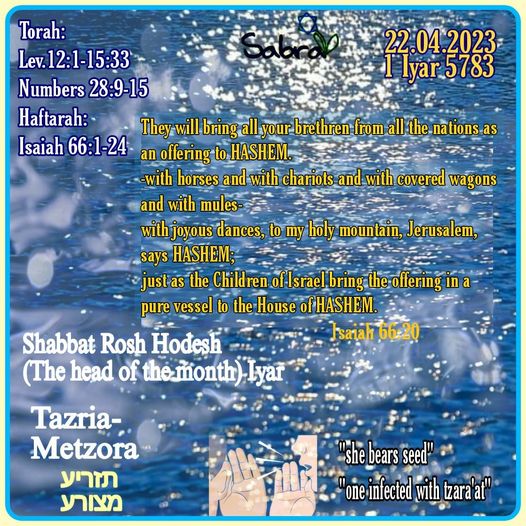
Tazria (She conceives) Lev12:1–15:33; 2 Kings 4:42–5:19, 7:3–20;
By Raphael ben Levi
This week we have a double Torah portion; “Tazriah” which covers when a woman gives childbirth, and “Metsora” which speaks about “Tzara-at” which most Bibles interpret as “leprosy” although the word “Tzara-at” includes all skin afflictions and diseases, including leprosy. We will see how both portions are closely related.
Lev.12 covers childbirth, where a woman is considered unclean and is confined to her tent, for 7 days plus 33 days, altogether, “40” days with “40” representing the number for testings and trials. Why, we might wonder, should a woman be rendered “unclean” simply because of giving birth? It is obviously not anything sinful to give birth, but rather the opposite – a wonderful blessing!
Some rabbinical midrashim (commentaries) state that there is both “death” and “life” during childhood. “Life” is the new baby, yet “death” because the woman loses blood symbolising life.
The child is in the womb for 9 months, which is a protected area, and a world in itself. When the baby is born he/she enters a new world in contrast to where he/she had been experiencing life both inside the womb and outside of it, yet the child comes forth with the sin nature, and the sin nature brings death.
As a type and shadow, Yeshua’s blood was shed during His crucifixion causing His death, just as a woman who loses blood through childbirth, symbolises death. Yet He rose again, from the grave bringing “life” and “hope” to humanity. The woman births a baby, representing “new life” – yet new life with a sin nature, which brings death. But through Yeshua’s death and resurrection, the curse of sin has been broken.
Lev.12:2 states that, “If a woman has conceived seed, and born a man child; then she shall be unclean 7 days.”
In Hebrew, it reads; “Isha Ki Tazria V’yaldah Zakhar V’tamah Shivat Yamim.” Within these 8 words, we find the letters that spell out “Yeshua!” Also, when we take the first letters of the first 5 words; “Isha Ki Tazria V’yalda Zakhar” (Aleph) (Kaf) (Tav) (Vav) (Zayin), counting the gematria value of each initial letter for every word, we get “434”. One of the titles of Yeshua is “Mashiach Ben David” The gematria value of “Mashiach Ben David” = 424. Almost the same, the difference is “10”. What is “10” in gematria? It is the letter “Yod” (hand). What did Yeshua, who is Messiah Ben David do on Calvary? He stretched forth his hands to receive the nails, to pay in full our sin debt.
Central to Tazriah is to the concept of ritual purity, a theme that runs deeply throughout Leviticus. It addresses the status of the Israelites individually where purity was a requirement, and also outlines how to restore purity whenever needed. This underscored the importance for both the physical and spiritual wellbeing of a person – body, soul and spirit, that enabled someone to live in close relationship with God.
The rituals in Tazria may appear a little obscure but they contain types and shadows that all point to Yeshua. The process of purification represents redemption, a prime focus of Yeshua’s teachings who offers us spiritual cleansing that over-rides the limitations of the Temple sacrificial system.
In this sense, the laws of Tazria contained in Leviticus were in anticipation of the ultimate purification and atonement that Yeshua embodied, underscoring the message of Divine grace and redemption that runs as a seamless thread throughout Scripture. Anyone who ignores this will bypass any true understanding of God’s eternal plan, past, present and future!
The Bible frequently refers to “Zarah” as an interesting root that in fact originates from the word “Metsora” literally meaning, “sowing seed” something that was easily understood by the Israelites who were an agricultural nation. But the word Metsora is additionally used metaphorically. For example, in addition to the meaning “infected one” it could also refer to growth and multiplication representing the beginning of something that would grow and bear fruit. Overall, the spiritual meaning of “seed” in the Bible represents the power of God’s Word to transform lives, the importance of sowing good seeds through righteous living, and the promise of a bountiful harvest for those who faithfully live in close relationship with the Lord.
Scripture states that “we sow in order to gain a harvest” and “what we sow we shall reap”. Scripture states how a tiny seed has the potential to grow into a mighty tree, and if we had the faith of even a mustard seed, the smallest of all seeds, we would possess the authority to move mountains!
Our faith and actions can have a powerful impact when nurtured and cultivated in the right environment as illustrated in Yeshua’s Parable of the Sower and the Seed In Matt.13. An important purpose of the parable explains what we must do to ensure that we ultimately earn a place in the good soil. No-one is automatically planted in the ‘good soil’. We have all experienced spiritual exile (dwelling in the barren wayside, the shallow soil, or the place where we are choked by the deceptiveness of the world – places we dwelt in before being re-born by the Holy Spirit of God. Scripture is replete with examples of people who started well but ended badly and even some who started badly but ended well. But every disciple of Yeshua must stand against any distraction of the world that seeks to entrap us? This is of great importance in particular in these end times when as Yeshua prophesied the “love of many believers would grow cold.” (Matt.24) Paul wrote in Gal.6:7-9, “A man’s harvest in life will depend entirely on what he sows. If he sows for his own lower nature his harvest will be the decay and death of his own nature. But if he sows for the Spirit he will reap the harvest of everlasting life by that Spirit.”
Yeshua often emphasised the importance of ‘sowing’ in terms of ‘doing’ what the Word of God teaches based upon the core value of loving Him with all our heart, mind and strength. This was facilitated through being familiar with Scripture – knowing what the Word of God taught. In Yeshua’s day, this came primarily from listening to it being read aloud in the synagogue or at school where it would be memorised and formed the basis of a person’s education. Torah scrolls were handwritten and were so scarce they would only be available in the synagogue.
The word “Metzora” originates from 2 words; “Motzi-Ra” meaning; “One who speaks (or brings forth) slander or evil against another.” Metzora or one with a tza’ra’at (skin disease) can be compared to an affliction caused by the spread of malicious gossip or slander. This particular type of gossip differs from lashon hara literally meaning an “evil tongue”. Metzora is when one spreads lies in order to defame or hurt another person. In contrast, Lashon hara is general gossip where true speech is used for a wrongful purpose, which is still nonetheless destructive.
The Sages associated tsa’ra’at’ (skin disease) with leprosy (even though it had a wider application) as a suitable punishment for the sins of slander and malicious gossip, to emphasise it’s seriousness in the sight of God. Slander and malicious gossip were compared to leprosy because it was highly contagious.
There is also a connection between the laws of leprosy and the dietary laws that teach us to be as scrupulous about what comes out of our mouths as what goes into them. In light of this we can better understand Yeshua’s words when He said, “it is not what goes into the mouth that defiles a person, but what comes out of the mouth; this defiles a person” (Matt.15:11)
In context, He was not referring to food, although many people wrongly interpret it as such. Rather He was making the point that we should not only avoid speaking evil, but also deal with problem areas within us that need healing and sanctification.
Every leper had to live in isolation OUTSIDE the camp and cover his/her MOUTH, shouting loudly, “tamei, tamei”, (“we are ritually unclean”) whenever they saw others from a distance. Leprosy was the only disease which rendered a person unclean. Anyone who contracted it would be isolated from the community, shunned and feared. (Lev.13:45-46) because it was no respecter of persons – rich, poor, king or pauper – leprosy was a terminal affliction for which there was no cure.
Yet, throughout the NT, Yeshua miraculously healed many lepers. The Gospel of Mark speaks of an incident when “… a leper came to (Yeshua), imploring him, and kneeling saying to him, ‘If you will, you can make me clean.’ Moved with pity, he stretched out his hand and touched him and said to him, ‘I will; be clean.’ And immediately the leprosy left him, and he was made clean.” (Mk.1:40-42) So when Yeshua healed a leper no-one could dispute that it was a miracle (although the religious hierarchy claimed that He did so under the power of Beelzebub, the prince of demons – which in context defines blasphemy of the H.S.)
Yeshua healed many people in His day from all manner of physical afflictions and conditions for which there was no cure. But He always went beyond external needs to a person’s need for inner healing. Take the instance when a paralysed man was brought to Yeshua in Mk.2:5). The people wanted Yeshua to heal him, but instead Yeshua declared: “Son, your sins are forgiven” Those who were standing by were offended and in their hearts thought: “Who can forgive sins? Only God can do so.” They accused Yeshua as being blasphemous and Yeshua knew it, so He asked them: “What’s easier to say? ‘Son, your sins have been forgiven’, or ‘Your sickness has been healed?” Then He addressed the paralytic and told him,”Your paralysis is cured. Get up and walk.”
So as they could not dispute that Yeshua held authority to forgive sins, He also healed the paralysed man:
“’I say to you, rise, pick up your bed, and go home.’ And he rose and immediately picked up his bed and went out before them all, so that they were all amazed and glorified God, saying, ‘We never saw anything like this!’” (Mk. 2:11-12)
Tractate Sanhedrin 98b contains a midrash (a commentary or exegesis) from Isa. 53:4: “ What is his (the Messiah’s) name? The school of R. Shila said: His name is Shiloh, for it is written, ‘until Shiloh come.’(Gen.49:10) – ‘10 The scepter or leadership shall not depart from Judah, nor the ruler’s staff from between his feet, until Shiloh [the Messiah, the Peaceful One] comes to Whom it belongs, and to Him shall be the obedience of the people.’) The Rabbis said: His name is the ‘leper scholar, as it is written. ‘Surely He has borne our grief and carried our sorrows yet we did esteem Him (as) a leper, smitten by God, and afflicted.” So here is a description of the Messiah using this extraordinary term, the ‘Leper scholar.’
The sages believed that the healing of ‘tsar-arat’ was a sign that the Messiah had come: “What is his (the Messiah’s) name? – The Rabbis said: His name is ‘the leper scholar,’ as it is written, surely he hath borne our grief, and carried our sorrows: yet we esteemed him a leper, smitten of God, and afflicted.” [Isa 53:4]
According to the sages, the Messiah would suffer the agonies of tza’arat by taking upon Himself the pain and punishment (sins) of His people who lived in (spiritual) exile. Scripture clearly states that the Messiah would be afflicted by God – akin to suffering leprosy though infinitely worse – something He did when He bore our sins on the crucifixion stake. “God demonstrated His love for us that whilst we were sinners Messiah Yeshua died for us.” (Rom.5:8)
The concept of the Messiah who would bear our iniquities as described in Isa.53, and be stricken with a form of this horrible skin disease is puzzling. Yeshua healed all who were oppressed by the devil but why was He not able to heal Himself? Isa. 53:4 states that, “…surely He bore our grief.’’ The Hebrew word for grief is ‘sickness’ that’s connected to the word for tza-arat. The Amplified Bible is explicit: “Surely He has borne our griefs (sicknesses, weaknesses,) and carried our sorrows and pains [of punishment], yet we [ignorantly] considered Him stricken, smitten, and afflicted by God [as if with leprosy].”
Unredeemed humanity is so defiled by sin that even our righteousness is like filthy rags to the One who is entirely holy. Isai.64:6 states that “…all of us have become like one who is unclean, and all our righteous acts are like filthy rags.” We are all spiritual “lepers” who need the cleansing power of God’s redemption which God has provided through Yeshua.
Yeshua our Passover Lamb is alone able to cleanse us from every sin and defilement. Just as He healed the 10 lepers, (Lk.5:12-13), so He presents all true believers holy and without blemish to the Father for:
“He himself bore our sins in his body on the stake, so that we might die to sins and live for righteousness—by his wounds you were healed.” (1Pet.2:24)
How can we respond to such a thing? There is surely nothing we can give unto the Lord that can ever match His gift of Divine forgiveness? But God views things from a different lens because He looks beyond our natural abilities to our heart and motives just like the unnamed woman who anointed Yeshua’s feet with the most precious ointment, and dried them with her tears. It was a kiss that drew the attention of the Divine. And it was in that spontaneous moment that He spoke tenderly to her with a glance containing unspoken words. And for those in His presence who looked on in disdain He explained to them, “She poured perfume on my body beforehand to prepare for my burial”. This woman, scorned by the company who surrounded her, alone understood the prophetic nature of her actions.
Soon, the Bridegroom will return for His bride, and every true believer will be gathered to Him with a loud shout from the Heaven and a piercing sound of the shofar. The time of betrothal will have ended and every disciple of Yeshua will enter their eternal inheritance with joy unspeakable. No more tears of pain or sorrow crushed within the crucible of affliction, but we will declare; “7 I have fought the good fight, I have finished the race, I have kept the faith. 8 Finally, there is laid up for me the crown of righteousness, which the Lord, the righteous Judge, will give to me on that Day.” (2Tim.4:7-8)
Our God is not only a God of miracles, but frequently uses those who are rejected and treated as ‘lepers’ by humanity to be the very agents who bring good news and deliverance to others; the weak, the foolish, the insignificant, and the despised of this world, to demonstrate His power and sovereignty.
As a final thought, let me share a short reflection from the late Shlomo Carlebach who posed the question, “What caused the downfall of the world?” And quoting from the Jewish sages, he identified two things. The first was that Eve ate, and gave Adam to eat the forbidden fruit giving entrance to sin. This is something we all know. Yet, he claimed that they were not driven out from the Garden of Eden at that moment but when God asked Adam and Eve, ‘What’s going on here?’ And he concluded that Eve should have jumped up and said, ‘I’m sorry. It was all my fault.’ And Adam should have said, ‘I’m sorry. It was my entire fault. I should have told her better.” Shlomo suggested that maybe had they repented immediately instead of making excuses for their actions, God may have responded differently?
It is a quaint thought, but he failed to understand that sin is sin no matter how small or big it may appear and sin had found entrance into the world that only God could provide the solution to.
Yeshua is our “Tikkun Olam” (Repairer of the world) and, therefore, our hero among heroes who we alone make our boast in, worthy of all honour, power, dominion and strength! So let us fix our eyes upon Yeshua, the “Author and Finisher” of our faith, who enfolds us in His arms of love and irrevocably transforms our lives!