Parsha Yitro – Ex.18:1-20:23; Isai.6:1-7:6; 9:5-6 Matt.5:8-20
By Raphael ben Levi
This parasha initially gives Jethro the Midianite, Moses’ father-in-law centre stage and reveals how Moses is impacted by his wise counsel which is amazing – God sent Jethro the Midianite who were the enemies of the Israelites and in alliance with the Amalakites at just the right time to Moses bringing with him Moses’ family who he had cared for in his long absence: “Now Moses had sent his wife, Zipporah (bird), and her two sons back to Jethro from Egypt, and Jethro had cared for them in his long absence. Moses had named one son Gershom, because as he said, “I have lived as an outsider in an unfamiliar land.” 4 Moses had named the other son Eliezer, for he said, “My father’s God was my helper, and He rescued me from Pharaoh’s sword.” 5 Jethro (Moses’ father-in-law) brought Zipporah and her two sons into the desert to meet Moses when he and the people of Israel were camped near God’s mountain.”
During this period the fame of Israel had spread throughout the region how God had delivered and performed amazing miracles for the Israelites. The surrounding nations were terrified knowing they could not stand against Israel yet they never made any attempt to establish diplomatic relations or better still to turn from their pagan practices and embrace YHVH as their God. Yet there were some individuals like Jethro who did – who abandoned their pagan life and culture and aligned themselves instead to the God of Abraham. Isaac and Jacob.(18:12-24)
When Jethro arrived, Moses offered him hospitality in accordance to the Jewish custom of that day. Then, we read something interesting:
13 The next day, Moses sat to judge the people, and they stood around Moses from morning till evening. 14 When Moses’ father-in-law saw all that he did for the people, he said, “What’s this you’re doing to the people? Why sit by yourself, alone, with all the people standing around from morning until evening?”
15 Moses answered his father-in-law, “It’s because the people come to me to inquire of God. 16 When they have an issue, it comes to me, and I judge between a man and his neighbour, so I make them understand God’s statutes and His laws.”
17 But Moses’ father-in-law said to him, “What you’re doing is no good. 18 You will surely wear yourself out, as well as these people who are with you, because the task is too heavy for you. You cannot do it alone, by yourself.
Had not God equipped Moses with supernatural strength and authority as we saw throughout his encounter with Pharaoh to fulfil that which he had been commissioned and entrusted with by God? Yes He had. So what was different in this case? Simply that there are occasions when our lives are defined by walking in a special commissioning for a special task alone and other times not so. The evangelist Rhinehard Bonke is a case in point who was commissioned by God to evangelise Africa and was apparently number 4 on the list after 3 others before him had declined. And following this he led millions to the Lord, At first he functioned alone but soon with vast numbers attending his crusades, he established a huge team around him who assisted and shared the work load which he would have been unable to do alone. Jethro the Midianite clearly understood an important principle.
The Midianites were descendants of Abraham and his concubine Keturah, but were the enemies of Israel. But here we see something that was in every sense different. Jethro, a Midianite priest, offered Moses safe refuge for a period of 40 years when he fled Egypt, and additionally blessed him with a wife, Zipporah his very own daughter, displaying honour and favour according to the culture of the times. Why would Jethro, a pagan Midianite act with such kindness towards Moses and treat him like a son rather than an enemy? Although we don’t exactly know the reason, we see how God’s blessing upon Jethro was now reciprocated in even greater measure because those who bless Israel will themselves be blessed!
Moses embraced Jethro into the family of God where he discovered a place of belonging and honour among God’s chosen people. His past as a pagan priest was behind him, the promise of a sure hope and future lay before him! The Egyptians who cursed Israel never regained their status as an empire, and their heroes are forever forgotten but one man, Jethro, who blessed Israel would be blessed and immortalised. So, Jethro shared the following advice to Moses:
19 Now listen to my voice—I will give you advice, and may God be with you! You, represent the people before God, and bring their cases to God. 20 Enlighten them as to the statutes and the laws, and show them the way by which they must walk and the work they must do. 21 But you should seek out capable men out of all the people—men who fear God, men of truth, who hate bribery. Appoint them to be rulers over thousands, hundreds, fifties and tens. 22 Let them judge the people all the time. Then let every major case be brought to you, but every minor case they can judge for themselves. Make it easier for yourself, as they bear the burden with you. 23 If you do this thing as God so commands you, then you will be able to endure, and all these people will go to their places in shalom.”
I want to share two points revealed in the text. One is clear and the other is implied (a remez). The first is that there is always a danger for leaders to overreach themselves because it’s easy for one to think of oneself as being indispensable, and perhaps Moses was in danger of doing this. This is a subtle lie of the enemy and should we buy into that false paradigm, we will eventually fall into pitfalls of destructive influences that is a consequence of going beyond the limits of our calling. Only God is indispensable!
The second point is one that’s easily overlooked. Things had changed for Moses because now his wife and sons were returned to him and he had a family to consider. This has been the error of many missionaries zealous for the Lord who have ended up spiritually bankrupt due to placing their ministry before their family (‘for the sake of the Gospel’). I have observed this first hand.
One example I am reminded of was when we were in South Korea. Korean missionaries are known for being willing to serve in remote places no others are willing to go, something noble and commendable in principle. But sometimes they would mistakenly confuse sacrifice with spirituality. For example, husbands and wives would think nothing of serving as missionaries separately in entirely different continents for extended periods. Their children would often be given a low priority and neglected them ‘“for the sake of the Gospel” which unsurprisingly resulted in serious backlashes. Their parents would be too busy “serving the Lord” than to provide their children with the love and support they needed.
Some Korean MK would be dumped into what became known as ‘Alternative Schools’, private boarding schools sponsored by Christian organisations primarily for children of missionaries. These schools’ basically function as spiritual hospitals for many who had been negatively affected as MK’s.
Here is a short extract by way of illustration from an interview I conducted whilst serving as Principal of a Korean High School. This is what a student shared with me:
“My family moved to Botswana as missionaries and this is where my life started to get built. As you all know, missionaries do not live luxurious or comfortable lives even though they work for God. During my adolescence, I resented the fact that my parents were missionaries and I wanted the freedom to be in the world and to have some fun. I was shy and did not have a very outgoing personality. I did not have the courage to talk or to be around people and so spent most of my time alone.
I was teased a lot in Botswana. They liked to tease the Asians, making fun of my appearance and taunting me. As a result I lost my self-confidence. I did not know how to respond because I was young but I began to harbour anger towards the black people for what they were doing to me.
I experienced hard times in school when I was in Botswana but also at home. Since my parents were missionaries, there was a constant stream of visitors at my parents’ house. The house was always noisy and busy with people and I had responsibilities offering hospitality to our guests. I hated doing this and I resented having people constantly making demands on my parents and interfering with the quality of our family life. We rarely spent any time together and I started to hate my parents for being missionaries.
I also began to resent my parents and blame them for all my troubles. Since they were missionaries, they did not spend much time with me. I hated living in Botswana. I hated the environment, the heat, the dry climate, the dusty terrain, the lack of places to play and the sheer boredom of life! I hated my school with poor facilities and no friends; I hated my parents because I felt that they did not care for me. I just did not like my life and I turned into a cheerless teenager who just wanted to leave Botswana and to leave my family.”
Fortunately the story ended well for this student but there were many occasions when it didn’t.
In contrast, the consequences of Moses’ response to Jethro became a pivotal point and a landmark in the development of Israel’s judicial system. Moses humbled himself and adopted the godly wisdom of his father-in-law rather than rejecting it through pride. As for Jethro, he was embraced into the family of God where he discovered a place of belonging and honour among God’s chosen people.
It’s interesting that Moses’ two children are mentioned in our parasha in passing. They named their first son, Gershom (‘foreigner’ or ‘sojourner’) and the second, Eliezar (‘my God helps’) Yet in the names of the two sons we see hidden in plain sight something of importance. The name ‘Gershom’ speaks of something beyond the fact that he was born in the land of Midian. The name ‘Eliezar’ means ‘my God helps’ and when they are brought together, something significant is revealed. These two Midianites both qualified to enter into covenant relationship with God. The children who were half Jew and Gentile through their parents (Moses and Zipporah) serve as a prophetic illustration when 1500 years later both Jew and Gentile, would be united through Yeshua as prophesied in Hos.1:10, and quoted in 1Pet.2:10: “Once you were “not a people,” but now you are “God’s people.” You were shown “no mercy,” but now you have been shown “mercy.”
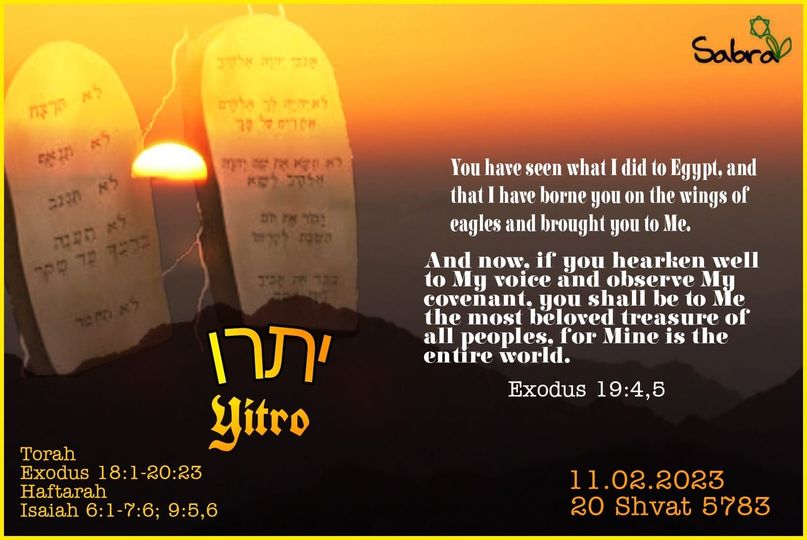
Our Torah portion for this week covers the giving of the 10 Commandments (or ‘utterances’) to the Israelites that were written by the ‘finger of God,’ an event that became a watershed which separated God’s covenant people from the pagan nations. The 10 Commandments are usually seen as two sets of five laws, the first one dealing with relationships between us and God, and the second focusing on the relationship between us and other people. The tenth commandment is the most important. All the others are physical acts of ‘dos’ and don’ts’ but the 10th commandment is an attitude of the heart. Yeshua made this point when he stated that hating another person is the same as committing murder (Matt 5:21) or lusting in one’s heart is the same as committing idolatry or adultery. (Matt 5:27)
The giving of the Torah was not a private affair confined to a small elite or group. The whole nation was included and each person was commanded to prepare and sanctify themselves. Three days before God spoke from Mount Sinai, the nation as a whole, including the mixed multitude from Egypt gathered, heard God’s voice and saw the mountain shake and smoke with fire. This was one of the most dramatic and significant events in the entire Tanakh. A whole nation – 600,000 men between the age of 20-50, their wives and children, their hand maids and servants, the Gentile who accompanied them out of Egypt, heard God’s voice audibly from the mountain, each according to their language and dialect. It was a terrifying sight and a perfect prophetic shadow of the flames of fire that fell upon 120 Jewish believers, who had gathered in the Temple courts as instructed by Yeshua 10 days before Shavuot (Pentecost). The power of God fell and they began to speak in tongues in languages that the multitudes who had gathered from all nations could understand – a mixed multitude. This was the Acts 2 event that turned the world upside down and changed history but with one important difference. At Sinai, God established the Israelites as a nation and a people – His people – but their failure to live up to the terms of the covenant opened the way for God to offer salvation to both Jew and Gentile!
God was not taken by surprise. He knew that the Israelites would not be able to fulfil the terms given to hem: “…now if you will pay careful attention to what I say and keep my covenant, then you will be my own treasure from among all peoples, for all the earth is mine; and you will be a kingdom of cohanim for me, a nation set apart.” (19:5-6)
Israel fell short – the best among the nations of the world – so although they would remain His treasure (‘segulah,’) because of His covenant promises through Abraham, Isaac and Jacob, the priesthood, would be extended to the whosoever. 1Peter 2:6: “But you are a chosen generation, a royal priesthood, a holy nation, His own special people, that you may proclaim the praises of Him who called you out of darkness into His marvellous light;”
God made a conditional promise to Israel where there was no room for a hybrid version but this is wrongly linked within Judaism to any Jew who converts to become a follower of Yeshua which they consider to be the unpardonable sin.
So, here is the context. The thinking within Judaism is that even when one Jewish person converts to Christianity it is considered as breaking covenant with God thereby bringing into jeopardy the very promise made by God to Israel in ch.19:5-6: “Now if you (Israelites as a community) will pay careful attention to what I say and keep my covenant, (separate yourselves) then you will be my own treasure from among all peoples, for all the earth is mine; and you will be a kingdom of cohanim for me, a nation set apart.”
It is a collective promise and therefore has to be understood collectively. Although we may rightly oppose this faulty and unbiblical rationale we can at least understand the logic behind it. Sadly, it is based on the false premise that converting to Christianity is to shed one’s Jewish identity. But it is not man-made traditions of the Church that have shaped and characterised christianity throughout the millennia which Messianic believers embrace. It is rather the biblical truth which celebrates Jewish identity wherein we find our fulfilment through a living relationship with a living God through our Jewish Messiah!
We cannot escape this reality except through denial which is why Messianic Jewish believers see themselves as completed Jews who embrace their Jewish heritage instead of abandoning it. And yet they are refused acceptance for making Aliya on the basis that they are no longer considered Jews. I suppose under those conditions, Yeshua and any of the early Jewish believers would also be rejected!
The Haftarah portion from Isa.6 continues with the theme of identity by emphasising the importance of a life characterised by holiness measured against the true character and nature of God’s absolute holiness. Religious enthusiasm without holiness simply becomes fanaticism. Sadly, the Haftarah portion skips the messianic prophecy of ch.7:14-16 and it doesn’t take much imagination to understand why: “14 Therefore the Lord Himself will give you a sign: Behold, the virgin shall conceive and bear a Son, and shall call His name Immanuel.”
The fulfilment of this prophecy was through Mary the mother of Yeshua: “Jewish sages believed that women would be the first to receive the teachings of the Messiah. While Yeshua taught many women, we know from Scripture that another Miryam became the first eye-witness to Yeshua’s resurrection from the dead — the absolute sign of Yeshua’s Messiahship and victory over sin.”
In Mark 16:9 we read, “Now after He had risen early on the first day of the week, He first appeared to Miryam of Magdala, from whom He had cast out seven demons.” In a culture where women witnesses were not thought to possess credibility, this is an extraordinary event that the Ruach HaKodesh wanted to communicate.
Yeshua has made a way for us so that instead of being consumed by His absolute holiness – His ‘consuming fire’ of judgment – that same consuming fire becomes a means of purification that cleanses us from sin. Yeshua invites us to come into the presence of Almighty God, through His redemption! Yes, our God is ‘a consuming fire’ (Deut.:24) but in His amazing love, compassion and mercy, He has made a way for us to be reconciled to Him. Instead of being consumed by His holiness, we now can enter into His presence and develop a dynamic relationship.
We are indeed blessed from the inside out, Jew and Gentile, as we bathe in His Divine love which changes every perspective wherever we are and whatever situation we may find ourselves in.
First love is just the beginning of the journey not the end; an initial introduction rather than the sum of it. And this knowledge spurs us on to enter the fullness of His love, the fathomless depths of His riches and eternal glory of His manifest presence! Yeshua told His disciples “If you love Me you will obey My commandments.” To obey the commandments without having any desire to love God, or to obey the commandments simply to conform or do out of habit, however commendable will ultimately stagnate and be a futile, meaningless gesture.
The Sages tell a story how God went to all the 70 nations of the world asking them if they wanted a copy of the Torah to adopt and implement. “What does the Torah contain?” they asked. “Thou shalt not…” said God and this was met with a “no-thank-you” almost before He could finish the sentence. So why did the Jews accept it? It was because they understood that God’s laws give Life and protection from everything that seeks to destroy us.
God has provided us with rules to guide our lives because He loves us so much.We demonstrate how much we love Him by the manner in which we respond. It isn’t so much a question of how perfectly we do this since all of us messy people otherwise there would be no need for Divine forgiveness. It is a heart issue and the reason why David with all his weaknesses cried out to God:
“Search me, O God, and know my heart: try me, and know my thoughts: And see if there be any wicked way in me, and lead me in the way everlasting.” (Ps. 139:23-24)
The authority of Scripture is the sole basis for leading us into the truth that alone can provide us with abundance, fullness of joy and life eternal through the One who is the Way and the Truth and the Life! And let’s not forget that, ‘The Shechinah glory does not dwell in a place of dejection’ but in our sure and confident hope.