The Bible has much to say about the leaders of Israel, in particular the kings of Judah. And one thing I like is that it reveals both their strengths and weaknesses which helps us to identify with them as flesh and blood who like us had vulnerabilities making mistakes which Scripture doesn’t hide, some more than others so that we can identify and learn from both their achievements and failures.
For example, King Manasseh was the worst of them all and failed miserably yet even he repented and found redemption at the end of his life. Others were somewhere in between. And in contrast, King Solomon who had been endowed with the greatest wisdom beyond any known person of his time and blessed mightily by God at the beginning, finished his life selling out and capitulating to his many pagan wives.
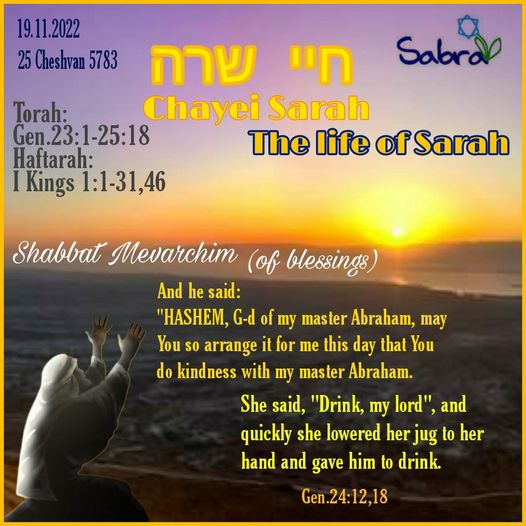
This week’s parasha is Chayai Sarah, (The life of Sarah) who was barren for most of her life but God did a miracle which changed everything. And incredibly, the same thing happened with Isaac’s wife, Rebecca, who gave up hope of ever bearing a child despite the fact that she knew how God had worked a miracle with Sarah. I’m not sure what was going through Rebecca’s mind but her name may give us a clue which means ‘bound up’.
Isaac understood to a measure the mind of Rebecca who considered herself a failure because she could not conceive, and he could empathise with her in a sense because etched in his memory was the event when Abram was about to offer him to God as a sacrifice. There was no hope left for him and he must have felt an immense sense of disappointment that he had failed God to have his life be cut short in the prime of life without having achieved anything noteworthy to dat. Yet at the last moment God stepped in who remains ever faithful. So too with Rebecca who after 22 years became pregnant and bore twins, Jacob and Esau. Yes, I believe Isaac understood something about the workings of God!
And. His response to Rebecca’s predicament was to motivate him to seek God’s face more earnestly for the miracle which was ultimately granted in God’s perfect timing. So, Isaac and Rebecca were blessed in the fullness of time. And God faithfully continued their godly lineage through their son Jacob, born to raise 12 sons who would become the 12 tribes of Israel through whose direct genealogy the Messiah would be descended from – the tribe of Judah.
The Hebrew root word for blessing (brakhah) means to bring a gift on bended knee, but with a small change in the vowel, it becomes ‘breicha’—a wellspring of water. (Ps.84) God turns the barren places into wellsprings of water. In (Isa.41:18) God promised Israel that He would “… make rivers flow on barren heights, and springs within the valleys. I will turn the desert into pools of water, and the parched ground into springs.” Although He was referring to the physical land of Israel we can also understand it to refer to our spiritual lives – from barrenness to fruitfulness.
For everything, there is a season and a right time for every intention. This is of tremendous significance for us as believers. When a life is placed under the full control of our Redeemer, the tyranny of the urgent is replaced by the active ingredient of shalom – from chaos to quietness and confidence in Yeshua that is our strength.
Nothing that appears random or out of sync with our own timings and agendas are without meaning, and although we may not be able to fathom every perplexing detail, ‘for everything there is a time and a season’ and yes, God is in complete control. Furthermore, He is faithful and true will never ever leave nor forsake us.
In these days we are facing hordes of demonically inspired evil unleashed upon the world, manicured to perfection. Unprecedented waves of deceptions are digging in their claws causing many a believer’s arms hang limp in the face of impossible odds. God is seeking out ordinary people just like you and me who allow Him to transform us into the people He created us to be, unveiled in the fullness of time.
CHAYEI SARAH Life of Sarah) Gen 23:1–25:18; 1Kings 1:1–31; Matt 2:1–23
By Raphael ben Levi
“Sarah lived to be 127 years old; these were the years of Sarah’s life.” (Gen 23:1)
Chayei Sarah, means ‘Life of Sarah,’ that celebrates her life following her death aged 127 in Kiriat Arba (modern day Hebron). She is the only woman in all the parashiot that is named after her.
Many times people remember her for her lack of faith in believing God’s promise for a son Isaac (laughter) yet ignore the many godly character traits that go unnoticed. For example, in 1Pet.3 we read: “For this is the way the holy women of the past who put their hope in God used to adorn themselves. They submitted themselves to their own husbands, like Sarah, who obeyed Abraham and called him her lord.”
Women are instructed to submit themselves to their husbands given that their husbands submit themselves to God comprising a harmonious alignment with Yeshua in the centre of their relationship. Peter emphasises the conduct of wives underlining the significance of inner beauty and a gentle spirit. The phrase “were submissive to their own husbands” underscores mutual respect and submission within marriage that’s grounded in love and reverence for God.
Sarah allowed Abraham to take Isaac to be sacrificed without challenge, trusting in the same way that he did, that God would provide a good outcome through it all. On an earlier occasion we find another example of Sarah’s trust in her husband. She agreed on two occasions to enter a foreign king’s harem where she could have been harmed and defiled.
Sarah’s death was linked in a sense to God’s covenant promise to Abraham about the land that he and his descendants would be given as a permanent inheritance. Until now, Abraham had received nothing. But now he’d got a downpayment and it came through his purchase of a tract of land with a tomb from a legal sale which provided a burial place for Sarah – hardly sufficient space for the eventual 12 tribes of Israel but it was highly symbolic. Sometimes the fulfilment of a Divine promise is incremental rather than all at once. For example when we first became a believer who would ever imagine the things God has in store for our lives as we await its full completion! In the in between, we trust God for His promises in completing that good work that He has started in our lives (Phil.1:6).
Israel is the eternal inheritance of the Jewish people, equally the property of every individual Jew. And so it was from the very first moment of Jewish ownership of Eretz Israel as described here in this parasha. Our sages tell us that the Torah contains 600,000 letters, the same number of people counted in the Exodus symbolising that the Torah is equally every Jew’s inheritance and by implication also every believer’s inheritance.
Abraham was 137 years of age following his bereavement and is described as being ‘Old and advanced in years’ yet, he lived a further 37 years because God still had some unfinished business for him.
The gematria of 37 (3x 10, & 7) represents the highest degree of Divine perfection marking the right moment. Yeshua was 30 years at the commencement of His ministry. Lk.3:23; — So too Joseph when he ruled over Egypt, – Gen 41:46; and additionally David when he began to reign – 2Sam. 5:4) E.W. Bullinger states in His book “Number in Scripture” – that the number 30 is underscored by the number 7. Bear in mind that Abraham had:
- Seven times already been promised the land of Canaan.
- God had promised him many children, a great nation, many nations, as many as the grains of sand in the sea-shore and the stars in the sky. Yet at that stage he had only one son of the covenant, Isaac, who was still unmarried at the age of 37 the same amount of years of life remaining for father. This was no coincidence.
So then what does a man of 137 do – the Torah calls him “old and advanced in years.” After suffering such a trauma following his bereavement we would not have been surprised had he spent the rest of his days in mourning and living in the memories of the past. But he did not.
Again, God had promised him many children, a great nation, many nations, as many as the grains of sand in the sea-shore and the stars in the sky. Yet he had only one son of the covenant, who remained unmarried at the age of thirty-seven so Abraham had every reason to basically give up hope. Yet he didn’t.
In one of the most amazing sequences, his grief is described in just five Hebrew words: in English, “Abraham came to mourn for Sarah and to weep for her.“ Then immediately we read, “And Abraham rose from his grief.” From thereon in, he engaged in a flurry of activity: first to buy a plot of land to bury Sarah and second to find a wife for his son. Abraham did not wait for God to act because he understood a profound spiritual truth: God is waiting for us to act in faith and obedience to His promises and calling for our lives.
What was it that gave Abraham such resilience? It was because he trusted God for all He had still in store for him and never looked back.
Two people in the Torah looked back, one explicitly, the other by implication. Noah, the most righteous man of his generation, ended his life by making wine and becoming drunk. The Torah does not say why he did this although we can guess. He had lost an entire world. While he and his family were safe on board the ark, everyone else – all his contemporaries – the entire humanity of 8 billion people and every living thing in the world had perished. It is not hard to imagine how this righteous man would be overwhelmed by grief as may have replayed in his mind everything that had transpired, constantly replaying in his mind whether how he might have done something that would have saved more lives to avert the catastrophe?
Lot’s wife, against the instruction of the angels, actually did look back as the cities of Sodom and Gomorrah disappeared under fire and brimstone. Immediately she was turned into a pillar of salt, the Torah’s graphic description of a woman so overwhelmed by shock and grief as to be unable to move on. So much of the anger, hatred and resentments of this world are brought about by people like this who are obsessed by the past. There is no good ending to this kind of story in these eventualities, only more tears and tragedy.
It is the background to this that helps us better understand Abraham after the death of Sarah. He set the precedent: first build the future, and only then mourn the past. If one reverses the order one will be held captive by the past and unable to move on and end end up becoming like Lot’s wife.
Abraham heard the future calling to him. Sarah had died. Isaac was unmarried. Abraham had neither land nor grandchildren but did not cry out in anger to God accusing Him of being unfaithful. Instead, he trusted Him and heard the still, small voice saying: “You must create a future that I will fill with My Spirit.” And Abram believed God and it was accounted to him for righteousness. That is, I believe, how Abram survived his grief and coped with his loss.
God enters our lives as a call from the future. Yeshua is beckoning to us from the far horizon of time, urging us to take a journey and undertake a task that, in ways we may not fully understand, we were created for. Discovering what that is may often takes many years and false starts. But for each of us there is something unique God which is calling us to do that He created us for, a future not yet made that awaits our making – that we like Paul claim declare,
“7 But what things were gain to me, these I have counted loss for Christ. 8 Yet indeed I also count all things loss for the excellence of the knowledge of Christ Jesus my Lord, for whom I have suffered the loss of all things, and count them as rubbish, that I may gain Christ.” (Phil.3:7-8)
Abraham was propelled forwards, driven by his trust in the One who never disappoints! (“Forgetting was is behind, I press forwards…”) The measure we trust God in all things will determine the measure of our future inheritance. Sometimes, people’s lives are depleted or filled with forfeit simply because they are not willing to trust God for His perfect timings.
When I think about these things, I reflect upon how well I trust the Lord especially when its put to the test – not only in the big things but in the nitty-gritty day-to-day small details of life? God doesn’t judge greatness by the level of human accomplishments, or recognition from others, or status or position. But it has everything to do with the depth of our love for Yeshua lived out before Him. Such a person is a hero in the sight of God. Abraham trusted God and it was accounted to him for righteousness… And he trusted Him with all his heart. This is where we must consider Sarah who is often overlooked in the partnership.
The Talmud (Ta’anit 23b) mentions that a woman’s chesed is greater than a man’s. She gives the starving beggar a loaf of bread, while he only provides the means to attain it. In other words, it is saying that a man may provide you with ideas but a woman tells you who you are, someone who is worthy of being a recipient of God’s love and receiving the measurement of it in practical ways.
I believe many times when Abraham was tested, it was Sarah who urged him to put God’s instructions into practice – to convince Abraham that it was more than a good idea to follow them even when the idea may have seemed implausible.
On an entirely different note, we can see close parallels between the things in Abraham’s life that he was facing and Yeshua’s parable concerning the Rich man and Lazarus. When we understand the parable in its proper context, the interpretation becomes clear how it has all about being a good custodian of our inheritance in Yeshua. Lk.16:19-31
Yeshua had just given His teaching about the unjust steward who had mishandled his master’s money (Lk.16:11-16) to illustrate good and bad stewardship:
Yeshua told the Pharisees: “So if you haven’t been trustworthy in handling worldly wealth, who is going to trust you with the real thing? And if you haven’t been trustworthy with what belongs to someone else, who will give you what ought to belong to you? No servant can be slave to two masters, for he will either hate the first and love the second, or scorn the second and be loyal to the first. You can’t be a slave to both God and money.”
In the parable of Lazarus and the Rich Man, Yeshua continues with His theme of stewardship as a warning against the Jewish religious hierarchy – stewardship in its widest sense, meaning all of the resources which God has bestowed to us. This is the only time where a person’s name is used in Yeshua’s parables. The name “Lazarus” is a transliteration of the Hebrew “Eli-ezer” (which means “God has helped”).
So who was Eleazar? He was the very same Eleazar mentioned in our parasha who was Abraham’s chief steward. The phrase, “desiring to be fed with the crumbs which fell from the rich man’s table” (as Yeshua described Lazarus in the parable) was a common phrase used to describe Gentiles. And the phrase in the parable where Lazarus was ‘laid at the gate’ of the Rich Man was a Jewish expression describing the “Proselyte of the Gate” who were Gentiles who respected and honoured the Jewish faith but still chose to maintain their Gentile identity.
A few chapters earlier in Gen.15, Abraham complained to God about having no heir to his inheritance. It would all go to Lazarus (Eliezar of Damascus). Abraham replied, “Adonai, God, what good will your gifts be to me if I continue childless; and Eli‘ezer from Dammesek inherits? You haven’t given me a child so someone else born in my house will be my heir.” Gen.15:2–3)
Until this point Lazarus (Eleazar) had been the legal heir to all of Abraham’s possessions which naturally disturbed Abraham because it threatened the promise God had made to him regarding his descendants (Gen.15:3). A bit of background here.
Eliezer, was the firstborn of Masek, one of Abraham’s concubines and first in line before Ishmael, who was born of Hagar. According to the Septuagint it reads “What will you give me, seeing I go childless and the heir of my house is Eliezer of Damascus, the son of Masek, my domestic maidservant.”
Although Abraham had altogether 9 sons from his concubines, (Ishmael, Eliezer, Isaac, Joktan, Zimram, Medan, Midian, Ishbak and Shuah) Eliezar was Abraham’s rightful heir before the birth of Isaac and if Issac remained unmarried. And so in desperation he cried out to God: “O my Lord, what would you provide for me otherwise I am going to die accursed and the one to inherit my household is Eliezar.” (Gen.15:2)
Here is the amazing thing that transpires. Abraham gave Eliezar (Lazarus) an assignment which resulted in Eliezar’s own disinheritance, something which he did willingly without complaint, with precision, exactly according to Abraham’s instructions. He told Eliezar, “…swear by the Lord, the God of heaven, and the God of the earth, that you shall not take a wife unto my son [Isaac] of the daughters of the Canaanites.’” Gen. 24:3
In ancient times it was customarily decided that the next of kin should be first in line to possess the inheritance. When there were no sons, a trusted friend would frequently be appointed as the heir, sometimes to the exclusion of a near relative. So when Abraham despaired of having children himself, he appointed Eliezar as his heir, rather than his nephew Lot (Gen.15:3).
Sarah, not wishing Ishmael to have any share in the inheritance with her son Isaac, persuaded Abraham to drive Hagar and her son out of her house (Gen.21:10); and Abraham later sent away his children by concubines, with presents, so that they would not interfere in the inheritance of Isaac (Gen.25:6). Above everything, Abraham was concerned about the preservation of his line based upon the covenant promises of God and it was this that was his primary motivation.
Most people fail to recognise the enormous generosity and greatness of Eliezar by willingly forfeiting all claim to Abraham’s inheritance. All which had been Eleazar’s inheritance had now been given to Isaac and his descendants: wealth, prestige, power, kingship, priesthood, and the land of Canaan as an “everlasting” possession. Elieazar aka Lazarus had been “cast out” and would inherit nothing. This is why Yeshua describes Lazarus as a “beggar” in His parable, who possessed nothing of earthly worth.
Eleazar [Lazarus], Abraham’s trusted steward, had disinherited himself from earthly rewards by his faithful obedience to Abraham’s wishes, and by so doing received his eternal reward of dwelling in “Abraham’s bosom” (another name for Paradise)
Israel the rich man who represented Abraham’s sons, the 12 tribes of Israel, inherited all the physical blessings while in the flesh, but stubbornly refused the message of salvation offered by Yeshua who said: ”Neither will they he persuaded, though one rose from the dead” (Lk.16:31).
Yeshua taught something unthinkable at the time through this parable how the Kingdom of God would now become open for the Gentiles as faithful as Eleazar had been if they support God’s eternal plan for the Jewish people.
Paul supports this in Rom.11 that although “…some of the branches (who are the Jews) were broken off. You who are not Jews were put in the place where the branches had been broken off. Now you are sharing the rich root of the olive tree.
But he also warned them:
“17 Imagine some branches are cut off of the cultivated olive tree and other branches of a wild olive (which represents all of you outsiders) are grafted in their place. You are nourished by the root of the cultivated olive tree. 18 It doesn’t give you license to become proud and self-righteous about the fact that you’ve been grafted in. If you do boast, remember that the branches do not sustain the root—it is the system of roots that nourishes and supports you.
19 I can almost hear some of you saying, “Branches had to be pruned to make room for me.” 20 Yes, they were. They were removed because they did not believe; and you will stay attached, be strong, and be productive only through faith. So don’t think too highly of yourselves; instead, stand in awe of God’s mercy. 21 Besides we know that God did not spare the natural branches, so there is no reason to think He will spare you. 22 Witness the simultaneous balance of the kindness and severity of our God. Severity is directed at the fallen branches withering without faith. Yet kindness is directed at you. So live in the kindness of God or else prepare to be cut off yourselves. 23 If those branches that have been cut from the tree do not stay in unbelief, then God will carefully graft them back onto the tree because He has the power to do that. 24 So if it is possible for you to be taken from a wild olive tree and become part of a cultivated olive tree, imagine how much easier it would be to reconnect branches that originally grew on that olive tree.
25 My brothers and sisters, I do not want you to be in the dark about this mystery—I am going to let you in on the plan so that you will not think too highly of yourselves. A part of Israel has been hardened to the good news until the full number of those outside the Jewish family have entered in. 26 This is the way that all of Israel will be saved. As it was written, so it also stands:
The Deliverer will come from Zion; He will drive away wickedness from Jacob.
27 And this is My covenant promise to them, on the day when I take away their sins.
Chesed (loving-kindness) the same character trait of Sarah was what led Eliezar to choose Rebecca to be Isaac’s wife who became the first Jewish bride. And it was the “chesed” of God which brought redemption to the world through Yeshua our Messiah.
The theme of chesed runs through the book of Ruth. It was her kindness to Naomi, and the kindness of Boaz to Ruth, emphasised within the story. The Sages stated that the three things most important to a Jewish person’s character are modesty, compassion, and (chesed) based on the character and acts of God Himself. The Talmud (Bavli, South 14a) states that, “The Torah begins with an act of kindness and ends with an act of kindness. It begins with God clothing the naked – “The Lord God made for Adam and his wife garments of skin and clothed them,” (Gen. 3:21) – and it ends with Him caring for the dead:” (Deut. 34:6). How beautifully this pictures the redemption of Yeshua who is the Alpha and the Omega who clothes our nakedness with His righteousness. Though our sins be as scarlet…
The parable of the Rich man and Lazarus is all about being a good custodian of the spiritual riches lavished upon us through Yeshua. This means we are called to place Yeshua first in our lives wholeheartedly and consistently irrespective of our circumstances. The parable demonstrates that a godly person will experience suffering in this life but will receive an eternal inheritance in contrast to those who are unrighteous who may be rewarded greatly on earth but receive the eternal recompense of an eternity in hell.
The question is all about being good custodians of God’s riches which he has freely bestowed upon our lives? Yeshua’s parable of the Rich man and Lazarus causes us to reflect upon who was the truly rich person in the parable?
The fiercest statement of faith and ultimate response within the darkest of times strengthened by God’s all-surpassing faithfulness is modelled with Abraham. God’s promises are unswerving in the good, the bad and the ugly; in a crisis and in a God-moment: in restoration and transformation: in the darkness of soul and on the mountain heights: in the shadows and in the fullness of God’s glory. Each of these things are demonstrated in Parashat Sarah, making a profound statement that challenges us to walk in the footsteps of the Master as did Abraham, the friend of God.
The unique message of Yeshua is that the greatest prize, the ‘pearl of great price’, is to discover the love of the Father through the Son who is above all things and takes precedence over all things. Through Him, we get to choose the best in life without lack. He is worth everything and the greatest investment in life is to forge the deepest relationship with Him that is of infinite worth. The most we can ever give Him is the very least He deserves, which leads to a life of fullest abundance.
And on God’s side, All that He does is motivated by His everlasting love for us that’s unending, and eternal. His everlasting love is always there in the past, present, and future.