MESSIAH IS COMING VERY SOON. ARE WE READY?
The Jewish people are eagerly awaiting the coming of the Messiah and although they missed him the first time round 2000 years ago, the late Israeli author and Holocaust survivor, Elie Wiesel anxiously articulated question facing a large and growing number of Jewish people throughout the world today whose hearts God is melting. Once, when addressing Gentile believers about this, he advised compromise as the best solution to his dilemma which was perhaps the worst advice anyone could give, not least from a person with such wisdom. He said:
“My good friends, what is the difference between you and me? We believe as religious Jews in the coming of the Messiah. You believe that the Messiah came, went back, and that you are waiting for Him for the second coming. We Jews believe He hasn’t come yet, but He will come. In other words, we are waiting, you for the second coming, we for the first coming. Let’s wait together. “
After a pause, he said, “And when He will come, we will ask Him, have you been here before?” Elie Wiesel added, “I hope I will be behind Him and I will whisper in His ear, ‘Please do not answer.’” Elie Wiesel’s words were tragically amusing, way beyond tongue-in-cheek, and unworthy of a person of such great stature who refused to consider an eternal reality that holds life or death implications.
Why would he say such a thing? Because it would place in jeopardy the entire paradigm and foundation of Judaism. What he did not understand were the eternal and negative implications of rejecting the Messiah. God is calling out the Jewish people today and pushing us off the fence in many uncomfortable ways in order that we might gain infinitely more than we could ever lose.
Ignorance is not bliss but just another form of escapism – “Please do not answer otherwise I could not bear live with myself.” I do not exaggerate. These were exactly the words my father spoke in response to the question.
So what can I say? Only that in these end times more and more Jewish people are discovering Yeshua as their Jewish Messiah. Let’s not be mistaken. Even though we may have missed it the first time round, history will bring to fulfilment the things that the Word of God bears witness to – Am Y’Israel Chai!
With anti-Semitism rising alarmingly word-wide and with the existential threat of the Jewish people’s annihilation looming ever large, the question stands stubbornly in front of us real time in and won’t go away.
You have heard me say that we serve a God of miracles who can do anything. He could even, as the Talmud puts it, ‘fit an elephant through the eye of a needle.’ How would He do it? Would He make the elephant smaller or would He expand the eye of the needle? Neither. The elephant would remain big, the eye of the needle small and He would fit the elephant through the eye of the needle. Illogical though true because logic is just another of His creations and He who created logic is permitted to disregard it.
We need to understand and wrestle with this this to appreciate that our God is the same “yesterday, today and forever,” the same God who delivered His covenant people from the Egyptians and parted the Red Sea.
There are currently many ‘elephants’ within the hearts of Jewish people who are seeking to make sense of this and embrace that which at one time was unthinkable.
We are a stubborn and stiff-necked people, but nonetheless God is able to squeeze us like an elephant through the eye of a needle. He delights to demonstrate His sovereignty against all impossibility as the Word of God bears witness to, and this alone settles the matter!
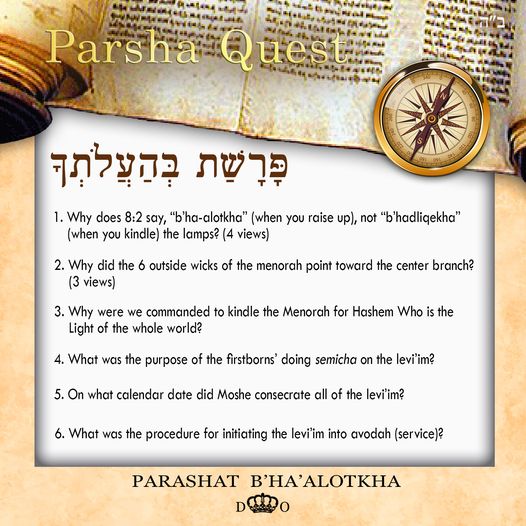
Parasha B’ha-alotecha (When You Set Up)
Num.8:1–12:16; Zech. 2:14–4:7; Lk.17:11–18:14
By Raphael ben Levi
In this week’s parasha, the Israelites followed a lengthy stay in the Sinai desert, and now prepare for the next stage in their journey to the Promised land. Their focus is no longer travelling from but travelling to. And so, finally the journey begins. But just as in life nothing is ever plain sailing so the Israelite’s response to the challenges they faced amid God’s promises and faithfulness are contested again and again with cynicism and unbelief that fills the air with the mantra, “If God” rather than trusting Him by faith with the declaration – “Yet God!”
So instead of being filled with excitement, everything appears to be a great anti-climax. They now begin to complain about a lack of creature comforts and craved other food in place of the manna which God had provided. They lamented, “If only we had meat to eat! We remember the fish we ate in Egypt at no cost – also the cucumbers, melons, leeks, onions and garlic. But now we have lost our appetite; we never see anything but this manna!” Num.11:4-6 It was a distorted yearning. Instead of thanking God for His manifold provision it morphed into unbelief. Instead of rejoicing in the God of their salvation it morphed into something ugly and distorted – fantasising about their quality of slavery – eating the bread of affliction, sorely oppressed in bitterness and without hope -wishing to exchange this in place of the manna provided by God – the food of angels! (Ps.78:23-28):
“Yet He commanded the clouds from above And opened the doors of heaven;
24 And He rained down manna upon them to eat And gave them the grain of heaven. 25 Man ate the bread of angels; God sent them provision in abundance. 26 He caused the east wind to blow in the heavens And by His [unlimited] power He guided the south wind. 27 He rained meat upon them like the dust, And winged birds (quail) like the sand of the seas. 28 And He let them fall in the midst of their camp, Around their tents. 29 So they ate and were well filled, He gave them what they craved.” (But sent leanness to their souls – Ps.106:16)
There was something so illogical and monstrous about their behaviour that caused even Moses to despair. Until that point he appeared fully in control but now he cried out to God in anguish of soul: “I cannot carry all these people by myself; the burden is too heavy for me. If this is how You are going to treat me, please go ahead and kill me – if I have found favour in Your eyes—and do not let me face my own ruin.” Num.11:11-15 This was a desperate prayer of someone who had come to the end of himself. Have you ever been in that situation? He was totally exhausted, drained from many disappointments and now it felt like just one disappointment too many.
Moses found himself in a situation without human companionship, isolated, lonely, misunderstood and rejected even by Aaron and Miriam his own brother and sister. He became the “lonely man of faith.” Yet, it was in this moment of isolation and despair that God lead him with bulls horns – trapped with no escape – into a deeper relationship with understanding – In quietness and confidence is our strength. Moses did not pretend or internalise things. Everything had become intensely personal and he cried out to God, “…15 If this is how You are treating me, kill me now! If I have found favour in Your eyes, kill me please—don’t let me see my own misery!” Does this not resonate with the words of the apostle Paul in the opening chapter of 2Cor.?
“Blessed be the God and Father of our Lord Jesus Christ, the Father of mercies and the God of all comfort, 4 who comforts and encourages us in every trouble so that we will be able to comfort and encourage those who are in any kind of trouble, with the comfort with which we ourselves are comforted by God. 5 For just as Christ’s sufferings are ours in abundance [as they overflow to His followers], so also our comfort [our reassurance, our encouragement, our consolation] is abundant through Christ [it is truly more than enough to endure what we must]. 6 But if we are troubled and distressed, it is for your comfort and salvation; or if we are comforted and encouraged, it is for your comfort, which works [in you] when you patiently endure the same sufferings which we experience. 8 For we do not want you to be uninformed, brothers and sisters, about our trouble, how we were utterly weighed down, beyond our strength, so that we despaired even of life [itself]. 9 Indeed, we felt within ourselves that we had received the sentence of death [and were convinced that we would die, but this happened] so that we would not trust in ourselves, but in God who raises the dead. 10 He rescued us from so great a threat of death, and will continue to rescue us. On Him we have set our hope. And He will again rescue us [from danger and draw us near to Him].”
Things never happen in our lives randomly for God’s ways are perfect and the plans He has for us are perfect! Moses learned this and because of it allowed God to transform him. He was never the same again!
Here God displayed such immense compassion with the things that Moses was facing despite how things looked externally. God said, “16 …Bring me 70 of the elders of Israel whom you know to be elders of the people and their leaders. Take them to the Tent of Meeting, so they may stand with you there. 17 Then I will come down and speak with you and, I will take some of the Ruach that is on you and will place it on them. They will carry with you the burden of the people, so you will not be carrying it alone.” (ch.11)
It was a simple and obvious solution similar to what Jethro his Midianite father-in-law had counselled Moses at an earlier stage in time. But clearly this was not enough because sometimes we also need flesh and blood human companionship and support from others.
God knows the smallest details of our lives, our deepest needs, and therefore, what is best: “God will supply our perfect needs according to His glory in Messiah Yeshua” but always in His perfect timings and on His terms. Whether it be a sovereign act of sending manna from Heaven, He always operates out of the magnificence of His infinite mercy, compassion and generosity.
Sadly, the Israelites resolution to walk solely according to God’s commands in faith and holiness began to wane at this point of their journey. Yet, amid all their failings, they remained constant in one thing. You may be surprised that this was in connection to the Shekinah Glory which covered the Tabernacle during the day as a pillar of cloud and as a pillar of fire during the night (9:15). The Israelites faithfully followed the Shekinah whenever it moved from the camp or settled in one place (9:18-23). We never read of one instance when they failed to follow the leading of the Shekinah glory.
The pillar of fire and the pillar of cloud ( עמוד האש ועמוד הענן ) that covered the presence of the Shekinah Glory was so amazing that it almost became something taken for granted!
The translation of ‘pillar’ from the Hebrew word “amud” conveys the sense of an upright structure, that covered and concealed Yeshua in His transfiguration – God’s manifest glory in human form that will be manifested to the remaining remnant of Jewish people on the Day of the Lord.
The cloud reminded the Israelites that God is our shelter who tabernacles and protects us from the scorching heat of the desert by day and with His warmth against the bitter cold of a desert night. In it all, we see how God surrounds and sustains His beloved elect in every circumstance continually!
No less of prophetic importance are we reminded of a soon time when Scripture states how Yeshua will come in the clouds (Hu Ba b’annaniym b’karov) to collect us to Himself!
But, instead of rejoicing and being glad, the Israelites complained loudly to Moses about their hardships until finally the fire of His judgement that now represented His judgement broke out among them, consuming those who were in the outskirts of the camp. (10:1-3). Whenever believers allow themselves to drift into the outskirts of God’s presence, they will become acutely vulnerable to the lies of the enemy. Many times it will result in lusting after the things of the flesh, preferring this over the provision of God. To do so is in effect trampling underfoot the eternal sacrifice God has made for us through Yeshua and cheapens our salvation to no more than a convenience store or an insurance policy.
Throughout Scripture and particularly here in this parasha, we discover that even amid this type of torrid situation God delights to restore us and will never abandon us. Mercy triumphs over judgment which reflects the heart of the Gospel message through Yeshua’s sacrifice on the cross. Yeshua took upon Himself the judgment that we deserve due to sin.
God delights to restore those who are wounded, deliverance to the afflicted and redemption to those who have lost their way. To the despairing, He brings hope; and He clothes the destitute with garments of joy, bringing peace to the troubled soul and rest to the weary! He is the glory and the lifter of our souls (Ps.3:3); He raises us from the ashes and places us upon a solid rock. As He did with Moses, so too He does with us His beloved.
And yes, there are consequences for the negative choices we make in life but it need not be the end of everything but just a new beginning. God is able to have His perfect way even amid our moments of unfaithfulness. His eternal plans never falter or change. He is the “father of lights in whom there is no change nor shadow of turning.” (James1) He who keeps Israel neither slumbers nor sleeps and although we may be likened to an elephant, God alone is able manoeuvre us through the eye of a needle! Am Y’Israel chai! Adonai Eloheinu Chai!
I want to close with sharing very briefly something I would be remiss by ignoring, that regards Moses’ character. The highest quality in a person biblically speaking is humility, (the opposite to pride) best defined as not thinking less of yourself but thinking of yourself less. Moses was changed from a stuttering no-hoper, into a spiritual giant as he learned to walk in humility and obedience, allowing God to transform him step by step. He chose to place God in the centre of his life instead of himself. As a former educator, I understand that child centred education biblically begins by placing Yeshua in the same way in the centre of our lives. That’s where it begins because only then can one receive the benefit and comprehensiveness of abundant life in fullness; and this is no less true for us as children of God.
When we accept this truth, our lives will not necessarily become any easier but it will be accompanied with the knowledge that God’s promises never fail and He undertakes to supply all our needs according to His riches through Messiah Yeshua. It demonstrates the extent to which He loves us and His willingness to go from the extra mile to infinity for us and back in order to bring us safely home to our eternal destination.
But there is even more. We read in our parasha the incredible fact that it was at the moment of Moses’ greatest crisis that God Himself spoke to him as a friend – not an enemy or a critic but a friend!
God generally takes us through seasons in life and whether you are currently in the valley or in the mountain tops, God’s love and faithfulness doesn’t change even the smallest fraction and will always bring us to a spacious place in the fullness of time as He did with Moses. God worked in him that which was pleasing in His sight, but first He needed to bring Moses to his knees, emotionally destitute, in desperation and despair. And in the end, Moses became known as the humblest person who walked the earth, the ‘eved Hashem,’ God’s servant. Only one other person, Joshua, his successor, was attributed this title until many centuries later Isa. 42 concerning the Messiah: “Here is my servant, (eved) whom I support, my chosen one, in whom I take pleasure in!”
Rabbi Yochanan said, “Wherever you find the greatness of the Holy One, there you find His humility. Greatness is humility, for God and for those who seek to walk in His ways. It is also the greatest single source of strength, for if we do not place ourselves in the centre, we cannot be injured by those who criticise or demean us. They are shooting at a target that no longer exists.”
Moses learned to reject betrayal and did not hold on to offences even when originating from his immediate family (Aaron and Miriam). We may not always have the strength to do the same, but God never takes us through any situation that He has not first equipped us to deal with even though we may end up being dredged through and Divinely hauled to the safety of green pastures!
Through Moses, we see how God delights in the person who has the courage and determination to place Him in the centre of their lives. The Greek word for “first” (protos) means “foremost,” “best,” “paramount,” “supreme” and “number one.”
Yeshua demands our love exclusively, and does not tolerate second place – nothing less, – first place, first love – above all things. Anything less is idolatry. There is no such thing as second love in the Kingdom of God! First love is just an aperitif and a preparation for the main course; an initial introduction, but the fullness awaits us in Heaven like the initial steps of a baby, that sets our course because it enables us to run the race with focus instead of crawling around in spiritual diapers.
Wise people pursue it single-mindedly. It is stronger than death and more powerful than the fiercest storm. Though it cost everything it is transformational beyond imagination and glorious beyond comparison. It cannot be fully articulated yet can be fully embraced, and those who dare discover the greatest eternal investment like the “Pearl of Great Price” which we gladly sell everything for. Paul wrote in Phil.3: “8 And more so, I now realize that all I gained and thought was important was nothing but yesterday’s garbage compared to knowing the Anointed Jesus my Lord. For Him I have thrown everything aside—it’s nothing but a pile of waste—so that I may gain Him. 9 When it counts, I want to be found belonging to Him, not clinging to my own righteousness based on law, but actively relying on the faithfulness of the Anointed One. This is true righteousness, supplied by God, acquired by faith. 10 I want to know Him inside and out. I want to experience the power of His resurrection and join in His suffering, shaped by His death, 11 so that I may arrive safely at the resurrection from the dead.”
God’s love has no rival; it never has nor ever will. He is a jealous God and will not tolerate competitors. But the world provides many counterfeits that vie for our attention in subtle and deceptive guises and counterfeit expressions. Artificial Intelligence (AI) is aptly named because it is both artificial and the greatest foolishness compared to the wisdom of God.
So my challenge today are for those who dare follow in the footsteps of the Master unreservedly, and be covered with the dust of His sandals, for a journey of fullness and intent without meanderings or pit-stops that each person would run the race well until the very end!
The quality of our lives is appropriated through the materials we choose to build with. Someone who is truly joyful is like a person who, although his house has burned down, begins to build anew.
His heart rejoices over every stone that is laid, because the Shekinah does not dwell in a place of dejection but in the honest grief of a person who recognises what he lacks and reaches out in the right direction for help.
The precious rewards we sow in life that characterise a person’s life can only be forged in the furnace of affliction. I repeat, the quality of our lives is appropriated through the materials we choose to build with. So, ket’s choose well as we stand altogether together as Scripture urges, and having done all, to stand!