Day 40 of the Omer
Count the Omer: Today is forty days, which is five weeks and five days of the Omer – (“Mem b’Omer”)
On the 40th day following His resurrection, Yeshua who had appeared before many witnesses (to more than 500 others – 1Cor.5:6) returned to Heaven to sit at the right hand of the Father. Yeshua told them to gather together in Jerusalem and “wait for what the Father promised,” (Acts.1:4). Just before this instruction He commissioned the apostles to evangelise the world (Acts 1:8; cf. Matt. 28:18-20) in preparation for the coming of the Ruach ha Kodesh at Shavuot when they would be empowered to fulfil His command. (Acts 2:1-4). This occurred at the Mount of Olives after which they asked Yeshua a question:
““Lord, are you at this time going to restore self-rule to Isra’el?” 7 He answered, “You don’t need to know the dates or the times; the Father has kept these under his own authority. 8 But you will receive power when the Ruach HaKodesh comes upon you; you will be my witnesses both in Yerushalayim and in all Y’hudah and Shomron, indeed to the ends of the earth!” (i.e., you don’t need to become preoccupied with all the fine details of every future event between now and My return such as with the impending destruction of the temple otherwise you may become sidetracked. But know that God has infinite authority over all times and seasons.) Here’s the knowledge you need right now; you will receive power when the Holy Spirit comes on you. And you will be My witnesses, first here in Jerusalem, then beyond to Judea and Samaria, and finally to the farthest places on earth.” Acts 1:7-11,
Understanding the context helps us appreciate why this empowerment which Yeshua referred to was so crucial. The disciples were about to face immense challenges, including persecution and significant opposition which Yeshua forewarned them about – the trials they would encounter but also how the Ruach ha Kodesh would guide and empower them.
And so, 2000 years later we are still eagerly awaiting Yeshua’s return and Scripture has made it clear that His time is very close. The counting of the Omer represents an interim period and transition point that leads to empowerment through the Ruach ha Kodesh for service in the Kingdom of God – which is the same message that Yeshua shared with His disciples.
During the 40-day period of the Counting of The Omer the resurrected Yeshua revealed Himself in person to many people. On one of these occasions there is a fascinating commentary recorded in 1Pet.3:18-20 that “… (Yeshua) made a proclamation (formal announcement) to the imprisoned spirits, to those who were disobedient long ago, in the days of Noah, when God waited patiently during the building of the ark…” (1Pet.3; 18-20)
These ‘spirits’ are a reference to the fallen angels whose fall was final: “For God did not spare the angels who sinned; on the contrary, he put them in gloomy dungeons lower than Sheol to be held for judgement.” The Greek word used here is ‘Tartarus’ a word originating in Greek mythology referring to the residence of fallen angels and an underworld for demons: “And the angels that did not keep within their original authority, but abandoned their proper sphere, he has kept in darkness, bound with everlasting chains for the judgement of the Great Day.” (Jude 6) Scripture confirms the purpose behind Yeshua’s proclamation in Col.2:15 that, “…having disarmed principalities and powers, He made a public spectacle of them, triumphing over them in it.” This is the victory Yeshua has won for each believer who walks in His pathways with rejoicing and thanksgiving.
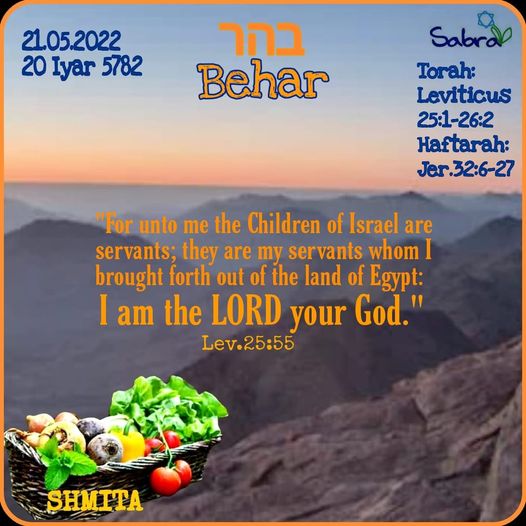
Behar (On the Mountain) and Bechukotai (By my regulations)
Lev 25:1–27:34; Jer 16:19–17:14; Matt21:33–46
On this Shabbat we are blessed with a double portion that takes us to the end of Leviticus. The first portion is called “Behar”: “The LORD said to Moses at Mount Sinai, “Speak to the Israelites and say to them: When you enter the land I am giving you, the Land itself is to observe a shabbat of rest for Adonai.” (Lev.25:1–2)
The ‘shabbat of rest’ referred to is a reference to the shabbat of years known as the ‘shemitah’ a Hebrew word meaning release. Every person who was in debt or enslaved would be released or ‘set free’, a type and shadow illustrating the redemption of Yeshua who sets the captives free.
Many believers have accepted Yeshua’s salvation yet choose to live under the bondage of a slave mentality believing that it is preferable to allowing God’s surgical knife to deliver from all the negative poisons that drain our lives – all the blockages that leave us spiritually crippled. This is a satanic lie seeking to keep God’s people bound in chains.
Other people play the blame game for the mess they find themselves in which is the suicide of liberty because it shifts any accountability from ourselves square on the shoulders of others.
And many times a persons problems are due to outside influences beyond their control where they find themselves as innocent victims through things such as generational curses, abusive relationships, betrayals, etc. But whatever the reason, good news is that deliverance is possible when we invite God into the situation who alone became the Divine scapegoat for all our scars and imperfections and woundedness.
God’s faithfulness stands out clearly in this week’s Torah portion because of His irrevocable covenant with Israel, despite some unwise choices made throughout history which has defined their path to this day – so many ups and downs! But here is the point. God uses every situation, the good, the bad and even the ugly within His eternal purposes. Even though there are consequences for the choices we make in life, nothing can jeopardise God’s purposes for us not, even the poor choices we may make, for every believer who has surrendered their lives to Him. Rom.8:28). God’s grace and compassion can sometimes be overwhelming!
The Shemitah which the Israelites observed occurred on a seven-year cycle. The land rested so the Israelites didn’t offer any tithes of their agricultural offerings to the Lord. According to the rabbis, the Shemitah year only applied to the Jewish inhabitants of Israel because the land belongs to Him. God has leased it out to His tenants on His terms alone and is the one and only authentic owner of Israel’s real estate. (Lev.25:23–24)
The implications of a Shemitah year meant that every Israelite needed to prepare in the sixth year to ensure that they had sufficient to live on. As with them, we too need to recognise the importance of being good custodians in our giving of the things which God has entrusted to us. Scripture in fact urges us to give no less than 100% of ourselves, body, soul and spirit – tithing was only the starting point. The principle of giving is beautifully illustrated in Lev.25:6: “What the land produces during the Shemitah year will be food for everyone in the land – you, your servant, your maid, your employee, anyone living near you, your livestock and the wild animals on your land; everything the land produces may be used for food.”
When we align ourselves in obedience to God’s laws He promises to fill our lives with an abundance (v.18-22). “‘Follow my decrees and be careful to obey my laws, and you will live safely in the land. 19 Then the land will yield its fruit, and you will eat your fill and live there in safety. 20 You may ask, “What will we eat in the seventh year if we do not plant or harvest our crops?” 21 I will send you such a blessing in the sixth year that the land will yield enough for three years. 22 While you plant during the eighth year, you will eat from the old crop and will continue to eat from it until the harvest of the ninth year comes in.”
During the Shemitah, the Israelites made the necessary agricultural and economic adjustments in order to take time out away from the day-to-day concerns to deepen their relationship with the Lord. Additionally, it provided a time of physical rest, saving both the land and the people from exhaustion. But there was something else of great importance. In Deut. 30:10-13 the Israelites were instructed, “…at the end of every seven years, in the year for canceling debts, during Sukkot, the Festival of Tabernacles, (Why Sukkot? Because this was the beginning of the civil year where calendar years are calculated) when all Israel came before the Lord in one place and the king would read this law (the law of the Shemitah) before them in their hearing. Everyone was assembled — men, women and children, and the foreigners residing in their towns — so they could learn to follow carefully in all the words He had commanded. Even the children, were included in order that they would be blessed in the land they would later possess when they crossed the Jordan – remember and retell the story – never forget but rather live the life.
During the Shemitah no-one went hungry whether rich or poor. Provision was made for even the poorest among the poor to pick the produce on the corners of the fields that grew without the land being worked, and in addition all debts were forgiven. It relates to the prayer Yeshua taught to His disciples that was adapted from the Amidah prayer: “Father forgive us our debts as we forgive those who are endebted to us” bringing to mind the Shemitah. And for us as believers we are reminded that our debt of sin that was paid in full by Yeshua. So now we better appreciate the importance of forgiveness from the heart for any offence committed against us because it will always be small compared to God’s forgiveness for us.
In addition to the Shemitah, the Torah refers to the Year of Jubilee (Yovel) celebrated on the 50th year that was an extra-special occasion experienced only once or twice ever in a lifetime. A cycle of seven sets of seven years (49 years) accumulated, followed by the 50th year so in the year of Jubilee there would be two consecutive years of rest instead of one. Lev.25:8,10 provided the following instructions: “Count off seven Sabbath years — seven times seven years — so that the seven Sabbath years amount to a period of forty-nine years.… Consecrate the fiftieth year and proclaim liberty throughout the land to all its inhabitants.” The Jubilee (Yovel) was an appointed time of liberty proclaimed throughout the land with the blowing of the shofar, on the Day of Atonement (Lev.25;9): “You shall sound a ram’s horn abroad on the tenth day of the seventh month; on the day of atonement you shall sound a horn all through your land.”
With the blast of the shofar, Hebrew slaves were freed and debts were forgiven. But in addition, hereditary property was returned to its original family, even if it had been sold because of misfortune, poverty, or to pay off a debt. This reinforced the truth that God is the rightful owner of Israel’s real estate and, therefore, it can never be permanently sold. The Jewish people are simply God’s tenants, and custodians of the land He had leased out to them! “The land must not be sold permanently, because the land is Mine and you reside in My land as foreigners and strangers. Throughout the land that you hold as a possession, you must provide for the redemption of the land.” (Lev.25:23–24)
It is clear biblically that there’s no such thing as ‘land for peace’ which the nations have sought to coerce Israel into! The law states in Leviticus that no one — no leader or politician or individual — has the right to sell, divide or give away God’s land!
Lev.26 specifies the conditions for blessing which is rooted in obedience. There are 11 verses speaking about all the good things that would happen. After these blessings are 33 verses which state all the bad things that would occur for anyone who chose to disregard them. In this respect Yeshua said something significant to His disciples in Jn.14: “If you love me, hold on to my commands”. Another translation puts it this way: “Loving me empowers you to obey my commands.”
And He follows this up with the promise: “I will ask the Father, and he will give you another Counsellor to be with you forever. 17 He is the Spirit of truth…” He is ‘The Truth’, and declared it openly in Jn.14, “I am the Way, the Truth, and the Life!” This is a central focus of our Shavuot celebration next Shabbat! How privileged we are by this amazing promise in a world filled with so much evil at a time where truth and integrity has become so impoverished and replaced with lies, half truths and deception. Yeshua promised every true believer: 18 “I will not leave you as orphans; I am coming to you. 19 In a little while the world will see me no longer, but you will see me. Because I live, you also will live. 20 In that day you will know that I am in my Father, and you in me, and I in you. 21 The one who has my commands and holds on to them is the one who loves me. And the one who loves me will be loved by my Father. I too will love him and show myself to him.”
Three times in this short passage, Yeshua reminded His disciples: “If you love me hold on to my commandments”. It is a great wonder to dwell upon God’s love and allow the wonder of it to permeate our lives (1Jn.3).
The second part of the double portion known as ‘Bechu-kotai’ (By My Statutes) continues with the theme of blessings and curses. God never willingly afflicts or grieves us as the prophet Jeremiah pointed out: “…God does not afflict willingly nor grieve the children of men.” Lam.3:33. Israel’s chequered history bears witness to this. Yet Divine judgment carries alongside God’s intention for restoration. The Jewish race has suffered more than any other people on the face of the earth, but God will never allow them to be utterly destroyed. They experienced exile following the destruction of the 1st Temple and returned to become a nation again two centuries later only to face the destruction of their 2nd Temple in AD 70 followed by a further 2000 years of exile. The 9th of Av (‘Tisha B’Av’) is where World Jewry mourns the destruction of these two temples, but this is not the end of the story because out of the ashes of the Holocaust the nation of Israel was re-established on May 14th 1948. ‘Am Israel Chai!’
Despite rampant expressions of anti-Semitism and anti-Zionism globally, Israel remains alive and vibrant, and continues to bless the world despite the volume of hatred extended towards her. Israel is unique among the nations. Let me brag a bit! Their history is not a matter of growth and decline compared to other empires who have appeared and eventually disappeared. So long as Israel stays true to her mission, she flourishes; if she rebels she suffers defeat, yet in everything the land and the people will never be destroyed and ultimately her future looks good which Scripture makes very clear!
God reminded the Israelites on many occasions that it was He who brought them out from slavery to freedom and empowered them to experience freedom in its profoundest sense. 1500 years later, Yeshua stated: “I have come that you may have life and life in abundance.” And “Whosoever the Son shall set free shall be free indeed!” What God determined for the Jewish people He also has provided for every disciple of Yeshua who walks in His ways!
Lightning is the most powerful natural force in nature, but God’s strength is infinitely greater to whom all of creation must bow the knee. How good that the Lord our God, the Almighty, Adonai Elohei-Tzva’ot, the Omnipotent, the Ruler of all reigns! (Rev.19:6)
So should you ever feel crushed or bowed down, discouraged or overwhelmed, just remember who the God we serve is! Do you recall the story in Mk.4? “35 On that [same] day, when evening had come, Yeshua said to them, “Let us go over to the other side [of the Sea of Galilee].” 36 So leaving the crowd, they took Him with them, just as He was, in the boat. And other boats were with Him. 37 And a fierce windstorm began to blow, and waves were breaking over the boat, so that it was already being swamped. 38 But Jesus was in the stern, asleep [with His head] on the [sailor’s leather] cushion. And they woke Him and said to Him, “Teacher, do You not care that we are about to die?” 39 And He got up and [sternly] rebuked the wind and said to the sea, “Hush, be still (muzzled)!” And the wind died down [as if it had grown weary] and there was [at once] a great calm [a perfect peacefulness]. 40 Jesus said to them, “Why are you afraid? Do you still have no faith and confidence [in Me]?” 41 They were filled with great fear, and said to each other, “Who then is this, that even the wind and the sea obey Him?”
We have all experienced storms in life that have come seemingly out of nowhere causing major disruption, but it’s during these times that how we respond is critical. The apostle Paul faced many crises. In 2Cor.1:8-10 he stated: “We were under great pressure—so far beyond our strength that we despaired even of living. In fact, we had within ourselves the death sentence—so that we might not rely on ourselves, but on God who raises the dead. He who rescued us from so great a danger of death will continue to rescue us—we have set our hope on Him that He will rescue us again.” The thing is this. Our circumstances and accompanying feelings are not what is primarily significant but rather how we respond to them. We have various choices. The first is to do nothing! Do you ever wonder what would have happened if the disciples had not woken Yeshua? Simple. The storm would not have abated and He would have continued to sleep! The circumstances would have remained unchanged. The second choice would be to do everything in our power to keep the boat from overturning. By this, one would barely survive but yes, we would eventually make it to the other side.Third, in our desperation we could, like the disciples, make the choice to cry out to Yeshua and allow Him to take control of the situation.
But there is still another choice which Yeshua hinted at when He told His disciples:“Why are you afraid? Even now you have no faith?” (v.40) For those with the courage to take God at His word is accompanied by the promise: “I will keep you in perfect peace whose mind is stayed on Me, because you trust in Me.” (Isai. 26:3)
Yeshua is in the stern of our boat and promises never to leave nor forsake us. Although we may panic, He remains unperturbed because He is in total control of every situation. He demonstrated this beautifully as we read here in this passage when His disciples cried out in desperation to Him.
When we allow Yeshua to abide with us we will always stay afloat! Here was an instance, one of several, where Satan unsuccessfully attempted to destroy Yeshua alongside His disciples and as always, Yeshua turned the tables on him. No demonic assault against us can succeed when Yeshua accompanies us in our journey through life. But how we deal with things can make the difference between being a struggling overcomer and a more-than-conqueror!
Here is a wonderful promise in the Book of Malachi: “But for you who fear My name [with awe-filled reverence] the sun of righteousness will rise with healing in its wings. [kanaphim] And you will go forward and leap [joyfully] like calves [released] from the stall. You will trample the wicked, for they will be ashes under the soles of your feet on the day that I do this,’ says the Lord of hosts.” (vs 2-3)
The biblical Hebrew word for the wings of a bird (kanaph) is the same one for the corners of a prayer shawl worn by observant Jews in response to the command given in Deut.2:12. The tassels represent God’s Torah and as one wraps oneself in this garment, it is a reminder that as one walks in His ways one is symbolically covering oneself under the wings of His glory.
We eagerly await the coming return of Yeshua with confidence as we soar in the midst of His glorious presence, led by the breath of the Ruach Ha Kodesh who guides us in all truth. God’s wings form a canopy which He invites His beloved, His betrothed, to dwell under (known as a ‘chupah’) as a sign of His covenant relationship with us; His love, protection and authority.