Now there was a man, a Pharisee named Nicodemus, a ruler of the Jewish people. He came to Yeshua at night and said, “Rabbi, we know that You, a teacher, have come from God. For no one can perform these signs which You do unless God is with Him!” Yeshua answered, “Amen, amen I tell you, unless one is born from above, he cannot see the kingdom of God.” “How can a man be born when he is old?” Nicodemus said to Him. “He cannot enter his mother’s womb a second time and be born, can he?” (Jn.3:1-4)
Nicodemus wrestled to understand Yeshua’s statement about being “born again” although one wonders why since the term was something entirely Jewish. For example:
1. When a Gentile converted to Judaism and was baptised, “the baptismal water (Mikva) was referred to as “the womb of the world”, and his baptism was recognised as a new birth that separated him from the pagan world. Such a person was referred to in the Talmud as “a little child just born” (Yeb. 22a; 48b; 97b)
2. When a boy had his Bar Mitzvah he was referred to as being “born again.”
3. When a person married he was considered “born again.”
4. Or if a person became a rabbi
5. Or if he became the head of a rabbinical school (i.e., Shamai, Hillel)
6. Or if he was elevated to the highest status and became a member of the Sanhedrin
These were all very familiar to Nicodemus yet failed to understand what Yeshua was telling him “You must be born again to enter the Kingdom of God.” Such a concept was something entirely alien to him. As an elderly and highly distinguished person who had strived to fulfil the requirements of the Torah throughout his life, he knew that something essential was still lacking – a God shaped vacuum – a void that nothing to this point could fill. He had sought wholeheartedly to cultivate a relationship with God, carefully crafted throughout his life yet something was glaringly missing yet visible in plain sight.
Nicodemus was elderly and time was running out. Would there be sufficient time for him to start all over again, to be “born again” in a different realm from which he had understood throughout his entire life? Yeshua responded with words that have become the most familiar and best loved in the entire NT: “For God so [greatly] loved and dearly prized the world, that He [even] gave His [One and] only begotten Son, so that whoever believes and trusts in Him [as Saviour] shall not perish, but have eternal life. Whoever believes and has decided to trust in Him [as personal Saviour and Lord] is not judged [for this one, there is no judgment, no rejection, no condemnation];” (Jn 3:16;18)
Nicodemus became a follower of Yeshua: “born again,” (Jn 19:39) when he finally understood that being born again involves a change from the inside-out not through any achievement or status. Yeshua made it clear to him that even the highest position or achievement in life does not qualify anyone for entrance into the Kingdom of Heaven because salvation cannot be earned it is a gift from God. This was what had puzzled Nicodemus, a dedicated Pharisee whose entire life had been taught something entirely different and disturbed him sufficiently to arrange a secret liaison with Yeshua at night – one that led to a radical change. He needed to be born again into the Kingdom of Heaven for the God-shaped vacuum within him to be filled, and Yeshua alone could provide him with this, the One who is the way, the truth and the life. (Jn.14:6)
In this day and age where we so often hear preaching that is carefully crafted to be ‘politically correct’ and ‘people sensitive’ from the pulpit with messages that are contrary to the teaching from the Word of God, we must hold firmly to the truth of Scripture without compromise.
As we enter a new cycle with our weekly Torah readings, we shall see how this message is reinforced from the very beginning of the Word of God from the opening chapters of B’reisheet through to the end of the Book of Revelation.
—————————————————————————————————————
B’REISHEET (In the beginning) Gen.1:1–6:8; Isa.42:5–43:10; Jn.1:1–18
The story of the first sin in the Garden of Eden is connected to the eye. The serpent enticed Eve with the words, “The truth is that God knows the day you eat the fruit from that tree you will awaken something powerful in you and become like Him: possessing knowledge of both good and evil.” (Gen.3:5). What was so appealing to Eve over and above the express command of God not to even touch let alone eat from the tree? In vs.6 we read that “…the woman approached the tree, eyed its fruit, and coveted its mouth-watering, wisdom-granting beauty. She plucked a fruit from the tree and ate.” (3:6). Scripture urges us to “…flee from all appearances of evil” Run as fast as you can from the playground of Satan’s delights! Do not entertain even a second thought but reject it in the name of Yeshua lest you be beguiled as was Eve in the Garden of Eden.
As one person wrote: “The sin of the first humans in the Garden of Eden was that they followed their eyes, not their ears. Their actions were determined by what they saw, the beauty of the tree, not by what they heard, namely the word of God commanding them not to eat from it.” (Rabbi Jonathan Sacks) This thought is reflected in the words of the Shema “Listen (and do)” that Yeshua later reinforced His teachings.
Listening to God means to apply His revealed word in our lives which is a sacred task rather than manual labour so that whatever action we do is transformed whether it be washing dishes or preaching to thousands of people because listening connects us to the heart of God.
The parasha from this week opens with good news that turned sour but ends on a good note! The opening words from Gen.1:1 state that “In the beginning God created the heavens and the earth.” This was indeed good news! We can only speculate what came before that because Scripture doesn’t provide us with the fine details. But something we do know is that God is the infinite first cause and originator who alone sustains the universe which He himself created and spoke into existence. The origin of all things are embedded in Him, the Creator God of new beginnings whose eternal plans are fully revealed within His Word.
Scripture describes the greatest event or ‘new beginning’ in the history of the world was humanity’s redemption – the good news that became sour through the entrance of sin has now became sweet through Yeshua’s blood shed for us at Calvary made freely available for the whosoever, 2Cor.5: “Therefore if anyone is in Christ [that is, grafted in, joined to Him by faith in Him as Savior], he is a new creature [reborn and renewed by the Holy Spirit]; the old things [the previous moral and spiritual condition] have passed away. Behold, new things have come [because spiritual awakening brings a new life]. ”
The Creator spoke forth His creation and everything within it. Yet, with Adam it was different. Scripture informs us that He formed him with His hands, fashioned him in His likeness and breathed His ‘Neshimah’ (breath) into his nostrils. Adam was created out of the dust of the earth (adamah) and was the crown of God’s creation. The last thing to be created was humanity who was afforded the highest status above everything else. Adam and Eve were created in the very image of God in form and given the responsibility to rule over it (“la’avda v’leshmara”), “to work and protect it”.
Although things went badly wrong with Adam and Eve, God’s eternal plans continued to unfold undeterred. Satan may win some battles, but God uses even those things that may appear to be a defeat as contributors in winning the war!
God could have stopped everything before He had even created humanity who have suffered the consequences of sin since the Fall due to rebellion, but instead revealed His “master card” through Yeshua who declared Satan’s irrevocable and final defeat – Yeshua who offered Himself as a sacrifice for our sin through His death and resurrection – “Grave where is your sting? Death where is your victory:”
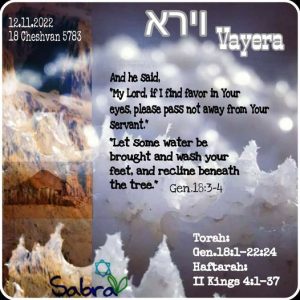
Every moment carries within it the possibility of a new beginning, and just as we have entered a new civil year in the Hebrew calendar, so God prophetically offers us the same when we allow Him full access in our lives. New beginnings are a trade mark of the Divine. God gives every individual the choice whether to allow Him to transform our lives or not. And although He communicates it to us an invitation, it is also in a sense an obligation. Yeshua warns us in Matt. 5 that “We are the salt of the earth; but if the salt has lost its taste (purpose), how can it be made salty? It is no longer good for anything, but to be thrown out and trampled underfoot.” Yeshua was referring to something His audience clearly understood— the Hill of Salt at the corner of the Dead Sea. This contained an outer layer of impurities due to chemical changes that caused it to lose its flavour and was discarded as useless. People used salt as a preservative and flavouring so it was symbolic of something that preserved and improved taste. There are many analogies one could draw from this such as what the Bible describes as the “Salt Covenant” a covenant of friendship between two people established over a meal that was irrevocable. At one point they would pour out a pouch of salt and intermingle them into one pile stating: “If anyone can separate each grain of salt and return them to the correct owner, so too will our friendship cease to be.” It represented an ancient symbol of unbreakable friendship that was everlasting. Yeshua told His disciples in Jn.15:15, “There is no greater love than this—that a man should lay down his life for his friends. You are my friends if you do what I tell you to do.” We must never allow anything to come between our friendship with Yeshua which is infinitely more precious than anything else in life!
In Gen.4 we read about the episode when Cain and Abel presented offerings before God. Abel offered a blood sacrifice that was accepted because it mirrored the essence of who he was, ‘adam’ because life is in the blood. Abel’s offering was a substitutionary offering, a life for a life, which mirrored a future redemption prophetically through the shed blood of Yeshua. Cain, however, scorned the grace of God and made an offering based solely upon human effort or achievement which was why it could never be accepted. Here was the first occasion when God required an offering from Cain and Abel because until then they had been covered by Adam and Eve until they reached the age of accountability.
God’s response to Cain following the rejection of his offering was amazing. In the English text we read: “If you are doing what is good, shouldn’t you hold your head up high? If you don’t do what is good, sin is crouching at the door—it wants you but you can rule over it.” (Gen. 4:11) (If you don’t follow the path of righteousness, you must face the consequences.) But when we examine the Hebrew text we see something different. The Hebrew word for sin used here is (‘Chata-ah’) the same word found in the Lev.6:17;24 for a sin offering. So, what God was telling Cain was this: “If you don’t do what is good, a sin offering is crouching at the door (i.e., is within ready reach).” God gave Adam and Eve a choice whether to obey Him in all things or to choose a life of compromise, and here we see a similar thing playing out with Cain and Abel
In love and compassion, God was giving Cain a second chance, a new beginning, with the opportunity to present the same type of offering his brother had presented. Instead, Cain refused, which led to the first murder and consequently Scripture states that he became a vagabond for the rest of his life, the mark of Cain, who preferred banishment from the presence of God with shame and humiliation shadowing his life and for the generations to come. He bore the hallmarks of the pride of life, the “mark of Cain”, a path which countless others have followed throughout history.
Scripture states that when we humble ourselves under the mighty hand of God He will in due time exalt us. But, should we choose instead to exalt ourselves we play directly into the hands of Satan. Humility is when we relinquish every thing that takes precedence over God: our time, abilities, energies, material possessions, even our ministries and our families – all these things we lay before the feet of Yeshua.
Yeshua said that should we hate another person, as did Cain, we are committing murder in our hearts no different in the sight of God whether we follow it through with action or not. The apostle John goes one step further in 1Jn.3:15, where he states that “…whoever hates his brother is a murderer; and no murderer has eternal life abiding in him.” God provides us with a choice: the narrow path with new beginnings or the broad path that leads to death and eternal destruction. The collateral damage is irrevocable. Even as Heaven is real , so is Hell – eternal life or eternal death: the choice is ours…
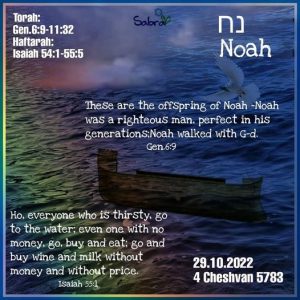
The effect of sin is exponential as we see how within just a few generations following humanity’s fall, things plummeted downhill to one of the saddest statements in the Bible where God observed the wickedness of humanity and said, “…I will destroy man whom I have created from the face of the earth, both man and beast, creeping thing and birds of the air, for I am sorry that I have made them.” Gen.6:7-8 It’s amazing that only one person stood between God and humanity’s annihilation who was a man named Noah, “…a just man, perfect in his generations, and walked with God.” – Gen.6:9:11 He was a “tzadik,” righteous the sight of God, in a world consumed with evil where “…all flesh had corrupted their way on the earth.” And we will reflect more in detail upon these things next week but I just want to make the point that Noah could easily have compromised and assimilated to the standards of the world but chose not to. Instead, he and his family were saved in an ark which took 120 years to complete. And throughout this period, he attracted much ridicule because everyone thought he was crazy that was akin to building a ship in the Sahara desert! Doing the will of God, in obedience to His instructions will always go against the flow of world opinion. When a believer stands for righteousness there will always be a high price tag attached that will attract ridicule and persecution even from those who call themselves ‘Christians.’
Trusting God may sometimes appear absurd should it ever contradict what appears to be rational but Noah’s obedience earned him a place as a hero of faith: “By faith Noah, being warned by God about things not yet seen, in reverence prepared an ark for the salvation of his household, by which he condemned the world, and became an heir of the righteousness which is according to faith.”
Every time we trust God against the flow of conventional wisdom or political correctness, against fierce opposition from both without and sometimes even from within, God views us heroes of faith who are unique and precious to Him.
Yeshua described the end times as comparable to the ‘Days of Noah.’ An element within His description is easily overlooked where He stated that before the Flood people, “… went on eating and drinking, taking wives and becoming wives, right up to the day Noah entered the ark; and they didn’t know what was happening until the Flood came and swept them all away. It will be just like that when the Son of Man comes………” (Matt,24) And so we do well to be well prepared, “…for the Son of Man will come suddenly when you are not expecting him.” (vs’s 37-44)
God has given us the capacity to demonstrate His love without being confined inside an ark but instead has commissioned us to demonstrate the Gospel within a world filled with darkness in these perilous times we live in.
God doesn’t love us because we had it all together but because we saw fit to allow Him into our lives. This is the miracle where God takes us as broken vessels and remoulds to be fashioned in His image. As Ullie-Kaye says in one of her poems,
“…don’t leave it too late when at the end of our lives we cry out in the darkness, “If only we knew what we know now.” That love conquers everything – that faith could move mountains – that good things happen to bad people and bad things happen to good people – that loud doesn’t mean strong and quiet doesn’t mean weak – that closed hearts are often hurt hearts that have yet to unfold – that silence can be both beautiful and terrifying – that healing takes time and time moves both quickly and unbearably slowly – that one step in any direction can change the course of your life forever – that bliss is sometimes just loving what you already have rather than wanting what you wish you had – that you will have days where you feel on top of the world and days where you feel like you have hit rock bottom – and that rising from the ashes requires going through the flames and that falling was part of it all.”
From all the many lessons we learn from this parasha, God urges us to be well prepared for Yeshua’s return. Many believers are standing on tip-toe awaiting His return as endgame events move relentlessly forward. And although many throughout the world are hurting badly through all manner of dark things the enemy is hurling in our direction, yet we remain the most optimistic of people on this planet. Those who place their trust in this life should understand that all the material possessions and accomplishments acquired during the course of a life-time pale into insignificance compared to the eternal reward awaiting those who love Him. A beautiful chassidic story explains it perfectly.
A visitor happened to stop by the home of a great 18th century chassidic rabbi, and was deeply distressed when he saw his abject poverty. His home was bereft of all but the very sparsest of necessities. He questioned the rabbi about his living circumstances finding it hard to believe that a man of such deep spirituality could have sunk to such levels of poverty.
“How could you live like this?” demanded the visitor.
The rabbi looked compassionately at the visitor whilst pondering upon his question, and then responded:
“Indeed, I don’t see any of your furnishings. How do you manage without them?”
“What do you mean” responded the visitor, “you do not really think that I would take all my possessions along with me wherever I go. When I travel, I make do with whatever is available. When I am home, it is another matter altogether!”
“Ah, yes” replied the rabbi, “at home, it is a different matter altogether . . .”
Let’s remember that the building blocks we use for investing in this life will determine the mansion we receive in the life to come.
www.mekudeshet.co.za