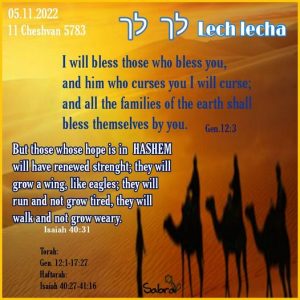
PARASHAT LECH LECHA – TORAH PORTION 3 – LECH LECHA (GO FORTH)
Gen.12:1–17:27; Isa.40:27–41:16; Matt.1:1–17
Our Torah portion begins with a command from God to Abram to make a journey that began with his father Terah, to settle in the place He would show him and there establish a people who would become His chosen remnant. It’s easy get stuck in a rut (as Terah did in Haran) and fall short of God’s destiny for our lives. God tried a second time with Abram and told him, “Get yourself out (‘lech lecha’) of your country, away from your kinsmen and away from your father’s house, and go to the land that I will show you.”
Why would God would choose an elderly couple, like Abram and Sarah to a land that was steeped in violence and evil and how would they be in a position to establish a people at their age? The Land of Canaan was definitely not among the top ten tourist places but has been described as “…a place that changed hands and governments like a person with stomach problems changes underwear.”(Joseph Shulam) It was as well that God never revealed to them their destination otherwise they may well have declined the invitation.
Sometimes, when God challenges us to step out in faith, it may appear to be a never-ending journey of 1 million miles rather than a brief hike so we need to be careful to hear the voice of God clearly before we move forwards and be willing to pay the price. And like Abram it is often in our best interests not to know where it will lead but simply to place one’s full trust in the Lord.
God always gives us the choice to follow Him or to politely decline, but should we fail to heed His voice we will continue with a journey that is at best second best rather than the best of the best. But here is the thing. God is not so much concerned with the length of our journey as to our willingness to walk in obedience and faithfulness. Missed opportunities are the enemy of obedience similar by way of example to an event that occurred during the Spanish Inquisition before the expulsion of the Jews in 1492. Two years earlier in 1490 there was a big gathering of the congregations of all the Jewish community in Spain. At this stage, the Jewish community flourished in positions in government, and prospered to the point where they were talking to each other, asking, ‘What can we do to make our identity as Jews stronger? One of them suggested, ‘You know how rich we have become! Let’s send a message to Istanbul that we want to buy the land of Israel back from the Turks. We will pay whatever price they want. We’ll return to the Holy Land and rebuild the temple!’
There was complete unity and great excitement at this suggestion so they appointed three representatives from the community to go from Spain to Istanbul to negotiate terms with the Pasha in Turkey and return. They set aside twelve months for this venture. In the meantime, they decided they would open new yeshivas for Kohanim (Priests) to learn their duties in the Temple and for Levi’im (Levites) to study music, and their joy was unbounded! They decided they would meet the following year on the sixth month of Elul in the year 1491.
The year passed quickly and they all assembled again to receive feed back from the emissaries.
‘We got a great price! We are buying the Holy Land!’ Everyone was ecstatic until suddenly one in their midst stood up and said, ‘Who gave us the right to buy the Holy Land? The Lord drove us out from the Holy Land, so we don’t have the right to go back unless we have a sign from Heaven!’
The people immediately responded with indignation. ‘Are you crazy? Do you need a bigger sign? We have the money! The Pasha wants to sell it to us, and we want to go!’
However, a wedge had been driven and the poison had found entrance. There were already two parties, one said, ‘White,’ and one said, ‘No! That’s red!’
They decided to wait exactly one more and everybody knows that on Tisha b’Av that year they were driven out of Spain. Do you know what the problem is? When the right moment arrives, Don’t wait, don’t wait . . .”
When we prepare for a journey, we are wise to take stock of the necessary provisions and equipment necessary to take with us. Terah, settled in the city of Haran and remained there contrary to God’s instruction. Haran was part of a prominent trade route. But it was also in a region known as the ‘armpit of the ancient world’ submerged in evil. No deodorant could disguise the smell. Terah compromised his destiny for a comfortable and easy lifestyle within a godless culture and environment that was rotten to the core. Although he was originally heading in the direction of Canaan, the same location God had destined for Abram, he ended in anonymity and is remembered only for being the godless father of the patriarch Abram.
Abram placed his full trust in the One true God in a pagan world, unlike his extended family who happily submerged themselves within their pagan surroundings.
Abram and his wife, Sarai, become the first settlers by journeying to Elon Moreh near Shechem. The Lord appeared to him again and confirmed His promises. It was here at Shechem (Nablus – Judea and Samaria) that God made His first promise to Abraham: “I’m going to give this land to your descendants”’ and told him to, “Arise, walk around in the land, through its length and its width, for I will give it to you.”
What God commanded Abram was not to make a sightseeing trip but to fulfil a legal custom in ancient times to claim ownership of a property by walking through it. Egyptian and Hittite kings would regularly leave their grandeur of their palaces to take a ceremonial walk through their countryside in order to confirm ownership of the land.
According to historians, the seller of a property would lift his foot off the land and set the buyers foot upon it which explains why God promised to give Joshua “every place the sole of his foot treads upon.” (Josh.1:3) So, legally, when Abram walked the length and breadth of the land, he took possession of it for himself and his descendants that was an eternal possession. The Jewish sages have compared Abram’s walk through the land to a vial of perfume that only gives scent when moved, wafting the fragrance of faith throughout the Promised Land. As with Abram, every believer is called to walk in the footsteps of Yeshua in order to possess our full inheritance and to be a sweet-smelling fragrance in a world filled with the stench of sin.
Whereas Noah walked “with” God; Abram walked “before” God, paving the way for the world to come to faith in the one true God. God gave Abram the ability to cross over borders: He not only crossed over from Mesopotamia to Canaan, he crossed from a world of idol worship to a world in which the one true God was worshiped. The world stood on one side and he stood with truth on the other. He crossed over into his destiny, and his descendants inherited the reward and blessing in addition to the characteristic of being marked by those who cross over. For this reason, Abram became the first person to be called an Ivri — one who crossed over. This word comes from the Hebrew verb la’avor (to cross over) and is transliterated into English simply as a Hebrew.
Lech Lecha is an exciting portion in the Torah that chronicles the adventures of the first Hebrew with God. But in addition it connects with the words of Yeshua in Jn.5:24: “Yes, indeed! I tell you that whoever hears what I am saying and trusts the One who sent me has eternal life — that is, he will not come up for judgment but has already crossed over from death to life!”
When we study the background to Abram and the life changing trip he took which would transform things for all humanity, we are only provided with scant information. All we know is that he responded to a call from God to step out in faith against the backdrop of a world filled with unbelief. Who could have predicted that the outcome of his decision to obey God would radically change the course of history? Abram became known as a hero of faith (Heb.11) but equally true is every believer who is saved by grace through faith and walks in relationship with Yeshua in obedience to His revealed Word. Such a person is no less a hero in the sight of God!
In Abram’s time humanity had descended once again to paganism and godlessness – so soon following the great flood in which the entire world was destroyed save Noah and his family. But there remained a small remnant who were faithful like Abram. When we examine his genealogy we identify that his forefathers were composed of godly descendants such as Noah and Shem who were (by the way) still alive at God’s calling of Abram. An important purpose of the genealogy links them to those who had survived the flood with Abram. From this we understand how Abram’s godly forbears would no doubt have exerted their influence for good over him that would have encouraged him to arise from the garbage heap of ungodliness and choose to live a life of faith in God.
At a later time God tested Abram by instructing him to take his son and offer him as a human sacrifice. It was a pivotal moment for Abram but he simply complied without question or negotiation. And yet we read earlier In Gen.18, when the three angels visited Abraham and told him they were going to destroy Sodom, Abram argued with them and sought to negotiate the possibility that God would cancel His verdict if as few as 10 righteous men could be found in that city. Why didn’t he do the same thing with his only beloved son and heir? Yet Abram obeyed God without negotiation and built an altar for the sacrifice of Isaac. This whole event in Gen.22 is known as the “Akedah” (binding) and holds immense significance to us as believers with manifold types and shadows relating to Yeshua’s sacrifice on the Cross for our sins. But the question remains why would he not negotiate terms as he had done concerning the destruction of Sodom? The simple answer is that some things in life are negotiable and others are not. But when we dig a little deeper and examine the Akedah in terms of types and shadows things become much clearer. Imagine if Yeshua had negotiated HIs way out of offering Himself as a sacrifice for our sins? “God so loved the world that He gave His only begotten son so that whosoever believes in Him should not perish but have everlasting life.” Such Divine love is not negotiable!
Our Haftarah reading from Isa 41:8 states that God described Abraham as ‘My Friend,’ an incredible statement forged through trust and obedience. Every person is imperfect but this need not hinder our destinies when we surrender our lives fully to God and allow Him to change us as a potter does with the clay or as silver in a refiners fire. This is not to glory in our imperfections but rather to recognise that the only safe place we have in life is abiding in the arms of Yeshua. How blessed are those who walk in His footsteps and are called His friend!
As we have said, we have no details regarding Abram’s childhood, his youth, his relationship with other family members, or how he came to marry Sarai although it would have been something nice to know! Because the key thing Scripture emphasises of overwhelming significance regards Abram’s faith his obedience which led him to became the ‘father of many nations’. As Abram, he was an exalted Father – meaning someone with high office, yet God changed his name to Abraham – a father of many nations. When God changes a name in Scripture, it signifies a new beginning – or as Yeshua told Nicodemus, being born again. God sealed his name by placing His own autograph in the middle of Abraham’s name with the Hebrew letter HEH.
God didn’t choose someone famous to fulfil His commission, but rather a person who was nameless and faceless according to the world’s standards, unlike in the eyes of God “… who has chosen what the world calls foolish to shame the wise; he has chosen what the world calls weak to shame the strong. He has chosen things of little strength and small repute, yes and even things which have no real existence to explode the pretensions of the things that are—that no man may boast in the presence of God.” 1Cor.1:28-29
When we are born again into the Kingdom of God through the precious blood of Yeshua, we no less experience a new beginning (2Cor.5:17), something I shared about last week. God places His signature upon us by giving us a new name and we become a Temple meet for His use.
On a different note, I want to provide an additional perspective for our encouragement. Should we neglect to heed God’s leading, or fail Him in ways however great, God is able to restore us and redeem us and furthermore even turn that which the enemy intended for evil for good. That is the genius of God where nothing is wasted in His Divine economy. Remember Peter when he denied Yeshua three times? Sometimes God allows us to fail as part of His strategy to restore and realign us along the road less travelled.
Parasha ‘Lech Lecha’ spans Abram’s life from the age of 75 to 99. That means he lived most of his life without knowing his destiny—not until God revealed it to him through a covenant that led to a name change, Abram to Abraham. He waited again a long time before he began to see its fulfilment through a miracle son who he named Isaac. This demonstrates that it’s never too late to enter into the destiny and calling which God has placed upon our lives even dare I say to our last breath. Moses was 80 years old before he began to minister in his calling. Missed opportunities do not necessarily mean that we have missed the boat. God was in full control at every step of Abram’s life and no matter how hard Satan tried, failed to jeopardise the eternal purposes of God. Instead, God used everything Satan used in an attempt to destroy His eternal plan and turned it around to instead facilitate it! This is important to understand as Paul wrote in Rom.8:28 “Everything works together for good for those who love God and are called according to His purpose!” Nothing and no-one in the entire universe can interfere with God’s eternal purposes even a flicker!
One person reflected that, “Every believer will face seasons of testing. Faith that is never tested cannot be trusted. God allows trials not to destroy us but to develop us. Just as gold is purified through fire, our character is refined through adversity. In trials, we learn endurance, patience in action. It’s easy to praise God on the mountain, but real faith worships in the valley. Paul said, “We glory in tribulations also: knowing that tribulation worketh patience.” (Rom.5:3) Endurance teaches us to depend completely on God, not our strength. Every difficulty is a spiritual gym where your faith muscles grow stronger.” This was no less applicable in the life of Abraham as it is with us, the imperfect heroes of faith who stand strong in Yeshua to become “more than conquerors.”
“The world’s kingdom is temporary, built on things that fade, but God’s kingdom is eternal. It cannot be shaken, it cannot be corrupted, and it cannot be defeated.”
As Scripture says, “Blessed be the God and Father of our Lord Jesus Christ, who according to His abundant and boundless mercy has caused us to be born again to an ever-living hope and confident assurance through the resurrection of Jesus Christ from the dead, 4 [born anew] into an inheritance which is imperishable and undefiled and unfading, reserved in heaven for you, 5 who are being protected and shielded by the power of God through our faith for salvation that is ready to be revealed [for us] in the last days.” 1Pet.3:5