Man’s wickedness led God to bring a Flood. The first act began with Adam and Eve in the Garden of Eden. From there, things went quickly downhill when Cain murdered Abel and it didn’t take more than a few generations later before we arrive to the time of Noah where we read that:
“11 The world was corrupt in Elohim’s sight and full of violence. 12 Elohim saw the world and how corrupt it was because all people on earth lived evil lives.
13 Elohim said to Noah, “I have decided to put an end to all people because the earth is full of their violence. Now I’m going to destroy them along with the earth.
Noah was righteous pure, and blameless in a world filled with evil where “The world was corrupt in Elohim’s sight and full of violence. ” (Gen.6:11–12)
It is an amazing thing how quickly sin took root in humanity following the fall of Adam and Eve. Shortly after they were banished from the Garden of Eden, we are informed of the incident between Cain and Abel which I briefly talked about last Shabbat. Only a few generations later, we arrive to the times of Noah who Scripture describes as “…;righteous) pure, and blameless) in a world filled with evil where “all flesh had corrupted their way on the earth.” (Gen.6:11–12)
All of this illustrates the effects of sin where there is no damage limitation. As the apostle Paul writes: “The wages of sin is death…” (Rom.6:23) It can start with one error smaller than a grain of sand, but once it has gained entrance and left unaddressed it can end in a tsunami of untold destruction without mercy or distinction upon those, good or bad alike.
How easy it would have been for Noah to compromise and assimilate to the standards set by the world, but instead he resisted. When we stand for righteousness, in accordance to the Word of God, Scripture promises that we will pay a high price: we will be ridiculed and persecuted even by those who call themselves ‘Christians.’
Trusting God may appear absurd when everything rational and logical dictates otherwise just as things are looking right now in the present situation in our nation where everything is falling to pieces. But, this is the moment when it’s critical to stand strong in the Lord. It was because Noah placed his full trust in God that he became a hero of faith:
“By faith Noah, being warned by God about things not yet seen, in reverence prepared an ark for the salvation of his household, by which he condemned the world, and became an heir of the righteousness which is according to faith.” (Heb 11:7)
This is the way it is in the Kingdom of Heaven. Scripture tells us to “Trust in the Lord with all our heart (not some of our heart) and lean not on our own understanding” lest we be reduced to a Rolls Royce with no petrol. (Prov.3:5-6)
Every time we trust God against the flow of conventional wisdom or political correctness, against fierce opposition from both without and within, we become a hero of faith!
God is searching for people like this among His people. One word of recognition and commendation from God is better than receiving a life time of tributes from the world. Paul wrote, “Yet every advantage that I had gained I considered lost for Yeshua’s sake. Yes, and I look upon everything as loss compared with the overwhelming gain of knowing Messiah Yeshua my Lord. For his sake I did in actual fact suffer the loss of everything, but I considered it useless rubbish compared with being able to win Christ. ” (Phil.3:7-8)
God instructed Noah to cover the ark inside and out with pitch. The Hebrew word for this is ‘ka-phar’ meaning ‘covering’ and it comes from the root word ‘kippur’ from the word, ‘Yom Kippur’ or the ‘Day of Atonement’ which literally means the ‘Day of Covering.’
So let us abide under His covering at all times and not allow the enemy to creep in unawares. And should he ever do so, be quick to make things right with God that the enemy gain no advantage over our lives. We have been given the promise that “He who dwells in the secret place of the Lord shall abide under the shadow (or covering) of the Almighty.” (Ps. 91) There are no short cuts for this.
Amid all the drama of the impending Flood there is one instruction God gave to Noah regarding the Ark’s construction that has mystified the sages. This was when He instructed him to make a “tzohar” for the ark within a cubit of the top. (Gen. 6:16) The word “zohar” (radiance) does not appear anywhere else in the Tanakh and refers to a source providing light within the Ark. But what exactly what it was remains a mystery. For the believer it represents the protective hand of God that surrounded the ark both within and without. Even during the fiercest and most tumultuous of times Immanuel is with us throughout the storms of life. God’s light was sufficient to keep Noah and his family safe throughout their ordeal that provided them with a window of hope against a backdrop of hopelessness.
The first thing Noah did when they finally arrived on dry land was to offer a sacrifice to God in thanksgiving to the One who alone can preserve life and provides us with new beginnings. This is something we can so easily ignore whereas it should constitute an integral feature of our walk with Him. Yeshua healed ten lepers, but only one returned to give Him thanks (Lk.17:11-19). After Yeshua fed the multitude, they sought Him for more bread rather than expressing gratitude for the miracle they witnessed. Jn.6:1-1)
We see recurring examples on these types of themes regarding ingratitude or a failure to acknowledge Yeshua’s acts of mercy, loving-kindness and power that’s illustrated throughout the NT. It’s a matter which reflects our innate ability as believers to take Him for granted in life: how easy a thing it is. This would account, at least partially, why Scripture is so full of admonitions for us to give thanks to him in all circumstances. Thankfulness opens the door to deep communion with God since when we express our gratitude to Him we acknowledge that we trust Him for being in complete control, and so we shift our focus from ourselves to God and others, acknowledging His goodness and constant provision. Even though it may be unseen God is always behind the scene. No wonder Paul teaches to give thanks in everything for this is the perfect will of God in Messiah Yeshua. (1Thess.4:15)
After the ark rested on dry ground, God made a covenant through Noah vowing never again to destroy the world by a flood. There is an interesting midrash linked to this. Noah said to himself, “Since I only entered the Ark with permission (from God), shall I leave without permission?” God said to him: “Are you looking for permission? In that case I give you permission.” Then God said to Noah, “Come out of the Ark.”
I referred very briefly to this last Shabbat when I made the comment that as believers it is all too easy for us to remain in the confines and safety of our “ark” than to venture outside of it in order to fulfil the destiny and calling over our lives rather than being destroyed by the comfortable choice of apathy.
In the Midrash, one of our sages makes the comment, “If I had been there, I would have smashed down [the doors of] the Ark and taken myself out of it.”
God calls us to be participators in rebuilding a shattered world, through the breaking down of strongholds that we have been given the mandate for without first needing His permission! When one sees a person about to walk over a cliff, one does not wait to see if someone will intervene to prevent him from committing suicide one immediately does so oneself. And the principal remains the same for the unsaved who are blithely walking each day over life’s cliff edges leading to spiritual death and eternal irrevocable loss.
After the ark rested on dry ground, God made a covenant through Noah vowing never again to destroy the world by a flood. Sadly, things went downhill from there. Noah planted a vineyard from which he made wine and became drunk. And yet the Torah states that Noah “walked with God” (6:9). There is much we could say here but sufficient to llustrate that “We are saved by grace through faith in Yeshua our Messiah” (Eph.2:8-9). None of us are perfect, not even the best among us – not even Noah. It is not to make excuses for him but simply serves to recognise the importance that emphasises the faithfulness of God compared to our own imperfections. Scripture states that God is faithful even when we are unfaithful because He cannot deny Himself. (2Tim2:13)
To take the road less travelled and venture out into the unknown involves faith. This is the lifestyle which every believer is called to like Abraham and Sarah who left everything in obedience to God’s command to a place He had yet to reveal to them. It was little different for the Israelites when they journeyed into the wilderness, guided only by a pillar of cloud by day and a pillar of fire by night and a promise from God.
Faith involves the courage to declare that “Though I walk through the valley of the shadow of death, I will fear no evil, for You are with me” (Ps. 23:4). It takes faith to surrender our lives to God unconditionally – to place a greater value on living out our faith with honour and integrity and witness as believers though it may cost us everything. (Rev.12:11). Faith involves risk taking and taking God at His word. It takes faith to relinquish our reputations and status for the sake of Yeshua in every area of life and function. It will sometimes result in being isolated, rejected and betrayed even from among those we love and in certain parts of the world even worse.
Occasionally Satan may choose to package things more subtly than overtly. Einstein made this point in terms of the fickleness of the world when he said, “If my theory of relativity is proven successful, Germany will claim me as a German and France will declare me a citizen of the world. Should my theory prove untrue, France will say that I am a German, and Germany will declare that I am a Jew.”
Faith is the courage to become a risk taker to the glory of God; our pilgrimage in life to a distant destination knowing that there will be hazards along the way, but knowing also that He is with us, accompanied by His strength to fulfil His perfect will in our lives.
Faith is the courage to live with a level of uncertainty, not in the sure hope that we possess in our salvation as believers, but sometimes in the choices and decisions we make.
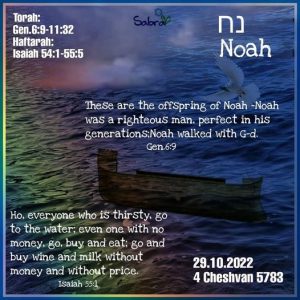
Scripture states that Noah was “a righteous man, perfect in his generations; Noah walked with God.” The only person in Scripture who comes close to these words of commendation (apart from Yeshua) is Job who was described as being, “blameless and upright fearing God and shunning evil” (Job.1:1). Noah was righteous (tzaddik) even though we are provided with no mention regarding his life and service by way of day-to-day illustrations – only that he was a man whose faith was accounted to him for righteousness. (Heb.11)
Yet the Noah we see post flood is not the same person we saw at the beginning. Noah was a man of the soil who Scripture records planted a vineyard. There is only one biblical story recorded that concerns Shem, Ham, and Japheth that is described here in this text. As already mentioned he drank some of its wine and became drunk lying uncovered inside his tent. Noah, the man of God was now reduced to a drunkard. He who was clothed in righteousness now lay naked. He who saved his family from the Flood now appeared so undignified that two of his sons are ashamed to even look at him in his drunken state. What had happened? The man who God used to preserve humanity also had flaws like each one of us. This is not to condone sin but to recognise the fragility of the human condition.
And here we see something about the character of Noah who was not a leader but a tzadik who held no influence over his contemporaries. God told Noah, “You alone have I found righteous in this whole generation” (Gen.7:1). Noah’s righteousness was restricted to his family of eight people in total together with the animals, who were saved from the wrath of God. But this is not a criticism of Noah but rather a simple observation that applies to most believers who have become righteous through the blood of Yeshua.
We must learn always to be ourselves in Him rather than to attempt being who we are not. Whilst we are called to be spiritual influencers through the witness of our lives, few are called to be leaders. This was the reason, I believe why Aaron allowed the Israelites to sin with the creating the golden calf in the absence of Moses. Moses was a true and anointed leader. Aaron was not.
We have no evidence to show that Noah was an influence for good in a society saturated in evil. Even through the righteous witness of his life, people refused to respond because their level of deception was great to the point that they called what was evil good and good evil. (Isa.5). In addition, we are informed through the Book of Enoch, that Noah was surrounded within a culture dominated by the Nephalim, a hybrid people without soul or ability to embrace righteousness unto salvation.
Noah may well have protested over the sinful actions of his contemporaries though no-one listened. Yeshua wrote that we are currently living in the end times comparable to the days of Noah facing the associated challenges that accompany.
And for our encouragement wee see that in all of this nothing is ever wasted with God. For example, the tragedy of Charlie kirk’s assassination is leading to revivals across the world among the younger generation. Many among the released Israeli hostages who endured unbelievable torture and evil at the hands of their tormentors are now sharing to others about God’s miracles and deliverance that they witnessed first-hand. And this is having a ripple-effect where we are seeing the softening of hearts as God is preparing the way ahead.
One commentator has noted, Noah was the third case in a series of failures of responsibility. Adam and Eve failed to take personal responsibility for their actions (“It wasn’t me”). Cain refused to take moral responsibility (“Am I my brother’s keeper?”). And now Noah failed the test of collective responsibility. This is in contrast to a Jewish saying: “Kol Yisrael arevim ze-ba-zeh” (“All Israel are responsible for one another”) which I provide an example of in my book “Romance of the Hebrew Calendar.” They called Noah a tzaddik im peltz, “a righteous man in a fur coat.” There are essentially two ways of keeping warm on a cold night. You can wear a thick coat, or you can light a fire. Wear a coat and you warm only yourself. Light a fire and you can warm others too. We are supposed to light a fire. Was this where Noah felt a strong sense of guilt and regret that maybe dogged his life following the Flood? He wore a fur coat instead of lighting a fire.
God has created us all unique and special with various abilities, strengths and weaknesses yet all that God desires from us is that we live in relationship with Him in the fullness of His love, serving Him in quietness and confidence in the manner that He created us to be – uniquely be – minus the tyranny of “what if” that we allow to characterise who we are. There is a famous rabbinic statement: “When a human being makes many coins in the same mint, they all come out the same. God makes us all in the same mint, the same image, His image, and we all come out different.”
In all of this Yeshua is warning us to be well prepared for His appearing, “…for the Son of Man will come when you are not expecting him.” (vs’s 37-44) because things may appear to stabilise and disaster averted and people will say “peace, peace, when there is no peace,” but it will only be something very temporary.
Let’s seize every opportunity God gives us to serve Him wholehearted, emblazed in first love scorning every sin and entrapment Satan lays in our pathway for we “…know who we have believed and are persuaded that He is able to keep that which we have committed to Him against that day!”