Ex. 10:1 – 13:16: JER. 46:13-28: ROM. 9;14-29
“Then the Lord said to Moses, ‘Go to Pharaoh, for I have hardened his heart and the heart of his officials so that I might perform these signs of mine among them” (EX 10:1)
The Book of Exodus speaks of God’s dealings and redemptive acts for the Israelites which opens up in chapter 1 with a people without any future or outlook.
But in this weeks parasha between chapters 10-13, we see how there came a time, planned by God before the foundations of the earth, where He sent Israel a deliverer at just the right time; it really was a suddenly moment – after 400 years of slavery and abject misery came redemption, the story of the Exodus. It is a prophetic shadow not only how God delivered the Israelites from Egyptian bondage to freedom but how Yeshua has redeemed us from the slavery of sin.
God is faithful and true to His promises as the Word of God demonstrates time over time and believers throughout the ages have tested and proven. No matter how bleak things may appear never forget that it’s impossible for God to fail. “We may fail but Jesus never! Blessed be His name!”
In last week’s parasha we read about the first 7 plagues which God sent to the Egyptians out of a total of 10. Ten represents completeness but in this instance we see more. In order to understand this, we need to go to Gen 1 describing how God created the heavens and the earth. Each of God’s creative acts finds its counterpart in the plagues. What we see here is that God loved Israel so much that He temporarily suspended the laws of creation to rescue the chosen people from bondage.
God’s words to Pharaoh show us why there had to be ten plagues recalling the ten words that God’s spoke at creation. Genesis 1 uses the phrase; “And [God] said…” – Va’yomer) a total of ten times (cf. Gen 1: 3, 6, 9, 11, 14, 20, 24, 26, 28-29).
For each creative word that God spoke into existence His creation, we can observe a counterpart against Egypt every time Pharaoh refused to let the Israelites free.
This principle runs throughout all of history – whenever a nation or a group curses Israel, their blessing is removed and replaced with Divine judgment.
God had earlier told Pharaoh, “For this purpose I have raised you up, to show you my power (כח; koach), so that my name might be proclaimed in all the earth” (Exod 9:16).
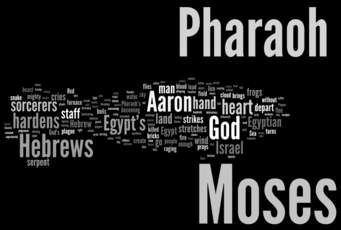
So, we can see how the conflict between Moses and Pharaoh was a war between the forces of darkness and Light and on each occasion evil had to bow the knee. God demonstrated His authority and power over His creation.
Every plague was directly linked to demonic entities – the Egypt gods who they served – with the severity of the plague increasing exponentially as on each occasion Pharaoh hardened his heart against the command of the One and true God who the Israelites served. In the initial stages Pharaoh’s magicians called upon stronger entities to demonstrate their power over God and on each occasion failed miserably and after the third time, they gave up altogether seeking to replicate God’s miraculous signs.
This week’s parasha opens with he words of the Lord to Moses: “Go to Pharaoh, for I have hardened his heart and the heart of his officials so that I might perform these signs of mine among them.”
Since Pharaoh knew that he could not win against Moses, he attempted to do the next best thing – to negotiate – and failed. He promised to release the Israelites but only the men; the women and children had to stay. So God released a plague of locusts and once again Pharaoh begged for Moses to intercede but when he did and the plague ended he once again hardened his heart.
The 9th plague was the plague of darkness that enveloped the entire Egyptian people demonstrating God’s power that took full authority over the Egyptian god, Ra, the god of light.
Pharaohs were considered to be the literal sons of this particular demonic entity who ruled over all the gods of Egypt, so this was the most stinging defeat for Pharaoh and a direct attack upon his personal identity.
On the 10th and final plague, all the firstborn of the Egyptians perished. Why the firstborn? God considered Israel to be His own firstborn among the nations and had warned about His impending retribution on Egypt earlier in Ex 4:22-23: “This is what the Eternal says: ‘Israel is My firstborn son. 23 I say to you, “Release My son, so that he may serve Me,” but in your stubbornness you refused to free him; therefore, I am going to kill your firstborn son.’”
In those times, the firstborn received the greater share of a father’s inheritance and represented the ruling elite, but interestingly this particular pharaoh was an exception since he didn’t die in the plague, although his son in line to be the next pharaoh did.
Throughout Moses’ encounter with Pharaoh, the gods of Egypt were muted. Serket, the goddess of protection, was proven powerless. Meshkenet, the goddess who presided at the birth of children, failed to save the firstborn. Sobek, god of protection and fertility who epitomized the might of the pharaohs, couldn’t protect anyone. Renenutet, the god who appeared as a vulture, the special protector god of the pharaoh, could not protect the pharaoh’s son who would be the next pharaoh. Osiris, the giver and ruler of life was conspicuously absent.
Following the 10th plague, the result was so devastating that pharaoh finally relented but what would have been the situation had he conceded from the very beginning?
Through all of this God worked a change in Moses from the time of his commissioning at the burning bush to the present! And so too, God will do the same for each person who is prepared to walk in obedience to God’s Word irrespective of any obstacle one might face. God takes us as we are and is able to do, ‘exceeding abundantly above all we can ever hope or imagine’ as Psalm 37 puts it so eloquently:
“Don’t be worried with evil workers or envy the gains of people with all-wrong-upside-down ways. 2 Soon enough they will wither like grass, like green herbs fading in summer’s heat. 3 Believe in the Eternal, and do what is good—live in the land He provides; roam, and rest in God’s faithfulness. 4 Take great joy in the Eternal! His gifts are coming, and they are all your heart desires! 5 Commit your path to the Eternal; let Him direct you. Put your confidence in Him, and He will follow through with you. 6 He will spread out righteousness for you as a sunrise spreads radiance over the land; He will deliver justice for you into the light of the high sun.7 Be still. Be patient. Expect the Eternal to arrive and set things right. Don’t get upset when you see the worldly ones rising up the ladder. Don’t be bothered by those who are anchored in wicked ways. 8 So turn from anger. Don’t rage, and don’t worry—these ways frame the doorway to evil. 9 Besides, those who act from evil motives will be cut off from the land; but those who wait, hoping in the Eternal, will enjoy its riches.10 You’ll see . . . the wicked won’t know what hit them; you’ll blink, and they’ll be gone; you’ll go out looking for them, but you won’t find them.11 But the humble-hearted will inherit the land; they will take pleasure in its peace and enjoy its abundance.”
This is the true perspective that the psalmist explains so vividly whenever we are engaged in spiritual warfare. The outcome is clear for those who operate in God’s strength and on His terms.
In all of this, we must never forget that Satan is entirely evil whose sole purpose is to “steal, kill and destroy.” Paul, in 2 Cor. 10 makes this point very clear:
“3 For though we walk in the flesh, we do not war according to the flesh. 4 For the weapons of our warfare are not carnal, but mighty through God to the pulling down of strongholds, 5 casting down imaginations and every high thing that exalts itself against the knowledge of God, bringing every thought into captivity to the obedience of Christ, 6 and being ready to punish all disobedience when your obedience is complete.” (2Cor.10)
Moses understood that God’s purposes cannot ever be changed or manipulated and those who attempt to do so will face the same devastation that occurred with Pharaoh. It took ten plagues before he finally capitulated when God brought the greatest nation of the ancient world to its knees.
Due to his stubborn and rebellious heart Pharaoh brought not only untold suffering upon himself but also upon his own people the Egyptians. How sad when people who are beaten up through their own stubbornness and pride still choose spiritual death over life and allow the ripple effect to affect countless others.
God’s message through Moses was, ‘Let my people go!’ And in the same way, Yeshua can break the chains and set free every person from the sin that binds and plagues them.
But it is incumbent upon us never to negotiate with the enemy for Satan is ‘the father of lies’. Every temptation, allurement and promise he offers is tainted with the poison of evil with intent to steal, kill and destroy entirely our whole identity, body, soul and spirit.
When we face off against the demonic forces of darkness, we have opportunity to put our faith into action, and we discover that the battle is one-sided in our favour! The Word of God teaches us in James 4:7 that if we submit ourselves to God and resist the Devil, he must flee from us! The only qualification God is looking for is a willing heart that allows Him to have His perfect way.
God can transform us into giant slayers no less than he did for Moses and so many other heroes of faith. God has equipped us with everything in life to be ‘more than conquerors.’ When we choose to live in accordance to God’s rules, no evil shall prosper against us because He reigns in our hearts!
The story of the Exodus did not end with Pharaoh releasing the Israelites, for he later had a change of heart and pursued them in the wilderness! Sin has an insatiable desire that is never satisfied: sin begets sin.
We read in this parasha how in the end, Pharaoh and all the Egyptians begged Moses and the Israelites to leave Egypt because they finally realised they were fighting against the living God, rather than some demonic principality. They even blessed them with gifts of gold and jewellery as they left Egypt so that no further calamity would befall them.
Egypt was glad when the Israelites departed as the Word of God states, “…for dread and fear had fallen upon them.”
According to the sages, this statement, repeated in Psalm 105:38, can be compared to a fat man who is riding on a donkey. The donkey, who is wavering under the load, is thinking to himself, “When will he get off me!” whereas the fat man is thinking, “When will I ever get off this donkey?” When the fat man eventually reaches his destination, he gets off the donkey and is deeply relieved and happy. The donkey also is extremely relieved.
It was like this for the Israelites and the Egyptians. When the Israelites were under the yoke of the Egyptians, they were longing for the moment when God would free them. During the period of the 10 plagues, the Egyptians were also longing for the Israelites to be released. When it finally happened, both were happy but sadly the story did not end there.
Here is something here important for every believer to understand. We can never assume when we experience breakthroughs that Satan will ever tire of seeking to regain lost territory. If we ever become spiritually complacent we will open a door of opportunity for Satan.
In this parasha, God spoke to the Israelites: “Tell your children the story of redemption from slavery to freedom.” This is central to all the Jewish feasts we celebrate: to remember and re-tell. It reflects as a shadow or type the story of eternal redemption that is available to every person through Yeshua our Redeemer, but unless we live the story, the message will be lost in obscurity. This is what the essence of ‘telling the story’ means: celebrating through words, and by our actions.
What is the greatest legacy we can ever leave to our children and descendants? It’s not money of possessions but the story. Yeshua is our identity. If we forget the story, we lose our identity.
One can easily forget about how things started off with Moses, an ordinary person with a stutter and a low self image who simply allowed God to transform his life even though at first he was reluctant to do so and God had to do a bit of gentle persuading. Like Moses, God desires to transform us no less than for him:
“For though we walk in the flesh, we do not war according to the flesh. For the weapons of our warfare are not carnal, but mighty through God to the pulling down of strongholds, casting down imaginations and every high thing that exalts itself against the knowledge of God, bringing every thought into captivity to the obedience of Christ, and being ready to punish all disobedience when our obedience is complete.” 2Cor 10:3-6
In these days God is raising up an army of warriors and each one of us can be included when we simply make the right choice to give Him full sway of our lives and my encouragement to you today is this: No person who has ever lived who has devoted their lives unconditionally and wholeheartedly to walking in full fellowship and relationship with God through Yeshua has been disappointed – and neither will you!
Raphael ben Levi