Parsha B’resheet+Noach by Roger Lenk
The story of the first sin in the Garden of Eden is intrinsically connected to the eye. The serpent enticed Eve with the words, “The truth is that God knows the day you eat the fruit from that tree you will awaken something powerful in you and become like Him: possessing knowledge of both good and evil.” (Gen.3:5). What was so appealing to Eve over and above the express command of God not to even touch let alone eat from the tree? In vs 6 we read that “…the woman approached the tree, eyed its fruit, and coveted its mouth-watering, wisdom-granting beauty. She plucked a fruit from the tree and ate.” (3:6).
As one person put it so well: “The sin of the first humans in the Garden of Eden was that they followed their eyes, not their ears. Their actions were determined by what they saw, the beauty of the tree, not by what they heard, namely the word of God commanding them not to eat from it.” (Rabbi Jonathan Sacks)
This thought is reflected in the words of the Shema Israel, “Listen (and do) Israel” and later in the words of Yeshua “He who has ears let him hear…”
Listening to God is to heed His revealed word and by so doing it becomes a sacred task rather than ‘avodah’ manual labour. And whatever we do as unto the Lord, however menial it may appear, suddenly becomes transformed. This is the power the Word of God holds because seeing may reveal to us the beauty and wonder of God’s creation but listening connects us to the heart of God and to the soul of one another.
A journalist once interviewed a godly woman. “When you pray,” he asked, “what do you say to God?”
“I don’t say anything,” she replied. “I listen.”
“Well, okay… when God speaks to you, then, what does He say?”
“He doesn’t say anything. He listens.”
Have you ever been in a room alone with your loved one and just felt comfortable sitting together in silence enjoying the moment together? So too, there are times when God desires the same with us instead of only receiving our shopping lists as though Heaven is just a grocery store. He loves it when we can lay these things aside for a moment to marinate in His presence as we gaze into His eyes and He in ours. That, I believe, is the highest form of listening.
Here is a story of a man who was a member of the Sanhedrin who struggled with listening. Maybe he was not so different to us?
“Now there was a man, a Pharisee named Nicodemus, a ruler of the Jewish people. He came to Yeshua at night and said, “Rabbi, we know that You, a teacher, have come from God. For no one can perform these signs which You do unless God is with Him!” Yeshua answered, “Amen, amen I tell you, unless one is born from above, he cannot see the kingdom of God.” “How can a man be born when he is old?” Nicodemus said to Him. “He cannot enter his mother’s womb a second time and be born, can he?” (John 3:1-4)
Nicodemus wrestled to understand God’s greatest miracle of being “born again” although this concept was entirely Jewish:
1. When a Gentile converted to Judaism and was baptised, the baptismal water (Mikva) was referred to as “the womb of the world”, and as a convert came out of the water it was likened to a new birth separating him from the pagan world. As he came out of these waters his status changed and he was now referred to as “a little child just born” or “a child of one day.“ (Yeb. 22a; 48b; 97b)
2. The coronation of a king.
3. When a Jewish boy embraced God’s covenant at his Bar Mitzvah.
4. When an individual married.
5. When an individual became a rabbi.
6. When a person became the head of a rabbinical school.
Since these things were already familiar to Nicodemus, he sought answers to something that was above and beyond. As a distinguished person who had strived to fulfil the requirements of the Torah with precision throughout his life, he knew he still lacked something vital in his spiritual life. How could everything he had carefully crafted which had taken a lifetime to achieve, now seem to be lacking? Was there sufficient time left to start all over again, to be “born again” in a different realm from which he had understood? Yeshua responded powerfully yet simply: “For God so [greatly] loved and dearly prized the world, that He [even] gave His [One and] only begotten Son, so that whoever believes and trusts in Him [as Saviour] shall not perish, but have eternal life. Whoever believes and has decided to trust in Him [as personal Saviour and Lord] is not judged [for this one, there is no judgment, no rejection, no condemnation];” (John 3:16;18)
Nicodemus became a follower of Yeshua: “born again,” – new beginnings (John 19:39) – changed from the inside-out, made possible through Yeshua who alone is the gateway to salvation.
The first two parashot in B’resheet focus upon new beginnings. The opening words from Gen.1:1 tell us that “In the beginning God created the heavens and the earth.” What came before that we can only speculate because we are not provided with the fine details only a statement. (Deut 29:29) What we do know is that God is the infinite first cause and originator who alone sustains the universe which He Himself created and spoke into existence. The origins of all things are embedded in Him, the Creator God. Scripture describes the greatest event or ‘new beginning’ in the history of the world as being humanity’s redemption through the shed blood shed at Calvary by Yeshua now made available for the whosoever, 2Cor. 5:17.
There is constant creativity and energy that injects life and newness into everything touched by the Divine fingerprints of God that always overflows with abundance. When He speaks, His words bring life. We are renewed and transformed, our old lives are wrecked as He begins to put all the pieces together again. It begins when we are saved and continues throughout our mortal lives over and over again into eternity in waves of excruciating glory and sometimes also excruciating pain – the agony of being moulded into His image!
We must choose whether to allow God to transform us or not, because if we wait too long our lives will simply stagnate. Yeshua warned us about this in Matt. 5 stating that “We are the salt of the earth; but if the salt has lost its taste (purpose), how can it be made salty? It is no longer good for anything, but to be thrown out and trampled underfoot.” Yeshua’s audience clearly understood that He was referring to the hill of salt at the corner of the Dead Sea. This type of salt contained an outer layer of impurities due to chemical changes that caused it to lose its flavour and was discarded as useless.
People used salt as a preservative and flavouring so it was symbolic of something that preserved and improved taste. There are many analogies one could draw upon but I want to focus on what in Bible times was known as the “Salt Covenant” a covenant of friendship between two people established over a meal. At one point they would pour out a pouch of salt and intermingle them into one pile stating: “If anyone can separate each grain of salt and return them to the correct owner, so too will our friendship cease to be.” Therefore, it represented an ancient symbol of everlasting friendship that was unbreakable. In other words, He has brokered a salt covenant with that no-one except ourselves can break.
Scripture states that God is the source and first cause who literally spoke the universe into being. Ps.33 states that “…by the word [davar] of the LORD the heavens were made, their starry host by the breath of His mouth.” (v.6) When God speaks, all creation must bow the knee to the Creator; even the winds and the waves of the sea obey Him, the sun stands still and even the stones cry out declaring His praises alongside the sun, moon and stars! (Ps.19)
The 2nd word in the opening sentence in B’resheet (in the beginning) is, ELOHIM, the name of God in plural form that describes His tri-unity, and this is followed, by the 3rd word, ‘bara’ in the singular (created) which emphasises that God is One not many. And the 4th word in the Hebrew text (following B’resheet Elohim Bara) composed of two letters, is an aleph and a taph which are the first and last letters of the Hebrew alphabet. We have spoken about this several times before that this word has puzzled the rabbis. Yet, for believers, we see how it perfectly describes Yeshua, the ‘Aleph and the Taph’ the Beginning and End, the title given to Yeshua in the Book of Revelation where He is the ‘Alpha and Omega’. (Gk)
And so, we have the completeness of a statement which is the hallmark that flows throughout the pages of the Bible from beginning to end mirroring the One who is the Aleph and the Taph. How can we ever fully grasp this – a God who demonstrated such amazing love for us that while we were yet sinners, Yeshua died for us? As flesh and blood we are limited to finite explanations. Yet, we can experience the fullness in our hearts even though it is ill-defined in human terms. Colos.1:15-17, attempts this in the statement that, “…(Yeshua) is the exact living image of the unseen God [the visible representation of the invisible], the firstborn [the originator] of all creation. … He is the controlling, cohesive force of the universe.”
The Creator spoke forth His creation and everything within it. Yet, with Adam it was different. He formed him with His hands, fashioned him in His likeness and breathed His ‘Neshimah’ (breath) into his nostrils. Adam was created out of the dust of the earth (adamah) the crown of God’s creation and the last thing created: Man and woman. Humanity was afforded the highest status above everything else, created in the very image of God in form and given the responsibility to rule over it “to work (or serve) it and protect it”.
Although things went badly wrong with Adam and Eve, God was always in full control. When Adam and Eve sinned, God’s eternal plans continued to unfold perfectly. Satan may win some battles but God has won the war! And the promise remains that ALL things work together for good for those who love God and are called according to His purposes!
And so, “…the LORD God formed man [Adam] of the dust of the ground [adamah], and breathed into his nostrils the breath (neshimah) of life; and man became a living soul.” (Gen. 2:7) Within the name of ‘adam’ is contained the word ‘adamah’ (dust) but also the Hebrew word dam (דָם blood) because life is in the blood. (Gen 9:4; Deut 12:23; Lev 17:11) From this it becomes clear that redemption was on God’s mind from the outset. God could have stopped everything before He ever created humanity. Instead, in His infinite love and in the fullness of time He chose to redeem us through the shedding of His blood. Mankind has suffered terribly since the Fall because of rebellion, but God has provided us with redemption through Yeshua as the antidote to sin.
Next, in Gen.4 we read of an episode when Cain and Abel presented offerings before God. Abel offered a blood sacrifice that was accepted because it mirrored the essence of who he was, ‘adam’ (from the Hebrew root word for blood) because life is in the blood. Abel’s offering was a substitutionary offering, a life for a life, which mirrored a future redemption prophetically. Cain, however, spurned God’s grace and made an offering based solely upon human effort which was why it could never be accepted.
God’s response to Cain when his offering was rejected is amazing. In the English text we read: “If you are doing what is good, shouldn’t you hold your head up high? If you don’t do what is good, sin is crouching at the door—it wants you but you can rule over it.” (Gen. 4:11) [[f you don’t do what is good, then face the full consequences without hope.”) The Hebrew word for sin used here is (‘Chata-ah’) the same word found in the Lev. 6:17;24 for a sin offering which when translated properly provides us with a very different meaning. What God was telling Cain was this: “If you don’t do what is good, a sin offering is crouching at the door and within reach).” (NOT – “…it wants you but you can rule over it.)
God was giving Cain a second chance, a new beginning, with the opportunity to offer the same type of offering his brother had presented. Instead, Cain refused, which led to the first murder and consequently he became a vagabond for the rest of his life, the mark of Cain, who preferred banishment from the presence of God with the shame and humiliation to accompany. He bore the hallmarks of the pride of life, the “mark of Cain”, a path which countless others have followed throughout history.
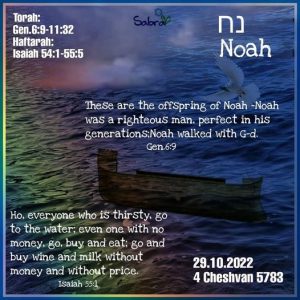
Murder comes in many different packages, physically, emotionally and spiritually. And we see how within just a few generations, things quickly plummeted to such a point that we read one of the saddest statements in the Bible in Gen. 6:7-8 where God observed the wickedness of humanity and we read that God regretted at that moment having created them. Only one person stood between God and humanity’s annihilation who was Noah, “…a just man, perfect in his generations, and walked with God.” – Gen. 6:9. Like the portion of Genesis that starts from ch. 1:1 and ends with ch 6:9, and contains all the most dramatic events since the dawn of time, the portion of Noach from Gen 6:10 has another set of events that are both dramatic and set the stage for all of human history until this very day. Noah trusted God and it was accounted to him for righteousness.
Every time we trust God against the flow of conventional wisdom or political correctness, against fierce opposition from without and within, we become heroes of faith in the sight of God as did Noah. Sometimes we ask ourselves whether it really is worth it? Paul thought so.
One word of recognition and commendation from God is better than a life time of worldly tributes and fame. In his words, “…every advantage that I had gained I considered lost for Yeshua’s sake. Yes, and I look upon everything as loss compared with the overwhelming gain of knowing Messiah Yeshua my Lord. ”
We can answer with a resounding “yes even though most of us don’t have it all together perfectly. In fact in the words of the poet, Ullie-Kaye, God says, “I never loved you because you had it all together. I loved you because you were falling apart and still saw fit to let me into your world.” This is the miracle of our God who takes us broken vessels and remoulds us into His image when we give Him permission. But don’t leave it too late when at the end of our lives we cry out in the darkness, “If only we knew what we know now.” That love conquers everything – that faith could move mountains – that good things happen to bad people and bad things happen to good people – that loud doesn’t mean strong and quiet doesn’t mean weak – that closed hearts are often hurt hearts that have yet to unfold – that silence can be both beautiful and terrifying – that healing takes time and time moves both quickly and unbearably slowly – that one step in any direction can change the course of your life forever – that bliss is sometimes just loving what you already have rather than wanting what you wish you had – that you will have days where you feel on top of the world and days where you feel like you have hit rock bottom – and that rising from the ashes requires going through the flames and that falling was part of it all.” Ullie-Kaye
Only one person stood between God and humanity’s annihilation. His name was Noah, “…a just man, perfect in his generations, and walked with God” in a world filled with evil (Gen. 6:9). Noah could have assimilated to the standards of the world, but, instead he and his family were saved in an ark which took 120 years to build. Throughout this period, he attracted constant ridicule as everyone mocked him for constructing a ship in the Sahara desert! After all, there had never been rain prior to the Flood. When we stand for righteousness we will always be mocked and ridiculed by others, even sometimes from those who call themselves ‘Christians.’
God destroyed all humanity except Noah and his family – 8 people who were saved in an ark that God had instructed Noah to build with precise specifications. Noah was saved by obeying God precisely. He was instructed to cover the ark inside and outside with pitch which in Hebrew is ‘kaphar’ meaning ‘covering’, the root word for ‘kippur’ from where we get the name, ‘Yom Kippur’ or ‘Day of Covering.’
Trusting God may sometimes seem absurd especially when it contradicts everything that seems rational and logical. These are times most critical for us to stand strong in the Lord. Every time we trust God against the flow of conventional wisdom or political correctness, against fierce opposition from both without and within, we too become heroes of faith just like Noah and countless others who have followed in his footsteps! God is searching for people like this His kingdom.
Yeshua described the end times as being as in the ‘Days of Noah’. And He said something easily overlooked. In Matt 24 He warned that before the Flood people, “… went on eating and drinking, taking wives and becoming wives, right up to the day Noah entered the ark; and they didn’t know what was happening until the Flood came and swept them all away. It will be just like that when the Son of Man comes………”
From this we are warned by Yeshua to prepare well, for just as the Flood came suddenly after 120 years, so it will be when the Son of Man returns, (24:37-44) God has called each one of us as with Noah to stand against the flow of ungodliness and walk in faith and obedience.
The majority of people in the world today (both non-believers but also many believers) live as though everything will surely eventually get better and are unaware of the precarious things happening around us in these end times and this is what Yeshua warns about. And this needs to be a wake up call for many. The sin of the Laodicean Church in Rev 3, was the sin of spiritual apathy.
From all the many lessons we learn from this parasha, God urges us to be those who are well prepared for Yeshua’s return.) Yeshua said that the great hallmark of faith in Him — of having the Torah written inside our hearts has not changed. When the Holy Spirit finds residence in our lives, everything else falls into place. His shalom fills us to overflowing despite all the evil around and about. So, we rejoice and are glad despite the perilous times we are living, in the knowledge that our redemption draws nigh as we live in the fullness of His calling.