Tazria (She conceives) Lev12:1–15:33;
2 Kings 4:42–5:19, 7:3–20; Matt.8:1–4, 11:2–6; Mk. 9:14–15
This week’s Torah portion is named “Tazria” meaning “She conceives” which has an interesting root from the word ‘Zarah’ meaning, “sowing a seed:” SHE CONCEIVES and SOWING A SEED. The Bible employs both meanings both literally and metaphorically.
The Bible frequently refers to sowing seed in the literal sense which people could easily understand since Israel was an agricultural nation and the word “tazria” was also frequently used as a metaphor (e.g., we sow in order to gain a harvest and what we sow we shall reap). It’s application was something everyone could easily access.
The phrase, ‘sowing a seed’ understandably is a common theme in the NT that appears 22 times – 15 times in the Gospels and 7 times in the epistles. A good example is in Gal.6:7-9 where Paul writes, “A man’s harvest in life will depend entirely on what he sows. If he sows for his own lower nature his harvest will be the decay and death of his own nature. But if he sows for the Spirit he will reap the harvest of everlasting life by that Spirit.”
Another connection related to ‘sowing’ as a consequence of ‘doing’ rather than just ‘hearing’ was reinforced by Yeshua who constantly urged people to be ‘good hearers’ reinforcing the cornerstone of the Jewish faith, “Shema Israel…” a call to apply the words of Torah in our lives – to hear and do.
When Yeshua taught, “He that has ears, let him hear” it was based on the practice that knowledge of God’s Word came from listening to it being read aloud after which it would be memorised. This is how the majority of people learned and received their education. Torah scrolls were handwritten and so scarce they were only available in the synagogue – normally one per town. Yeshua emphasised the importance of listening in the biblical sense and that hearing without doing is meaningless beautifully illustrated in the Parable of the Sower found in Matt.13.
An important point of the parable connects with what we must do to ensure that we ultimately earn a place in the good soil. No-one is born in the ‘good soil’, it’s a place we discover and choose to dwell in. We have all experienced the spiritual isolation of dwelling in the barren wayside, the shallow soil or the place where we are choked by the deceptiveness of the world. Scripture is full of examples of people who started well but ended badly (Solomon, King Saul) and even some who started badly but ended well (Manasah, Paul). Good that we start and end well but how do we avoid the many distractions the world seeks to trap us in that so many people fall into which have led to the shipwreck of their faith? This is something of great importance particularly in these end times where Yeshua prophesied that the ‘love of many believers would grow cold.’ The answer is in fact very simple. We must always take care to ensure that we place Yeshua first in our lives above all things without reservation but how we do this is something to consider for another time. Here is a good example I shared this morning on whattsap:
“I want to remember your face so that when I meet you in heaven, I will be able to recognise you and thank you once again.”
When Nigerian billionaire Femi Otedola in a telephone interview, was asked by the radio presenter, “Sir what can you remember made you a happiest man in life?”
Femi said: “I have gone through four stages of happiness in life and finally I understood the meaning of true happiness.”
The first stage was to accumulate wealth and means. But at this stage I did not get the happiness I wanted.
Then came the second stage of collecting valuables and items. But I realised that the effect of this thing is also temporary and the lustre of valuable things does not last long.
Then came the third stage of getting big projects. That was when I was holding 95% of diesel supply in Nigeria and Africa. I was also the largest vessel owner in Africa and Asia. But even here I did not get the happiness I had imagined.
The fourth stage was the time a friend of mine asked me to buy wheelchair for some disabled children. Just about 200 kids.
At the friend’s request, I immediately bought the wheelchairs.
But the friend insisted that I go with him and hand over the wheelchairs to the children. I got ready and went with him.
There I gave these wheel chairs to these children with my own hands. I saw the strange glow of happiness on the faces of these children. I saw them all sitting on the wheelchairs, moving around and having fun.
It was as if they had arrived at a picnic spot where they are sharing a jackpot winning.
I felt REAL joy inside me. When I decided to leave one of the kids grabbed my legs. I tried to free my legs gently but the child stared at my face and held my legs tightly.
I bent down and asked the child: Do you need something else?
The answer this child gave me not only made me happy but also changed my attitude to life completely. This child said:
“I want to remember your face so that when I meet you in heaven, I will be able to recognise you and thank you once again.”
What would you be remembered for after you leave that office or place? Will anyone desire to see your face again where it all matters?Are you planted in the good soil?
Related to this in this week’s parasha, are contained the laws of purity and impurity (tumah v’ta’harah). For example, in the NT Mary went through the Jewish rite of purification (ritual Mikvah) 7 days following the birth of Yeshua who was circumcised on the 8th day according to the Laws of Moses – followed by 33 days of ritual purity in accordance to the laws found here in this Torah portion. This was a period of isolation allowing for the bonding between a mother and child that provides us with the principle and importance of setting aside time alone with God as we reflect upon the the One who has given us new birth and is the Giver of Life.
The gematria of 33 has many interesting connotations. For example, 33 is the number that represents the Star of David – the One who is the ‘bright and Morning Star! The name Elohim is given first mention in the opening verse of Gen.1 (Bereshit bara Elohim et ha shamayim ve’et ha’aretz) that appears 33 times in the account of creation. 33 is also the numeric equivalent of the word “Amen.” (El melech na-aman).
As we know, with everything God creates, Satan seeks to counterfeit and there is another word connected to TAZRIA which is Tza-araat the name for a skin disease that could afflict people in addition to garments or homes. If white or pink patches appeared on a person’s skin (dark red or green in garments), it would be determined whether the affected person was tameh (impure) or tahor (pure). The most feared form of Tsa-arat was leprosy which rotted the flesh and disfigured the body causing incredible pain and was no respecter of persons.
A person afflicted with tza-arat was required to dwell alone in total isolation outside of the camp (Lev.13:45-46) “And the leper in whom the plague is, his clothes shall be rent, and the hair of his head shall go loose, and he shall cover his upper lip, and shall cry: ‘Unclean, unclean [tameh, tameh].’ All the days wherein the plague is in him he shall be unclean; he is unclean; he shall dwell alone; without the camp shall his dwelling be.”
Our Haftarah portion in 2Kings describes a connected incident during the time of Elisha with the Northern Kingdom. The city of Samaria had come under siege for 6 months from the King of Aram, Ben-Hadad, and the city faced imminent destruction.
A siege was one of the most cruel and difficult military tactics to deal with. With no incoming food, starvation, hunger, and desperation would eventually take over. Things became so bad that according to the biblical account two women decided to eat their babies in order to survive. 2Kings 7:3-10. According to the story, “…there were four men with tza’arat dwelling outside the camp who said to each other, “Why should we sit here till we die? 4 If we say: ‘Let’s go into the city,’ then the famine is in the city, so we will die there; but if we sit still here, we’ll die also. So come, let’s go into the camp of the Arameans. If they spare us, we’ll live; and if they kill us, we’ll just die.”
5 So they got up at twilight to go to the camp of the Arameans. But when they arrived at the edge of the Aramean camp, behold, no one was there! 6 For God had caused the army of the Arameans to hear a noise of chariots and a noise of horses—indeed a noise of a huge army. So they said one to another, “Look, the king of Israel has hired against us the kings of the Hittites, and the kings of the Egyptians to assault us.” 7 So they got up and fled at twilight, abandoning their tents, their horses and their donkeys—the entire camp just as it was—and fled for their lives.
8 When these men with tza’arat came to the edge of the camp, they entered into one tent, ate and drank, and took from there silver, gold, and clothes, then went and hid them. Then they returned and went into another tent, and took from there too, and went and hid them. 9 Then they said to each other, “It’s not right, what we’re doing. This day is a day of good news, and we’re keeping silent! If we wait till the morning light, punishment will overtake us. Let’s go now and report to the king’s household.”
10 So they came and called out to the city gatekeepers, and told them, “We went to the camp of the Arameans, and look, there was not a single soul there, no human voice—just the horses and the donkeys tied up, and the tents just as they were.” 11 Then the gatekeepers called out, and it was reported to the royal palace inside.”
God sometimes uses those scorned by the world who are treated as ‘lepers’ to be the very vessels who He uses to bring deliverance to others; those regarded as weak, foolish, insignificant, and despised by the world’s standards, to confound the wisdom of the world and the pride of life and bring glory to His name!
Scripture teaches that sin is the most serious of all problems that is comparable to tza-arat because it isolates us from God and its end is death. “All of us have become like one who is unclean, and all our righteous acts are like filthy rags; we all shrivel up like a leaf, and like the wind our sins sweep us away.” (Isa 64:6)
Only the blood of Yeshua can cleanse us from our sin. Just as Yeshua healed the lepers, so too He is able to save to the uttermost all who come to Him, and present us holy and without blemish to the Father.
The account in Scripture of Miriam’s leprosy (Num.12) connects tza-arat with evil speech (lashon hara). “Miriam and Aaron began to talk against Moses because of his Cushite wife. ‘Has the LORD spoken only through Moses?’ they asked. ‘Hasn’t he also spoken through us?” God’s anger was kindled against Miriam, and He afflicted her with this terrible disease, saying, “Why then were you not afraid to speak against My servant Moses?’ The anger of the LORD burned against Miriam. When the cloud lifted from above the tent, Miriam’s skin was leprous—it became as white as snow. Aaron turned towards her and saw that she had a defiling skin disease.” (Num.12:8–10)
Scripture considers gossip and slander to be a type of “moral leprosy,” and the rabbis believed tza-arat to be an affliction from God as punishment for all forms of destructive communication. The account of Miriam’s leprosy provides us as a caution against falling into the same trap ourselves.
In Tractate Sanhedrin 98b there is included a midrash (a commentary or exegesis) from Isa 53:4: “ What is his (the Messiah’s) name? The school of R. Shila said: His name is Shiloh, for it is written, ‘until Shiloh come.’(Gen.49:10 – ‘10 The scepter or leadership shall not depart from Judah, nor the ruler’s staff from between his feet, until Shiloh [the Messiah, the Peaceful One] comes to Whom it belongs, and to Him shall be the obedience of the people.’) The Rabbis said: His name is the ‘leper scholar, as it is written. ‘Surely He has borne our grief and carried our sorrows yet we did esteem Him a leper, smitten by God, and afflicted.” So we see here a description of the Messiah using this extraordinary term, the ‘Leper in the house of study.’
The sages believed that the healing of ‘tsar-arat’ was one of the signs that the Messiah had come: “What is his (the Messiah’s) name? – The Rabbis said: His name is ‘the leper scholar,’ as it is written, surely he hath borne our grief, and carried our sorrows: yet we did esteem him a leper, smitten of YHVH, and afflicted.” [Isa 53:4]
And in the commencement of Yeshua’s ministry, John the Baptist’s disciples came to Him asking if He was indeed the promised Messiah. Yeshua answered them, “Go and show John again those things that you hear and see: the blind receive their sight, and the lame walk, the lepers are cleansed, and the deaf hear, the dead are raised up, and the poor have the good news preached to them and are acquitted.” (Mat.11:4-5)
According to the sages, the Messiah would suffer the agonies of tza’arat by taking upon Himself the pain of His people who lived in (spiritual) exile. Scripture clearly prophesies that the Messiah would be afflicted by God – something akin to leprosy demonstrated when He bore our sins on the crucifixion stake.
The concept of the Messiah who would bear our iniquities described in Isai. 53, and be stricken with a form of this horrible skin disease is puzzling. Yeshua healed all who were oppressed by the devil but why was He not able to heal Himself? Isai. 53:4 states that, “…surely our grief He Himself bore.’’ The Hebrew word for grief is ‘sickness’ as connected to tza-arat. The Amplified Bible makes this clear: “Surely He has borne our griefs (sicknesses, weaknesses,) and carried our sorrows and pains [of punishment], yet we [ignorantly] considered Him stricken, smitten, and afflicted by God [as if with leprosy].”
Unredeemed humanity is so defiled by sin that even that which is considered righteous is like filthy rags to the One who is entirely holy. Isai.64:6 makes it clear that “…all of us have become like one who is unclean, and all our righteous acts are like filthy rags;”
As we fast approach Pesach our attention is focused upon God’s redemption through the blood of Yeshua our Passover Lamb who alone is able to cleanse us from every sin and defilement. Just as Yeshua healed the 10 lepers, (Lk.5:12-13) so too He cleanses all true believers and will present us holy and without blemish to the Father:
“He himself bore our sins in his body on the stake, so that we might die to sins and live for righteousness—by his wounds you were healed.” (1Pet.2:24)
During the Temple period, everyone sang the melodies as they worshipped God. The Psalms were written specifically for singing, but following the destruction of the 2nd Temple these melodies were lost in exile. Since then, the Jewish people have the Torah but have still not yet regained its melody, but one day soon they will worship at His feet and proclaim Him as their Lord and King.
The word ‘worship’ in Hebrew implies a ‘kiss,’ or to give reverence with a feeling of awe and devotion. Prov. 24:26 states that “An honest answer is as precious as a kiss on the lips.” (i.e., a sign of true friendship).
In biblical times, people would greet a friend with a kiss on the cheek as an open expression of friendship and mark of relationship between friends. Of course, there was also the counterfeit as with Judas Iscariot: “ Yeshua looked at him with sorrow and said, “A kiss, Judas? Are you really going to betray the Son of Man with a kiss?” Satan used a kiss—a sign of affection—to unleash a surge of hatred. Is this something we ever reflect upon at Pesach?
The highest position we can ever achieve is when we kneel in the presence of Yeshua, like the unnamed woman who anointed Yeshua’s feet with the most precious ointment and dried them with her tears. It was a kiss that drew the attention of the Divine – the bridegroom towards His bride – for it was in that spontaneous moment that He spoke tenderly to her with a glance in unspoken words. And for those in His presence who looked on in disdain He explained in mild rebuke, “She poured perfume on my body beforehand to prepare for my burial”. Only this woman, scorned by the company who surrounded her, understood the prophetic nature of her actions.
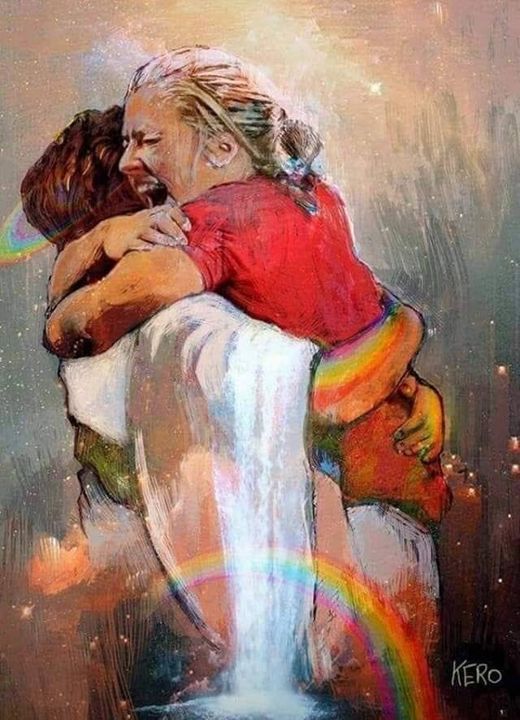
The last person who ever “kissed” Yeshua on the cheeks on earth was the traitor Judas. But, soon, the Bridegroom will return for His bride, and every true believer will be gathered to Him with a loud shout from the heavens and a piercing sound of the shofar. The time of betrothal will have ended and they will enter their eternal inheritance – the bride, pure and spotless – as they greet Him with joy unspeakable like a kiss on the cheeks, His words resounding in our ears, “Welcome home my beloved! Enter into your eternal rest.” No more tears of pain or sorrow crushed within the crucible of affliction, for they too will echo the words of Paul; “7 I have fought the good fight, I have finished the race, I have kept the faith. 8 Finally, there is laid up for me the crown of righteousness, which the Lord, the righteous Judge, will give to me on that Day, and not to me only but also to all who have loved His appearing.” (2Tim.4:7-8)