Parsha Yitro – Ex.18:1-20:23; Isai.6:1-7:6; 9:5-6 Matt.5:8-20
This parasha focuses initially upon Jethro (Yitro), Moses’ father-in-law, but also contains the giving of the 10 Commandments (or ‘utterances’) to the Israelites written by the ‘finger of God’ an event that was a watershed in separating the covenant people of God from the pagan nations. They are usually seen as two sets of five laws, the first set dealing with relationships between us and God, the second set focusing on the relationship between us and other people.
Some divide them into three groups of three. The first three (There is one God; We should have no other God; Do not take God’s name in vain) are about God, the Author and Authority of the laws. The second set (Keep Shabbat; Honour parents; Do not murder) are about creation. Shabbat reminds us of the birth of the universe. Our parents brought us into being. Murder is forbidden because we are all created in God’s image (Gen.9:6). The third three (Don’t commit adultery, Don’t steal, Don’t bear false witness) are about the basic foundations of society: marriage, laws of private property, and establishing a society of justice. Reject or ignore any of these and our freedom crumbles.
Where then would the tenth command fit into these sets?
“Do not crave your neighbour’s house. Do not crave your neighbour’s wife, his male or female servants, his ox, his donkey, or anything else that is your neighbour’s.” In Hebrew thinking the last item of a list is usually a summary of the other ones. To covet something, is to desire something at any cost that rightly belongs to someone else and is the antithesis of loving God as our primary objective and purpose in life. The Psalmist expresses it beautifully in Ps.73:25-26: “Whom have I in heaven but You? and there is none upon earth that I desire beside You. My flesh and my heart fails: but God is the strength of my heart, and my portion for ever. The tenth commandment is recognised as the most important commandment of all. All the others are physical acts of ‘dos’ and don’ts’ but the 10th commandment is an attitude of the heart.
The tenth commandment is traditionally recognised as the most important commandment of all. All the others are physical acts of ‘dos’ and don’ts’ but the 10th commandment is an attitude of the heart. Yeshua referred to this in the beatitudes where he made the point that hating another person is the same as committing murder (Matt 5:21) or lusting in one’s heart for a woman is the same as committing adultery. (Matt 5:27)
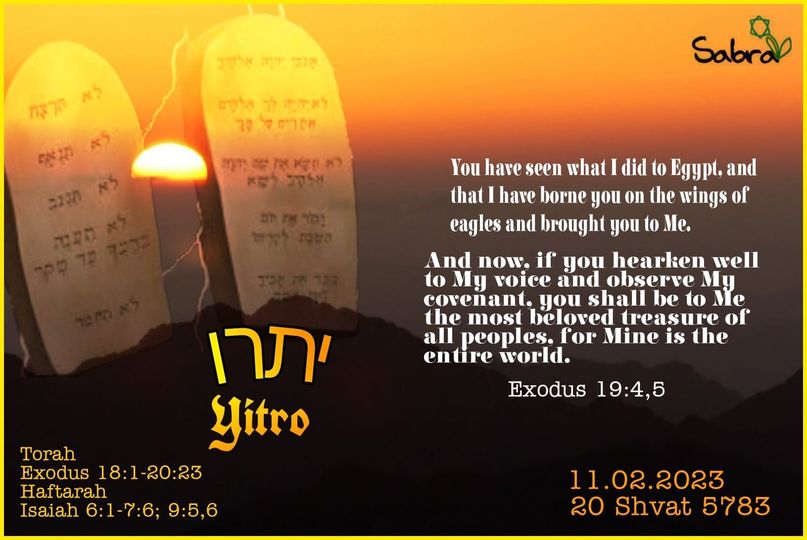
Moses went up the mountain where God promised him: “Now if you will pay careful attention to what I say and keep my covenant, then you will be my own treasure from among all peoples, for all the earth is mine; and you will be a kingdom of cohanim for me, a nation set apart.” (19:5-6)
God is making a conditional promise to Israel that He would embrace them as His special treasure. In Hebrew, the word for treasure is ‘segulah,’ from the word ‘sagol,’ meaning purple representing the colour of royalty.
This is why the concept of assimilation for Jewish people is considered abhorrent and unthinkable and to convert to Christianity is the unpardonable sin due to the track record of the church. So, it is here where we see the context. For even one person to break covenant with God in this manner is to betray and jeopardise the very promise made by God to Israel in ch.19:5-6. It is a collective promise not an individual one and therefore has to be understood collectively. Although we may strongly disagree with the prohibition for Jewish believers to be accepted for Aliya to Israel, we can now better understand the logic behind it. Sadly, it is based on the false premise that one is shedding one’s Jewish identity for a religion that has cause untold suffering for the Jewish people. But it is not the man-made religious traditions of the Church that has characterised a counterfeit christianity through the millennia which Messianic believers embrace but the biblical truth embedded in the Word of God which celebrates Jewish identity wherein we find our fulfilment through a living relationship with a living God through our Jewish Messiah!
The Israelites responded to the words of God very enthusiastically: “Everything Adonai has said, we will do!” (19:7) So what went wrong? Enthusiasm alone cannot guarantee fidelity to the Lord until it is grounded in relationship. I have made my decision; irrespective of everything I will follow the Lord unconditionally.
The Haftarah portion from Isa.6 follows on with this by emphasising that our intentions as illustrated by the Israelites can only be attained through a life characterised by holiness. The Haftarah portion highlights the true character and nature of God’s absolute holiness. And even as God is holy, He calls us to be the same: “But as he which hath called you is holy, so be ye holy in all manner of conversation; Because it is written, Be ye holy; for I am holy..” (1Pet.1:15 from Lev. 20:7)
Enthusiasm without true holiness morphs at best into an expression of empty religiosity because it is misdirected. Yeshua provides us with a yardstick: “If you love me you will obey my commandments.” And He continues with a promise: ” And I will ask the Father, and He will give you another Counsellor to be with you forever. He is the Spirit of truth. The world is unable to receive Him because it doesn’t see Him or know Him. But you do know Him, because He remains with you and will be(i) in you. I will not leave you as orphans; I am coming to you.” (John 14:15-18)
Sadly, the Haftarah portions skip the pivotal messianic prophecy in ch.7 commencing in vs.14-16 and it doesn’t take much imagination why: “14 Therefore the Lord Himself will give you a sign: Behold, the virgin shall conceive and bear a Son, and shall call His name Immanuel.”
The fulfilment of this prophecy was through Mary the mother of Yeshua.In one commentary, they write that:
“Jewish sages also believed that women would first receive the teachings of the Messiah. While Yeshua taught many women, we know from Scripture that another Miryam became the first eye-witness to Yeshua’s resurrection from the dead — the absolute sign of Yeshua’s Messiahship and victory over sin.
“Now after He had risen early on the first day of the week, He first appeared to Miryam of Magdala, from whom He had cast out seven demons.” (Mark 16:9)
In a culture where women witnesses were not thought to possess credibility, this is an extraordinary event that the Ruach HaKodesh (Holy Spirit) wanted us all to know.” Messianic Bible | news@biblesforisrael.com | Bibles For Israel | P.O. Box 8900 | Pueblo, CO 81008
In Heb.2:18-24 the writer employs a Messianic midrash (interpretation) to our Torah portion: “18 For you have not come [as did the Israelites in the wilderness] to a mountain that can be touched and to a blazing fire, and to gloom and darkness and a raging windstorm, 19 and to the blast of a trumpet and a sound of words [such that] those who heard it begged that nothing more be said to them. 20 For they could not bear the command, “If even a wild animal touches the mountain, it will be stoned [to death].” 21 In fact, so terrifying was the sight, that Moses said, “I am filled with fear and trembling.” 22 But you have come to Mount Zion and to the city of the living God, the heavenly Jerusalem, and to myriads of angels [in festive gathering], 23 and to the general assembly and assembly of the firstborn who are registered [as citizens] in heaven, and to God, who is Judge of all, and to the spirits of the righteous (the redeemed in heaven) who have been made perfect [bringing them to their final glory], 24 and to Jesus, the Mediator of a new covenant [uniting God and man], and to the sprinkled blood, which speaks [of mercy], a better and nobler and more gracious message than the blood of Abel [which cried out for vengeance].”[Heb12:18-24]
Yeshua provides each one of us with the means by which we can come into His presence and abide in Him through His blood covenant by His amazing love, compassion and mercy. He has made a way for us so that instead of being consumed by His absolute holiness – His ‘consuming fire’ of judgment – that same
consuming fire becomes a means of purification that cleanses us from all sin. What a wonderful thing we have through Jesus who gives us the possibility to come into the very presence of Almighty God, through His redemption! Yes, our God is ‘a consuming fire’ (Deuteronomy 4:24) but in His amazing love, compassion and mercy, He has made a way for humanity to be reconciled to Him. Instead of being consumed by His absolute holiness, we can enter into His presence through the reconciliation which Jesus won for us through His precious blood and be filled with His everlasting Life!
Another key focus of this Parsha deals with the wise counsel of Jethro: “Now Moses had sent his wife, Zipporah (bird), and her two sons back to Jethro from Egypt, and Jethro had cared for them in his long absence. Moses had named one son Gershom, because as he said, “I have lived as an outsider in an unfamiliar land.” 4 Moses had named the other son Eliezer, for he said, “My father’s God was my helper, and He rescued me from Pharaoh’s sword.” 5 Jethro (Moses’ father-in-law) brought Zipporah and her two sons into the desert to meet Moses when he and the people of Israel were camped near God’s mountain.”
A bit of background here: Moses had sent his wife Tziporah (bird) and his two sons Gershom (foreigner) and Eliezer (my God helps), and now Jethro returns to visit Moses and brings back his wife and sons. The fame of Israel had spread throughout the region how God had rescued them from the Egyptians and responded in one of two ways. Most of the surrounding nations were terrified because they could not stand against the One True God. But there were some individuals, and Jethro was one of them, who forsook their allegiance to pagan gods and aligned themselves instead to YHVH, God who is Lord over the entire universe He has created! (18:12-24) The same has been true throughout history. The majority of people reject Yeshua and rather choose to follow their own gods of this world – of materialism, power, status, and all the pleasures and enticements of Satan. Every person must one day stand before the Divine Judge and give an account of their lives, both believer and unbeliever and the choices we make have eternal implications for us.
Jethro, Moses’ father-in-law arrived to visit him with Tziporah and Moses’ two sons, Eliezer and Gershom where Moses offered him hospitality in accordance to the Jewish customs of that day. Then, we read something interesting:
13 The next day, Moses sat to judge the people, and they stood around Moses from morning till evening. 14 When Moses’ father-in-law saw all that he did for the people, he said, “What’s this you’re doing to the people? Why sit by yourself, alone, with all the people standing around from morning until evening?”
15 Moses answered his father-in-law, “It’s because the people come to me to inquire of God. 16 When they have an issue, it comes to me, and I judge between a man and his neighbor, so I make them understand God’s statutes and His laws.”
17 But Moses’ father-in-law said to him, “What you’re doing is no good. 18 You will surely wear yourself out, as well as these people who are with you, because the task is too heavy for you. You cannot do it alone, by yourself.
Why was this? Had not God equipped Moses with supernatural strength and ability as we saw throughout his encounter with Pharaoh to fulfil that which he had been commissioned and entrusted with by God? Jethro continued:
19 Now listen to my voice—I will give you advice, and may God be with you! You, represent the people before God, and bring their cases to God. 20 Enlighten them as to the statutes and the laws, and show them the way by which they must walk and the work they must do. 21 But you should seek out capable men out of all the people—men who fear God, men of truth, who hate bribery. Appoint them to be rulers over thousands, hundreds, fifties and tens. 22 Let them judge the people all the time. Then let every major case be brought to you, but every minor case they can judge for themselves. Make it easier for yourself, as they bear the burden with you. 23 If you do this thing as God so commands you, then you will be able to endure, and all these people will go to their places in shalom.”
There are two points here that are revealed in this text. One of them is very clear and the other is implied. What is clear was that an effective leader must not overreach themselves and consider themselves to be indispensable because it will only lead to disappointment. No-one is indispensable other than God. We are just His vessels and the moment we ignore this, pride creeps in and results in a fall that can lead to exhaustion, burnout and the destruction of all that has been built-up over a period of time. Our foundation that stands can only be built upon the rock, not on sinking sand. Matt.7.
The second point is more hidden but nonetheless critical in our service of the Lord. Now, Moses was not operating on his own but his wife and sons had been returned to him and he had a family to consider in addition to himself. Whenever we neglect our family there will be negative consequences, even when we place ministry over them. This has been the mistake of countless believers zealous for the Lord who ended up spiritually bankrupt as a result of falling into this trap with children who have forsaken the Lord and marriages that have fallen into disrepair.
24 So Moses listened to his father-in-law and did everything he said.
We do well to listen to the godly advice of others. Godly advice is different from ‘good’ advice. Most people are more than ready to offer their opinions, or as armchair critics tell us what we should be doing, or as fair-weather friends stick close to us until things go wrong or if we hit hard times, and then disappear. even the kisses of an enemy are profuse, but faithful are the wounds of a friend (Prov. 27:6) and there is a friend who sticks closer than a brother, and His name is Yeshua who never ever fails us and gives us the best advice in all situations if only we have ears to listen. And God provides us also with Jonathan friends, people who walk the walk and are bound together even as David and Jonathan were. In all of this, we must be discerning in our judgments when we receive advice whether from a trusted source that is tried and tested or, otherwise from a reliable and trustworthy source. We need to exercise caution as to whose advice we choose to accept and be wise as serpents but gentle as doves. (Ps.1)
The Midianites were descended from Abraham and his concubine, Keturah and for the most part were antagonistic towards Israel throughout their history. But here was something different. Jethro, a Midianite priest, offered Moses safe refuge for a period of 40 years when fleeing the Egyptians, and additionally blessed him with a wife, Zipporah who was his very own daughter, displaying honour and favour according to the culture of the times. And now, God’s blessing upon Jethro is reciprocated. Moses embraces him into the family of God where Jethro discovered a place of belonging and honour among God’s chosen people. His past as a pagan priest was behind him, the promise of a sure hope and future lay before him! The Egyptians who cursed Israel were destroyed, but Jethro who blessed Israel received blessings that were beyond his imagination!
Jethro was a Midianite, who held alliances with the Amalekites (the grandson of Esau) sworn enemies of Israel. Although puzzling, it reminds us against making generalisations about people and nations from which is found every evil root of discrimination. Jethro was clearly a lover of the Israelites. Just a few weeks ago marked the 60th anniversary of the Wannsee conference when the Nazis conceived and implemented the Final Solution – racism at its most violent expression ever devised – the plan to exterminate 11m. Jews from the face of the map of Europe. Despite the horror that such a thing could ever have been implemented by a nation considered to be the most civilised in the the world we must not fall into the trap of labelling all Germans as Nazis.
Moses’ two children are explicitly mentioned in this passage but only very briefly, earlier in a couple of other places in Exodus. (ch.2:21-22; 4:20) in his marriage to Zipporah (who was the pagan Midianite priest’ Jethro’s daughter) They named their first son, Gershom (‘foreigner’ or ‘sojourner’) and their second son, Eliezar (‘my God helps’) After this reference here in verse 4 to them it is the last time that we ever hear of the two sons. Yet, in the names of the two sons is hidden something for us of immense prophetic importance.
The name ‘Gershom’ (foreigner) is an unusual name, and goes beyond the fact that he was born in the land of Midian. (names have status and function) The name ‘Eliezar’ (‘my God helps’ and rescues me from Pharaoh’s sword) and when they are coupled together, something very significant is revealed prophetically as shadows of the physical reality.
The ‘foreigner’ (Gershon) and (‘Eliezar’ – God is my help) can also enter into covenant relationship with God. The children representing Jew and Gentile (Moses and Zipporah) would in the fullness of time become one in Yeshua. As written in Hosea 1:10, “Once you were “not a people,” but now you are “God’s people.” You were shown “no mercy,” but now you have been shown “mercy.”
God has designed us as the Body of Messiah to be dependent upon each other irrespective of status, background or culture. (1Cor.10: Heb 10:6)
Scripture also reveals something else which it presents as a warning to us: “Loved ones, I urge you as strangers and sojourners (GERSHONITES) to keep away from the fleshly cravings that war against the soul.” (1Pet. 2:10-11)
So here we see that as believers in Messiah we are simply those who are passing through whose eyes are fixed on a far bigger prize through Yeshua. In our passports is written ‘Citizen of Heaven’ and as such we have full rights that carry us through this life into the fullness of a glorious eternity that awaits us!