Most Christians joyfully celebrate Pentecost as the time of the pouring out of the Holy Spirit on the Church, but few realise that this special day originates as a Jewish holiday and miss out by ignoring the Jewish roots of their faith.
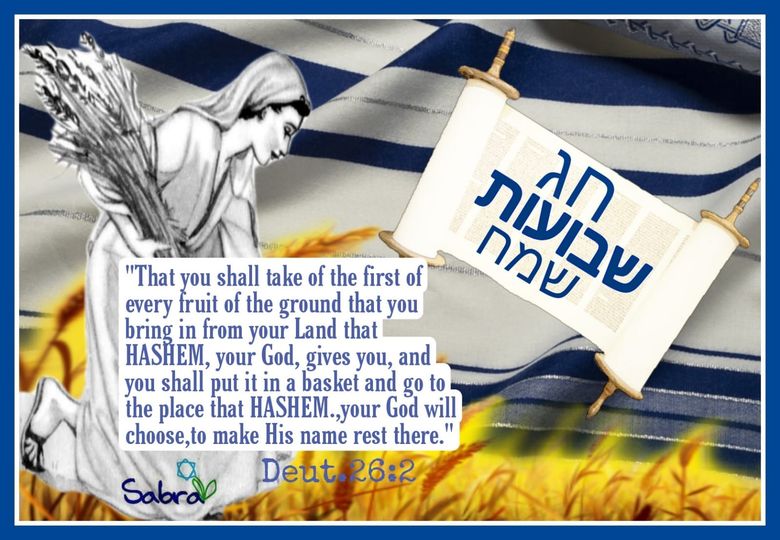
The biblical feast of Shavuot/Pentecost is the second of the Shelosh Regalim, three major annual pilgrimages that all Jewish men aged 20 or over were commanded to observe. In (Deut.16:16) we read that,
“Three times a year all your men must appear before the LORD your God at the place He will choose (Jerusalem): at the Festival of Unleavened Bread [Passover], the Festival of Weeks [Shavuot] and the Festival of Tabernacles [Sukkot].”
It is interesting that both Peach and Sukkot are celebrated over 7-8 days yet Shavuot only one day yet all three feasts are afforded equal importance. The sages explain that this is because God’s presence was so powerful at Shavuot that it couldn’t be contained for a longer period! But there is also another layer that whilst the stories of Pesach and Sukkot occurred over a period of time, it was not so with Shavuot – the giving of the Torah on Mt. Sinai and the Acts 2 event with the pouring out of the Holy Spirit were both ‘suddenly’ events, reminding us that our God is a ‘suddenly’ God meaning that we should always be prepared as we see end-time events unfolding exponentially as we await His imminent return.
Shavuot was originally considered a minor agricultural holiday. All Israel stopped work and came before God in the Temple to acknowledge Him as their provider. Only later, when the sages linked it directly with the giving of the Law at Sinai did it increase in prominence and during the Temple period, men would journey together with their families in large crowds to Jerusalem to celebrate the Feast.
Nowhere in the entire Torah is the date of Shavuot mentioned, only that it takes place on the 50th day following Pesach. The number 49 (the total number of days in the count from Pesach to Shavuot) represents the completion of a full cycle as we enter a new phase and beginning.
Shavuot is closely connected to Pesach. For example, at Pesach we eat only unleavened bread, reminding us of Yeshua’s offering of His sinless life for our sins. At Shavuot, two leavened loaves of bread are offered at the altar, the only occasion that leavened bread was offered by the priests and a future prophetic picture of how God would graft in the Gentiles into His Kingdom to become “one new man” (Jew and Gentile) in Yeshua.
At Pesach we are brought out of slavery, but at Shavuot we are brought into His fullness.
At Pesach, the Song of Solomon is traditionally read which is a story of betrothal but at Shavuot, we read the Book of Ruth which is a love story that ends with a wedding. Boaz fell in love with Ruth and married her but, according to tradition, died after being married for only one night; this was his sole purpose for coming into the world because through them was born David the ancestor of Yeshua our Mashiach.
As with all traditional Jewish marriages, the bridegroom gave his bride a special name. And so at Shavuot God called Israel His “Treasured possession.”.
It was through God’s covenant with Israel that they were birthed as a nation at Shavuot. On this occasion, they heard God’s voice like the sound of the shofar (trumpet) thundering from the mountain, accompanied by fire and lightning. The Jewish sages claim that they not only heard God’s voice but saw the words as a fiery substance coming upon each individual in the encampment. This is an amazing statement because it parallels the incident when crowds of Jewish pilgrims, who had gathered together in the first Shavuot following Yeshua’s resurrection, and witnessed the pouring out of the Holy Spirit upon a small group of Yeshua’s disciples.
The Book of Acts describes how these pilgrims had gathered in Jerusalem from all over the known world. Many of them, 3000 in total, returned home after the Feast born-again and filled with the Holy Spirit following Peter’s preaching explaining the significance of what they had witnessed – the prophetic fulfilment where God would write His law upon peoples’ hearts and empower them through the indwelling of the Holy Spirit to bcomee His faithful witnesses in Jerusalem, Israel and throughout the four corners of the earth – as He had promised them: “18 “I will not leave you as orphans [comfortless, bereaved, and helpless]; I will come [back] to you. 19 After a little while the world will no longer see Me, but you will see Me; because I live, you will live also. 20 On that day [when that time comes] you will know for yourselves that I am in My Father, and you are in Me, and I am in you.” (Jn.14:18-20)
Israel failed as God’s treasured possession as His representatives among the nations, but now they were presented with a second opportunity as they witnessed these things through a small Jewish remnant of believers. The tragedy is that after the Gospel was later spread to the Gentiles it quickly morphed into a hybrid of the original into a strongly anti-Semitic theology established by the Roman Catholic Church that filtered into the Protestant denominations until the present day. Israel may have failed, but the Church did no less without excuse.
John the Immerser prophesied over Yeshua at His baptism: “I am immersing you with water, but He who is coming is more powerful than I – I’m not worthy to untie His sandals! He will immerse you with the Holy Spirit and in fire.” (Luke 3:16)
There has never been a greater urgency for the fire of Shavuot to consume our lives than now in these current days. God looks beyond our imperfections to our heart as Scripture states how “…the Spirit searches all things, yes, the deep things of God?” (1Cor.2:10) In view of these things let’s engage in the Lord as never before and prepare ourselves as we await the return of our Lord and Saviour.
Many believers are fearful of entering into close fellowship with God like the Israelites because of the cost factor – the fire of God referred to by John the Immerser. Yet, those who unreservedly invite God into their lives understand His fire in a different light. Many are called but few are chosen because few are willing to choose this path, yet for those who do, there is a great reward!
Those who truly love Him are not fearful of being destroyed by His fire, and allow Him to purify, correct and cleanse us from every hindrance. God’s fire produces ‘first love’ which is a bridal identifier of a true believer who longs for more of Him. And the closer we grow to God, the more earnestly we desire to be conformed to His image, and therefore the less we will fear His fire.
Natural fire takes dense matter composed of different atoms and breaks them apart into simpler elements, usually gases and we notice that flames naturally flicker upward with the ignited gases producing the flame.
When we allow the fire of God to consume us, we become purified like silver in the refiner’s fire, transformed into His likeness!
The fire of God is holy which cleanses and purifies and its importance for us as cannot ever be overestimated, “14 Pursue … holiness without which no one will see the Lord,” (Heb.12:14).
God’s holiness does not conform to a standard because He is that standard. He is entirely holy with a fullness that is incapable of being other than it is. Because he is holy, every attribute of God is holy, which makes him, “Holy, holy, holy”.
When the fire of God descends upon us, He purges us of the sin that lingers and lurks in the shadows of our lives.
The fire of God defines the character of holiness. The true believer does not seek first to be happy but to be holy. When he does so, he gains both!
Let’s not limit the unlimited God by closing our hearts when He alone is the fulfilment to every godly desire. Let’s not reduce God to a theological formula. As Oswald Chambers stated: “(God) is not an eternal blessing machine; he did not come to save us out of pity; he came to save us because he had created us to be holy. The holy person is the most humble person you can meet. The holiest person is one who is most conscious of what sin is.”
Ultimately, this is one of the deepest and most vital truths we need to apprehend at Shavuot. All other parallels of Shavuot holding spiritual significance pale in comparison because without the fire of God all that remains are the residual embers. In view of this, let’s rekindle the flame and allow God unconditionally to invade our lives. And may He bless us and fill us with a double portion of His Ruach ha Kodesh as we eagerly await His soon appearing to gather us to Himself when we shall rule and reign with Him throughout eternity!