Counting of the Omer
“You shall count seven full weeks from the day after the Sabbath, from the day that you brought the sheaf of the wave offering. 16 You shall count fifty days to the day after the seventh Sabbath. Then you shall present a grain offering of new grain to the LORD. Lev.23:15-16
There are no real guidelines in the Bible for counting the Omer other than to begin the count the day after the day the First Fruits sheaf is waved. There are some controversies around which shabbat is being referred to in the Scripture from Lev.23, – the weekly Sabbath or the High Sabbath of the first day of Unleavened Bread.
The short version of the reason why is, when the Temple was destroyed, Rabbi Hillel came up with a calendar for observing the Feasts of God, so depending on how you interpret Sabbath contained within the Leviticus instructions, is when you start your Omer count.
Significance of Counting the Omer
Yeshua’s resurrection makes this period we are in known as the counting of the Omer a season of special significance and joy. For us as disciples of Yeshua, it is a 50-day period when we focus upon His resurrection. All His post-resurrection appearances fell within the days of the Omer count, including His ascension on the 40th day of the Omer Count, ten days before Shavuot (Pentecost).
The culmination of the Counting of the Omer within Judaism is the Giving of the Torah but for us it also aligns with the outpouring of the Ruach HaKodesh on the 50th day of the Omer at Shavu’ot (Pentecost). There is so much significance to the Counting of the Omer for us as believers, it’s not just some ancient or liturgical Jewish tradition, so here are a few passing thoughts for us for reflection.
Why Count 50 Days?
According to the sages, the Israelites were told that the Torah would be given to them exactly 50 days after their Exodus from Egypt. The people were so eager following their deliverance they immediately began counting the days with the expectation that with each day there was one day less to wait for the giving of the Torah! This midrash is an attempt to explain why the Torah would command the Israelites to count the days from Pesach to Shavuot. And so, every year the Jewish people commemorate the Giving of the Ten Commandments (The Ten Words, or Mattan Torah in Hebrew) following Pesach and begin the counting.
Then again, why did God wait 50 days after the Jews left Egypt before giving the Torah? Why didn’t He simply give it to them in Egypt, or immediately after their departure? Again, the Sages of Israel provide a midrash explaining that the Jews were not yet spiritually equipped to receive the Torah. For over 200 years, they had been living in an Egyptian society known to be the world centre for immorality and vice. Consequently, Israel had descended to the lowest level of sin, (which in Judaism is known as the “49th level of sin”) while in Egypt. According to tradition, at the 50th level God would have cut them off, but instead He decided to redeem them, because of His covenant with Abraham. The Omer count for Jewish people represents the way of teshuva, one day for each of the 49 “levels of sin” they had descended into while being slaves in Egypt. So for us as believers it helps us better understand why the counting of the Omer focuses upon the resurrection of Yeshua, His redemption won for us at a price greater than we can imagine, and our response to it.
10 miraculous plagues and the splitting of the Red Sea ― launched the Israelites into physical freedom. But the greatest miracle in itself cannot necessarily permanently change a person’s emotional state of being because it’s all about the choices we make. Spiritual growth, like climbing a ladder, usually takes place one step at a time. And our growth and Scripture compares spiritual growth to a marathon: 2Tim4:7-8: “ I have fought the good fight, I have finished the race, I have kept the faith. Now there is in store for me the crown of righteousness, which the Lord, the righteous Judge, will award to me on that day.”
So counting the Omer is not about a race to beat another person but rather a race to allow God His perfect way in our lives. As we climb the ladder, it’s more important in which direction we’re heading rather than which rung we’re on. In other words, don’t just count the Omer, but focus upon making the Omer count!
The key to get counting the Omer is to get to our destination one step at a time, by counting. The root word for “counting” in Hebrew is “chä·shav”, meaning to calculate or simply to count. The Torah, in describing the Omer, says, “count for you” (Lev.23:15) – because each person has to do this for himself. You have to get there at your own pace. You don’t want to climb a ladder and get tripped up between the rungs and fall! even if that ladder is Jacob’s ladder (the Messiah).
The last thought is that Pesach represents the relationship between Jew and Gentile believers and Yeshua, and Shavu’ot symbolises the marriage between the Bride and the Bridegroom. The mountain (Mt Sinai) represents the “chupa”, the tablets of sapphire with the Ten Words being the ring, and the Torah being the Katubah (the marriage vows). A biblical Jewish wedding is always preceded by courtship. Counting the Omer is symbolically the connector, the transition between these two.
What is the mechanism for preparing oneself for the wedding? It is to seek His face with an ever deeper thirsting as we await with great anticipation His soon return to gather us to Himself.
=============================================================
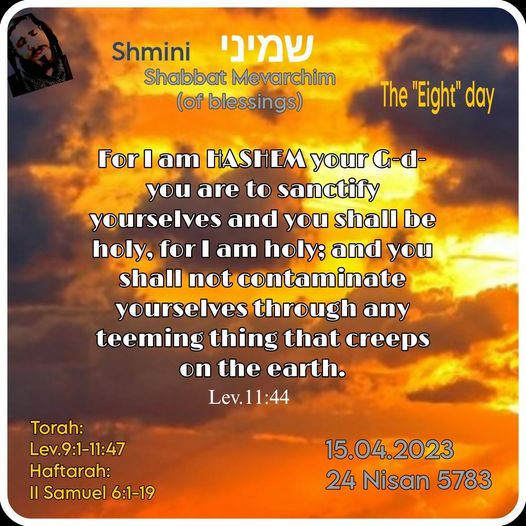
SHEMINI (Eighth) Lev 9:1–11:47; Num 19:1-22; 2 Sam 6:1–7:17; Mk 9:1–13
By Raphael ben Levi
Our Torah portion begins on the eighth day following 7 days of careful preparation following the construction of the Tabernacle. Priests were appointed and trained, and the parasha opens with the words, “…on the eighth day Moses summoned Aaron and his sons and the elders of Israel.” (Lev.9:1)
Following all the highs and lows of their 40-year wilderness wanderings, the Israelites witnessed a pivotal event as the Glory of God filled the Tabernacle that demonstrated the visible sign of His covenant that for us is a type and shadow of the Holy Spirit’s seal upon us.
It was at this stage with the priestly garments made, the timetable of the priests arranged, the offerings and duties organised even to the smallest detail – here in the midst of everything, a catastrophe occurred. Aaron’s two eldest sons appointed to serve in the sanctuary were destroyed by the holy fire of God. Scripture is explicit: “Aaron’s sons Nadab and Abihu took their censers, put fire in them and added incense; and they offered unauthorized fire before the Lord, contrary to his command. So fire came out from the presence of the Lord and consumed them, and they died before the Lord.” (Lev.10:1-2)
Sometimes bad things can happen to us that are defined as a “force majeure”, (an act of Heaven). But, in this instance there occurred something that was catastrophic yet avoidable. Nadab and Abihu, Aaron’s two eldest sons offered “unauthorised fire” [‘zarah’-something of another kind]. Any person who claims to identify as a committed believer whose life is filled with rebellion will harvest the fruit of their labour. In the case with Aarons two eldest sons it resulted in their deaths. To underestimate the holiness of God is to do so at one’s peril. In Acts 5, Annas and Saphira are an example who were struck down by God for something many church leaders today would trivialise. Paul describes how within the early Corinthian assembly several believers experienced sickness and death by participating in the Lord’s Supper carelessly. Now that’s food for thought…
No-one knows for sure what it was Nadav and Avihu offered as ‘unauthorised’ but It was probably connected with drunkenness, since shortly after this event God commanded Aaron in Lev.10:9-10 “Do not drink wine or intoxicating drink, neither you nor your sons with you, when you come into the Tent of Meeting, so that you will not die.”
To treat God’s holiness lightly is folly. Some believers who start well end up exchanging their relationship with God for the allurements of the world, with devastating results. Similar to Aaron’s two eldest sons, they may have experienced the glory of God at some stage yet allowed it to deteriorate into a second-hand memory. May we never allow Satan’s allurements to override God’s boundaries, but instead choose to live in the holy fear of the Lord, – always holding Him in reverential awe – because the fear of the Lord is the beginning of wisdom.
It was a profoundly sad moment when Aaron heard about his eldest two sons but God told him to keep silent about it. He was forbidden to publicly grieve or make excuses for their ungodly behaviour, nor show any outward emotion, or even question the Divine judgment of God. Yet how he must have pondered deeply where he had gone wrong as a father? But the fact remains that maybe it had nothing to do with him as a father as Scripture provides several examples of.
But one thing we do know is that the easiest and most natural thing for us as parents is to make excuses for our children no matter how deeply they may be entrenched in sin. But we cannot stand in their place on that day when each person must give an account of their lives before God. So it is contingent upon us to contend for their salvation for maybe we are the only people in the world who do so? SO many times I have heard testimonies of those who experienced NDE’s where they discovered that the only reason they were spared an eternity in hell was due to the prayers of a loved one. God is faithful as several people in our midst can testify to in this regard so let’s be encouraged to continue contending for our unsaved loved ones and never tire or become discouraged in the knowledge of God’s faithfulness!
There is a midrash of a king who once entered a city and all the inhabitants came out to applaud him. This pleased him so much that he said to them: “Tomorrow I will erect various kinds of baths for you, Tomorrow I will provide you with a water-conduit.” He went away to sleep, but never rose again. Where is he or his promise? But the point of the story is that with God it is different because He is always faithful to His promises. King’s Unfulfilled Promises – Tanhuma, 3rd century, Lev R 26:1
I want to share something that’s profound. King David experienced deep betrayal from people whom he considered were dear to him. In Ps.55:12-14 he cried out to God, “If it were just an enemy sneering at me, I could take it. If it were just someone who has always hated me, treating me like dirt, I’d simply hide away. But it is you! A man like me, my old friend, my companion.We enjoyed sweet conversation, walking together in the house of God among the pressing crowds.”
David was devastated, but in the end he could vouch for the faithfulness of God! “But for my part, [Adonai,] I put my trust in you!” He placed his confidence in the living God who never fails even in the worst moments that life throws at us or in the most impossible situations.
Here is something incredible. God can transform anything – the good, the bad and the ugly – and change it into something of inestimable value. Joseph could testify that what man intended for evil God turned for good. In His infinite compassion and mercy, He patiently takes the raw material of our lives – that formless lump of clay – and fashions it into something of infinite beauty! There are no limitations in the Kingdom of God for those who yield themselves unreservedly to Him!
The opening verse of our parasha specifically mentions the 8th day when Moses, “…summoned Aaron and his sons and the elders of Israel.” Eight in Scripture represents covenant and new beginnings. Here began a new phase for the Israelites with the introduction of the sacrificial system enabling anyone who sinned against God or their fellow man, to be reconciled, restored and forgiven. God’s provision was truly wonderful, unique and unprecedented. And yet, Heb.10:1-10 reveals that something in it all was flawed – not God’s provision but rather humanity’s inherent sinful nature that at best can only produces sticky-tape solutions. It states things very plainly:
“The old system … Even with its steady stream of sacrifices offered year after year, still was nothing that could make our hearts perfect before God. For if animal sacrifices could once and for all eliminate sin, they would have ceased to be offered and the worshipers would have clean consciences. Instead, once was not enough so by the repetitive sacrifices year after year, the worshipers were continually reminded of their sins, with their hearts still impure. For what power does the blood of bulls and goats have to remove sin’s guilt? So when Yeshua the Messiah came into the world he said, “Since your ultimate desire was not another animal sacrifice, you have clothed me with a body that I might offer myself instead! Multiple burnt offerings and sin-offerings cannot satisfy your justice. So I said to you, ‘God— I will be the One to go and do your will, to fulfil all that is written of me in your Word!’ ” … So by being the sacrifice that removes sin, he abolishes animal sacrifices and replaces that entire system with a newer covenant. By God’s will we have been purified and made holy once and for all through the sacrifice of the body of Yeshua, the Messiah!
Yeshua has provided us with something infinitely superior to the Temple sacrificial system through His sacrifice on the Cross in plain view that we are reminded of every time we celebrate Communion. Yeshua conquered death and rose from the dead on the 3rd day, on the 1st day of the week being the 8th day that offers a new beginning for every person who embraces Him as their personal Saviour and Lord. The Biblical number eight occurs several times in Scripture with 8 individual resurrections recorded in the Tanakh that finds alignment through Yeshua in the NT.
Among the prophets, the miracles Elijah performed were 8 in number and the miracles of Elisha were 16 because he received a double portion of anointing from Elijah (8×2).
The Greek name for Yeshua ‘Ihsous’ has a gematria of 888 because He is the perfecter and supreme provider of new beginnings for every sinner who repents that’s illustrated within the 7 names of Yeshua in Greek which are all stamped with the number 8.
So, on the 8th day following a week of purification, God’s glory descended upon Aaron and his four sons after they made sacrifices to Him- the sin offering – burnt offering – and the fellowship offerings. When they came out of the Tabernacle, Aaron blessed the Israelites; and the Shekinah Glory appeared to the entire population. It was a new beginning…
The Jewish people are confident of their continued existence as a greater reality despite the negative motivations of horrific anti-Semitism throughout the world that is growing exponentially day-by-day to the point that in many instances anti-Semitism has become embraced let alone legitimised. And whilst the politics against Israel among the nations are smeared with all manner of legalese and false accusations, whilst revisionists are busy seeking to rewrite history, and blood libels have become the order of the day, the Bible clearly states that God has already sealed the future, confirmed through His covenant promises. Though deeply concerning, Israel is not surprised by the nations’ who shake their fists against them since their isolation has been clearly prophesied in Scripture but so has the end of the story…
Since this is a true observation, how important it is for every believer to counter this in word and action as we stand for righteousness and godliness in a world that has capitulated to the evil of the day!
Allow me to spend a few closing thoughts reflecting upon the nature of leadership from our parasha with reference to Moses and Aaron, two great men of God who like each one of us held strengths and weaknesses. The first point is that our weaknesses do not necessarily disqualify us from the Kingdom of God but rather they are something God desires to transform – from weakness to strength to demonstrate that “…His grace is always sufficient for us for His strength is made perfect in weakness.” A principle running throughout Scripture is that people do not become great leaders due to natural talent but to the extent to which they submit totally to Him and choose to allow Him His perfect way in their lives.
Most people consider themselves inadequate for the task. Moses did. So did Aaron yet they were willing to trust God amid their sense of inadequacy when faced with impossible challenges and even amid times of failure.
The people who can sway crowds with their charisma and oratory are rarely among the greatest heroes in God’s sight because He never chooses people who speak with their own voice, telling the crowds what they want to hear. He chooses those who are fully aware of their inadequacies, who stammer like Moses did literally or metaphorically. He told people what they didn’t want to hear, but what they had to hear. What Moses thought was his greatest weakness was in fact his greatest strength.
Moses was not a natural leader – he depended upon God’s anointing. Aaron was not a natural priest – he also depended upon God’s anointing. Moses’ most important qualification was his humility rather than any inherently natural talent. Aaron had to understand that his own experience of sin and failure in the incident with the golden calf was a catalyst that transformed him into the representative of a people conscious of their own sin and failure.
Feelings of inadequacy can be bad news or good news depending on what you do with it. But, here is something we all need to be encouraged with – God’s faith in Aaron never wavered even when Aaron lacked faith in himself because God is never limited to the present and always sees the finished product rather than the work in progress.
When I was a young believer I would sometimes question why God would allow me to experience a sense of inadequacy? I hated that feeling yet now I can look back with a sense of deep gratitude knowing that God permitted it to happen in order to protect me from myself until I received His healing in the fullness of time.
God never intended for us to be anything less than what He created us to be. Our individuality is a gift and hallmark of our uniqueness which we surrender at our peril. Yet, it only resonates with true greatness when we allow it to be crafted by God rather than by the world.
There is a story of a person was strolling in the gardens on a visit to a mental institution when he met a young man who was reading a philosophy book. His apparent normal behaviour and good health made him stand out from all the other inmates so, intrigued, he sat down beside him and began a conversation asking him why he had been sent to this place?
The inmate looked at the person, surprised. However, since he was not one of the doctors, he replied:
‘It’s very simple. My father, a brilliant lawyer, wanted me to be like him. My uncle, who owns a large emporium, hoped I would follow his example. My mother wanted me to be the image of her beloved father. My sister always set her husband before me as an example of the successful man. My brother tried to train me up to be a fine athlete like himself. The same thing happened at school, with the piano teacher and the English teacher—they were all convinced and determined that they were the best possible example to follow. None of them looked at me as one should look at a man, but as if they were looking in a mirror. So I decided to enter this asylum. At least here I can be myself.’”
The good news is that amid all the challenges we face in these end times, God has never called us to be anything less than who we are in Him but simply invites us to allow Him permission to transform our lives! It is the greatest choice and investment in life we could ever make!