EX. 1:1 – 6:1 ISA. 27:6-28:13, 29:22-23; JER. 1:1 – 2:3 LK. 16-20
Time and again in Scripture some of the most significant historical events were preceded by the worst machinations of evil and slaughter of countless victims that raises the same question: why do bad things happen to good people in an attempt to rationalise something that many times defies human explanation.
God is faithful to His covenant people who turns catastrophes into victories. We saw this with the life story of Joseph, and many years later with the new Pharaoh following Joseph’s death as in this week’s parasha.
The word ‘crisis’ in Hebrew is the word, “Mashber” which can also mean, ‘a child-birth chair.’ This word is employed in Scripture in several places including Yeshua’s description where He compares it to the end times of birthing like the intense pain of a woman giving birth that ushers in something new speaking of the Millennium reign.
In these end times, many believers are facing unprecedented ‘crises’ but it is a battle that God is in full control of as a “Mashbar” a ‘child-birth chair’ that will eventually lead to the birth and dawning of a new age.
In this week’s Torah portion, God revealed His intention to redeem the Israelites from Egyptian bondage in the fullness of time that in this case was a period of several centuries. Why couldn’t it have been sooner? Because it was not in God’s perfect timing. Yet it contained the same pattern when God sent Yeshua to deliver us from the slavery of sin in the second Exodus! With these things in mind, let’s set the stage by turning to the passage in the Torah for this week from Ex.1:1-17:
“1 Now these are the names of Bnei-Yisrael who came into Egypt with Jacob, each man with his family: 2 Reuben, Simeon, Levi and Judah; 3 Issachar, Zebulun and Benjamin; 4 Dan, Naphtali, Gad and Asher. 5 The souls that came out of the line of Jacob numbered 70 in all, while Joseph was already in Egypt. 6 Then Joseph died, as did all his brothers and all that generation. 7 Yet Bnei-Yisrael were fruitful, increased abundantly, multiplied and grew extremely numerous—so the land was filled with them.
8 Now there arose a new king over Egypt, who did not know Joseph. 9 He said to his people, “Look, the people of Bnei-Yisrael are too numerous and too powerful for us. 10 Come, we must deal shrewdly with them, or else they will grow even more numerous, so that if war breaks out, they may join our enemies, fight against us, and then escape from the land.”
11 So they set slave masters over them to afflict them with forced labor, and they built Pithom and Raamses as storage cities for Pharaoh. 12 But the more they afflicted them, the more they multiplied and the more they spread. So the Egyptians dreaded the presence of Bnei-Yisrael. 13 They worked them harshly, 14 and made their lives bitter with hard labor with mortar and brick, doing all sorts of work in the fields. In all their labors they worked them with cruelty. 15 Moreover the king of Egypt spoke to the Hebrew midwives, one of whom was named Shiphrah and the other Puah, 16 and said, “When you help the Hebrew women during childbirth, look at the sex. If it’s a son, then kill him, but if it’s a daughter, she may live.” 17 Yet the midwives feared God, so they did not do as the king of Egypt commanded them, but let the boys live.”
TIMELINES
(Ex.12:40–41) “The time that the people of Israel lived in Egypt was 430 years. At the end of 430 years, on that very day, all the hosts of the Lord went out from the land of Egypt.”
(Gen 15:13) “Then the Lord said to Abram, “Know for certain that your offspring will be sojourners in a land that is not theirs and will be servants there, and they will be afflicted for 400 years.”
(Acts 7:6) And God spoke to this effect—that his offspring would be sojourners in a land belonging to others, who would enslave them and afflict them 400 years.
(Gal.3:16–17) “Now the promises were made to Abraham and to his offspring. It does not say, “And to offsprings,” referring to many, but referring to one, “And to your offspring,” who is Christ. This is what I mean: the law, which came 430 years afterward, does not annul a covenant previously ratified by God, so as to make the promise void.”
The Israelites were reduced to slaves in Egypt for over 400 years, a period of exile (affliction). How can one make sense of something like that? It was the same period of time that the Ottoman Empire ruled with a rod of iron across large parts of Asia and the mIddle East from 1617 – 2017 during the Sinai and Palestine campaign against the Ottoman Empire in the conquest of Palestine. Let me share a few interesting things here.
In the winter of 1917, the area around Jerusalem was a series of battlefields and was held by the Ottomans, with a mixture of Turkish and German troops.
The British commander in Palestine was General Sir Edmund Allenby. No Christian had governed the city since 1244. Fighting in the Judaean Hills had ceased by 3 December, and by 8 December the Turks were no longer defending Jerusalem.
General Allenby entered the city formally on 11 December, two days after the surrender. It was a carefully choreographed episode being the third day of Hanukah, a miraculous festival for the city’s Jewish population. the “third” day represents a day of significance, restoration, and rescue. And, in the Tanakh, the third day is the moment when an event attains its climax. It is repeatedly the day when a situation is completed or fulfilled.
Allenby rode up to the Jaffa Gate in the west of the city walls. Already there was great symbolism. Dan.12:12 predicted that there would be blessings for Jerusalem after 1,335 days and 1917 in the Islamic calendar was the year 1,335. More than that, the Islamic year ended on 8 December. 1335 was up so the interpretation was obvious.
There was more. Allenby arrived at the Jaffa Gate on horseback, then dismounted, and walked into Jerusalem on foot with his officers. He had come not as a conqueror but as a liberator, because he believed that only the Messiah would ride into the city. Allenby commanded an official proclamation to be publicly read out, designed to reassure a population which had seen Jerusalem itself fall without a shot being fired. It was printed in seven languages, including Hebrew that was the first official use of Hebrew in the city since it had fallen to the Romans in 70 AD. There is one more thing. In Arabic, General Allenby was called “Al-Nabi”. The phrase means “the prophet of God”. Can we see the finger-prints of God at work here?
Sadly, between 1917-1948, the British rescinded on their promise to hand over the land of Palestine to the Jewish people to what amounted to little more than a postage stamp compared to what had been originally offered to them. And furthermore, the British decided for political reasons to support the Arabs in their conflict with the Jews.
After the story of Joseph which we have just completed in the last few Torah readings, we are again faced with the dilemma of suffering in the story of Moses and the Israelites. Why do bad things happen to good people? How could God have allowed the Israelites to suffer slavery for over 400 years? We can only answer that in the end God’s timings are perfect and in everything He is always in full control. It is in times of perplexity however extreme that we need to firmly hold on to what we know about the nature of God: omnipotent, omniscient, all loving, gracious, merciful, faithful and holy, perfect in all His ways and timings. The Israelites had several generations to mull this over but we never read on any occasion when they turned their back on God. When things seemed that things could not get worse for the Israelites slaves, they just did!
The new Pharaoh “who knew not Joseph” decreed a massacre of new-born babies, a favourite demonic ploy of the enemy: we are reminded of King Herod who ordered the destruction of all children in Bethlehem under the age of 2; the Holocaust where Hitler destroyed over 1 million Jewish children in Western Europe, constituting three-quarters of the entire Jewish population, and in more recent times, the murder of unborn children that numbers tens of millions. There are innumerable examples where God sovereignly has intervened in this Holocaust and continues to do so to his day. But I will never forget the example of our pastor in Taiwan, Andrew Houghton, a wonderful man of God whose mother was a rape victim survivor, unmarried, who refused to have an abortion despite incredible pressure placed upon her by her family.
The consequence of godly obedience is always disproportionate and so much greater than the sacrifices we are willing to make for righteousness. We read in the text from Ex.1:15-21 that “…Moreover the king of Egypt spoke to the Hebrew midwives, one of whom was named Shiphrah and the other Puah, and said, “When you help the Hebrew women during childbirth, look at the sex. If it’s a son, then kill him, but if it’s a daughter, she may live.” Yet the midwives feared God, so they did not do as the king of Egypt commanded them, but let the boys live. So the king of Egypt summoned the midwives and said to them, “Why have you done this—let the boys live?”
The midwives told Pharaoh, “Because the Hebrew women are not like Egyptian women. They are like animals,[a] and give birth before the midwife comes to them.” So God was good to the midwives, and the people multiplied, growing very numerous. Because the midwives feared God, He gave them families of their own.”
Here in the opening chapters of Exodus we see one small episode easily overlooked that became the catalyst and turning-point in the history of humanity. Its key players were these two remarkable women, Shifra and Puah. Our sages note that this is the first recorded instance in history of civil disobedience where some basically nameless and faceless people refused to obey an order given by the most powerful man in the ancient world simply because it was immoral. They chose to obey God rather than the dictates of man.
Rabbi Sacks, added this astute observation. He said that, “It took more than three thousand years for what the midwives did to become enshrined in international law. In 1946, the Nazi war criminals on trial at Nuremberg all offered the defence that they were merely obeying orders, given by a democratically elected government. Under the doctrine of national sovereignty every government has the right to issue its own laws and order its own affairs. It took a new legal concept, namely a ‘crime against humanity’, to establish the guilt of the architects and administrators of genocide.
The Nuremberg principle gave legal substance to what the midwives instinctively understood: that there are some orders that should not be obeyed, because they are immoral.”
And in the immediate present, world Jewry who vowed, “never again!” are facing an existential threat unprecedented in modern history as Israel seeks to defend itself against an implacable foe surrounded by an enemy on 7 fronts that’s accompanied by growing support day by day from nations throughout the world including false accusations and blood libels reminiscent of a demonically inspired hatred of a people simply because they are Jews.
And yet, in all of this we also see a thread that reminds us that whatever Satan intends for evil, God will turn for good. The thing we cannot overlook or underestimate is the cost factor in the knowledge that although today the focus may be upon the Jews, tomorrow it could be knocking on every true believers’ door.
How do these things provide meaning for us? How does this connect to the mystery of suffering epitomised by the sacrifice of Yeshua for our redemption. “Though He was in the form of God, He did not count equality with God something to be grasped but emptied Himself and took on the form of a servant and in like manner humbled hImself even unto death on the Cross.”
This is a mystery we cannot fully grasp but no less changes the reality and its implications for all humanity.
The late Rabbi Sacks made these astute points: “Time became something understood as a journey or a quest. All this is hinted at in those three words, “I will be what I will be.” I am the God of the future tense. …Throughout the Torah, the promised land lies in the future. Abraham does not acquire it. Nor does Isaac. Nor does Jacob. Even Moses, who spends forty years leading the people there, does not get to enter it. It is always just beyond. Soon but not yet.
“I will be what I will be” means that I will enter history and transform it. God was telling Moses that there was no way he or anyone else could know in advance what God was about to do. He told him in general terms that He was about to rescue the Israelites from the hands of the Egyptians and bring them to a land flowing with milk and honey. The destination to which I am calling you is just beyond the visible horizon.” With one exception – God invaded time by sending Yeshua into the world to demonstrate that He is not only the God of the future but also the God of the eternal present – “I am who I am” and simultaneously “I will be who I will be”.
God’s eternal plans remain entirely intact and contain a good ending.
The Bible informs us that following the history of the unfathomable suffering of the Jewish people, the end will be good. And this will come following Israel’s recognition of Yeshua before His glorious appearing at the end of this age.
There, in a spirit of great mourning and repentance the Jewish people will experience the fruit of God’s salvation followed by unprecedented blessings beyond imagination. Scripture tells us that David’s dynasty will be re-established when Yeshua returns and we are seeing the reality of that unfolding before our very eyes!
But, if you as an unsaved Jew were there at the time of Israel’s impending annihilation as the nations surround it poised for its destruction, would you be able to make any sense of it? So what does Israel do finally? They cry out to the God of Abraham, Isacc and Jacob for mercy, and Yeshua reveals Himself to them, intervenes to deliver them, and they shall look upon Him who they have pierced and recognise Him as their Mashiach, the veil will be lifted and they will embrace Him as their Messiah.
God consistently turns what appear to be catastrophes into moments of sweet victory. We saw this with the life story of Joseph, and many years later with the new Pharaoh following Joseph’s death, in the life, death and resurrection of Yeshua the Messiah and finally in our very own lives. Whether you may be at the beginning, middle or end of an overwhelming challenge and are wondering what life is holding for you, hold on tightly with every vestige of strength in the knowledge that God who is ever faithful will bring you through into a place of greater glory than before!
Rabbi Jonathan Sacks commented about this when he said:
“…It goes back to the moment in which the (Jewish) people received its name, Yisrael – Israel. Yaacov wrestled alone at night with an angel, until dawn broke, when his adversary begged to be let go. “I will not let you go until you bless me,” said Yaacov (Bereishit 32:26). That is the source of what he termed the Jewish people’s “distinctive obstinacy that became the basis of his new name and identity. Yisrael, the people who “wrestled with God and man and prevailed” (Bereishit 32:28) is the nation that grows stronger with each conflict and catastrophe.” And this is no less true than for every true believer whether Jew or Gentile – the same principle applies. In this week’s Torah portion, God revealed His intention to redeem the Israelites from Egyptian bondage in the fullness of time – from slavery to redemption, and again the same pattern applies in the manner that God sent Yeshua to deliver us from the slavery of sin.
God’s faithfulness is no better demonstrated than here in this parasha as He moved the chess pieces behind the scenes when everything looked so bleak for the Israelites – so characteristic of what we saw recently when we celebrated Hanukah and what we will also see demonstrated as in the Feast of Purim coming up in March.
These things are a hallmark in the Book of Exodus speaking of God’s dealings and redemptive acts for the Jewish people who in the beginning had no outlook or any kind of future to look forward to – until a time planned by God before the foundations of the earth were created, where He sent Israel a deliverer at just the right time. Out of slavery came redemption. The story of the Exodus reminds us that God not only delivered the Israelites from Egyptian slavery but continues to do so for every true believer – out from the slavery of sin into His glorious light through the Lamb of God – a shadow of God’s redemptive purposes in the fullness of time.
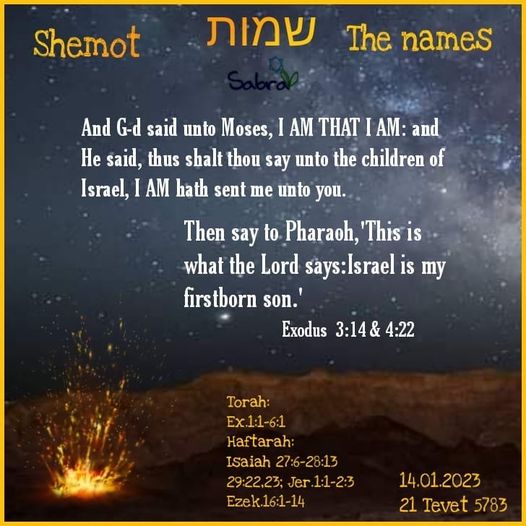
He is a God in whom “there is no change nor shadow of turning.” He is a God whose name is “Ehyeh Asher Ehyeh” – “I Am that I Am,” though with the Hebrew grammatical form in the future tense it could be more accurately translated, “I will be what I will be.” In other words, we have confidence to trust Him in every circumstance at every moment in time from the beginning to the end because He is the Aleph and the Taph and everything in-between who has delivered us from the slavery of sin and given us eternal life through our precious Saviour, Yeshua Ha’Mashiach!
Israel has gone through many hoops from their days of Egyptian slavery to the present time, but at a every point God has been entirely faithful which should give us as believers the joy, confidence and perseverance when confronted with wave upon wave of evil that’s drowning the world in darkness and despair. This is our moment of opportunity to engage in sharing God’s love whilst there is yet time as we fulfil the destiny and calling upon our lives.