Many people work to live and others live to work, but there is a third option: to live for Yeshua. “For me to live is Christ and to die is gain!” – the greatest investment in life in season or out. Everything is transformed into a form of accelerated worship for His glory from the most menial and overlooked action.
Many years ago during my devotions, the Lord spoke to me regarding this and to paraphrase, He told me: “I so much long for all your worship, not just the fragments diluted by the applause of others.” God revealed my heart with things I was unaware of because Divine love exposes anything that comes in-between a living relationship with Him. Our destinies are enfolded in the choices we make. True worship uncovers everything including the “little foxes which ruin the vineyards that are in bloom.” (S.of S. 2:15) and we must make a choice.
It seems strange that in the middle of a romantic, tender conversation, the matter of a fox hunt is included in the Song of Solomon. The foxes are clearly symbolic but the point is very clear. There is a need to remove the “foxes”— everything which threatens the relationship. The foxes are “little”— things that are easily overlooked, that spoil rather than enhance. God challenges us to address anything that threatens our relationship with God, the “little foxes” that spoil the vineyard
We cannot overestimate the power of true worship couched in first love! Worship blesses God manifoldly. Heaven is saturated with melodies of exquisite praise. Yet, nothing blesses God more than when His children offer unto Him heart worship in the beauty of holiness. King David clearly understood this and so in all his military engagement he placed the worshippers (temple priesthood) in the front line.
At the end of the day, all that is of ultimate importance, all that God searches for, are those who seek Him above everything else, who have cultivated a relationship of first love because this is the highest form of worship, the mark of His Bride, and the identifier of His remnant.
I may strive to make millions of dollars, but it will never in itself change my life: it’s simply hard labour. But when we enter His Sabbath rest and God enfolds us in His love, our lives become irrevocably transformed. If God may ask us how much we love Him, just as He did with Peter, the manner in which we respond with painful honesty encapsulates worship in its fullness because with it come transformation.—————————————————————————————————————
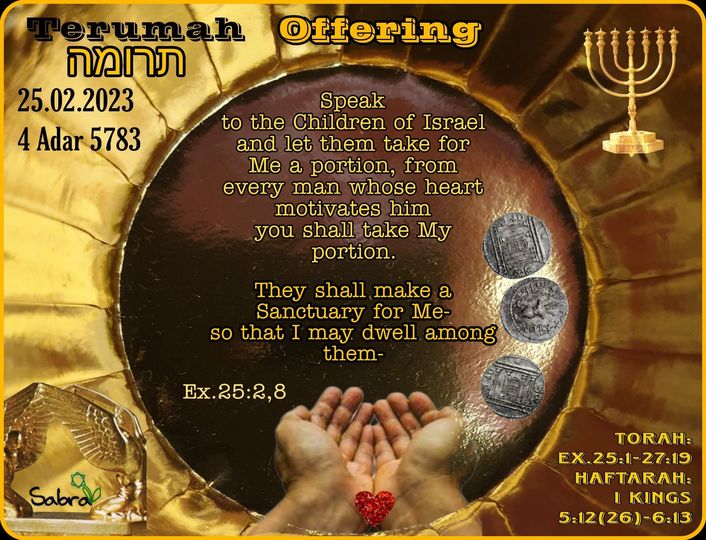
PARASHA TERUMAH – Ex.25:1–27:19; 1 Kings 5:26–6:13; Heb 9:1–28
Before I begin, can I write a disclaimer with a story who the great Hassidic Rabbi Mordechai of Lekovitz once shared when passing through the town of Minsk expounding the parasha to various Talmudic scholars there. They didn’t like what he shared and told him indignantly,
“What you say does not explain the Parasha in the least.” “Do you really think,” he replied, “that I was trying to explain the verses in our Torah portion? That doesn’t need any explanation! I want to explain the verse that is within me.’”
So I pray that the Holy Spirit will speak to our hearts what my words cannot adequately express and that it will bring us into a deeper appreciation of His unfathomable love.
Terumah begins the longest single passage in Exodus taking us to the end of the book where it describes in minute detail instructions for the construction of the Mishkan (Tabernacle) that was to become first collective house of worship of the Jewish people. It was there that God commanded Moses to take up a freewill offering (a terumah) from the Israelites. This was entirely voluntary for establishing a place of worship where God Himself would reside. And amazingly, the response was overwhelming where everyone gave according to their means that resulted in an overflow which is always the case when we choose to give God our best! From this parasha onwards until the end of Exodus we are provided in minute detail about the construction of the Mishkan, (Tabernacle) the first collective house of worship for the Israelites.
Unlike the golden calf that was a counterfeit offering the Tabernacle was established entirely out of voluntary offerings,. The Tabernacle represents the signature of a person’s life who is wholeheartedly and voluntarily submitted to the One who ‘tabernacles’ in us. “The Word was first, the Word present to God, God present to the Word. The Word was God, in readiness for God from day one. (And tabernacled with us.” (Jn.1:1-2)
The Terumah, was one of five different types of offerings in the Tabernacle. Five is the biblical number representing grace, and Yeshua fulfilled all five offerings when He offered Himself as a sacrifice for us for our sins on the Cross: “By Grace we are saved through faith.” (Eph. 2:8)
God offers us His best but we don’t always understand correctly what that may mean. Once, reflecting upon this, a poor man asked God a question, “Lord, what is a million years to you?” God replied, “My son, a million years to you is only like a second to me.” Then the man asked, “Lord, what is a million dollars to you?” And God replied, “My son, a million dollars is less than a penny to me. It means almost nothing to me.” The man asked, “So Lord, can I have a million dollars?” And God replied, “ Okay, in a second!”
I share this because the story illustrates a fundamental principle in Scripture that’s embedded within Judaism known as ‘tzedekah’ (charity) where even the poorest person in the most wretched of circumstances can contribute something as Yeshua illustrated with the widows mite. The pashat implies that the widow gave everything from the little she had compared to the religious hierarchy who gave out of their abundance was this. But the underlying remez is that to receive but never to give is to lack in the very basics of human dignity and identity.
Until this point in Israel’s history, the Israelites had received many miracles of provision from God, but here for the first time they were given the opportunity to give back something to Him – a terumah – a freewill offering. And it begs the question how can we ever begin to repay God for sending us His most precious gift of all: His dearly beloved Son, Yeshua? (Jn. 3:16)
The word ‘Terumah’ meaning “a voluntary contribution,” literally means ‘something you lift up by dedicating it to a sacred cause.’ You lift it up, then it lifts you up. This again holds profound implications because God doesn’t live in a house of stone but in the hearts of those who give generously, as encompassed in Rom.12:1-2 – when we surrender our lives as “living sacrifices” to Yeshua – body, soul and spirit – it represents generosity in its fullest definition.
The Tabernacle’s construction is strongly connected to the Book of Genesis in ch’s1-2. which begins with an act of Divine creation, and in Exodus ends with an act of human creation with the Tabernacle. But there’s more. The Tabernacle represented a miniature universe constructed with the same precision, Divine wisdom and order, as the universe which God created. God spoke His creation into existence and the Tabernacle was formed in accordance with His spoken instruction that became a dwelling place for the Divine.
Scientists have confirmed that the dimensions of the universe are totally precise mathematically. Had they differed even in the smallest detail it would have been impossible for any form of life to exist. No wonder because God is perfect so His ways are also perfect.
The Tabernacle became a visible reminder of God’s presence in the midst who occupies the entire universe He created. Nothing in God’s creation, no physical space, however large, is big enough to contain Him and no space is too small that can conceal Him. It was Israel’s first creative achievement signalling the amazing reality that we too as believers can become a home for His Divine presence.
And in the interim, “…neither life nor death, nor principalities, things present nor things to come; neither height nor death nor any created thing can ever separate us from the Love of God in Messiah Yeshua our Lord! (Rom. 8:37-39)
God exceeds eternity because He is the Creator of eternity and infinity is just another one of His creations. No physical space, however large, is big enough to contain Him and no space is too small that can conceal Him. The Tabernacle was a visible reminder of this which is mind blowing when one considers that the same person who occupied a tiny space in the tabernacle, also fills the entire universe He created!
The biblical account of Creation contains just 34 verses compared to 100’s of verses with the construction of the Mishkan which may appear puzzling because the universe is infinite in size compared to the smallness of the Mishkan and, therefore, surely higher in significance?
The length of any description in Scripture is a guide to determine its importance. The sages explain that the Torah devotes an enormous amount of time to the Mishkan for it’s not difficult for God to make a home for humanity as in the Creation narrative. What is difficult is for humanity to make a home for God as illustrated with the Mishkan point for point with types and shadows that have been the topic of countless books in history.
Throughout the Israelites ups and downs, there was never a moment when the Shekinah glory departed throughout their 40-year sojourn. This is remarkable. Despite their frequent murmurings and rebellions, the Israelites nonetheless followed wherever the Shekinah led them. This provides testimony to the faithfulness of God! However imperfect our obedience may be and even though we may mess up, sometimes in great measure, He remains faithful because faithfulness is what is stamped alongside His name.
Although each believer holds an accountability before God which holds consequences it still endorses the fact that we serve a God who is able to do exceedingly abundantly above all we can think and imagine because He is a God of new beginnings and second chances who uses even our failures and mistakes that are interwoven into His Divine purposes.
In recent times I find myself spending more and more time reflecting upon the incredible love of God which is something I find I can scarcely articulate. And though I apprehend it with both hands it still causes me agony of soul because of the paucity of my giving to Him compared to what He has given me. And I so much want to be able to give Him more than my best – to signal my deepest appreciation to the One who means more to me than life.
But recently, I heard a story by the late Rabbi Jonathan Sacks which brought me a level of understanding that put all of that to rest. He spoke of when he was a child of around 6-7 years of age. He shared how blessed he was with very caring and protective parents. Life had not given them many chances, but they were determined that their children should have some of the opportunities which they themselves were denied. It seemed to the children very important to show their father their gratitude in whatever way they could. But what could they possibly give him? It seemed to them to be a completely asymmetrical relationship. And then, eventually, in some shop where Jonathan searched, he found a plastic model of a silver trophy. Underneath it was a plaque that read, “To the best father in the world.” Even many years later, Jonathan would cringe at the memory of that object. It was cheap, (probably made in China) and almost trite. What was unforgettable, though, was what his father did after Jonathan had given it to him.
What he remembered was that his father placed it on his bedside table, where it remained for all the years that Jonathan was living at home.
The point is that Jonathan’s father gave him the freedom to give him something, and then showed that the gift mattered to him. He allowed him to recognise that he could give to one who had given him all he had however paltry it may have looked like in the eyes of the world. And even in its small but human way, his father demonstrated that when he put the cheap plastic gift by his bedside all those years ago to the man who became the great Lord Rabbi Jonathan Sacks, it was perhaps the most generous thing he had ever done.
God wants us to know that His love is so great that our best is always good enough for Him. This is what I now understand not just theologically but in the deepest recesses of my heart. And how stupid of me to ever imagine that I can love like He loves – but it will never prevent me from trying! Paul summed things up when he wrote: “…22-25 All around us we observe a pregnant creation. The difficult times of pain throughout the world are simply birth pangs. But it’s not only around us; it’s within us. The Spirit of God is arousing us within. We’re also feeling the birth pangs. These sterile and barren bodies of ours are yearning for full deliverance. That is why waiting does not diminish us, any more than waiting diminishes a pregnant mother. We are enlarged in the waiting. We, of course, don’t see what is enlarging us. But the longer we wait, the larger we become, and the more joyful our expectancy.” (Rom.8:22-25)…
“God knew what he was doing from the very beginning. He decided from the outset to shape the lives of those who love him along the same lines as the life of his Son. The Son stands first in the line of humanity he restored. We see the original and intended shape of our lives there in him. After God made that decision of what his children should be like, he followed it up by calling people by name. After he called them by name, he set them on a solid basis with himself. And then, after getting them established, he stayed with them to the end, gloriously completing what he had begun.” (Rom.8:29-30)
“None of this fazes us because Yeshua loves us. I’m absolutely convinced that nothing—nothing living or dead, angelic or demonic, today or tomorrow, high or low, thinkable or unthinkable—absolutely nothing can get between us and God’s love because of the way that Jesus our Master has embraced us.” (Rom.8:39)
Yeshua desires to reign within us who alone makes ‘all things new’. What greater offering can we ever give in response to this other than the totality of our lives? Let’s give Him our best rather than the scraps under the table, yet even then Yeshua will take us in His embrace though He receives so little. Yet can we then bear looking at the sadness in His eyes from one who has invested so much in us?
At the cross, we encounter God’s justice through the judgment of sin, God’s love and mercy through the forgiveness of sinners, and God’s power through His defeat of Satan (Rom.3:21–26;Col.1:13). At the cross, Yeshua brings salvation to those who believe, and judgment to those who refuse to believe. In God’s wisdom and holiness, the cross opens the only way to the Father for sinful humanity (Jn.14:6). At the cross, Yeshua sets us free from the chains of sin. The lifting up of Yeshua on the cross is the greatest demonstration of Divine ‘terumah,’ a freewill offering, and a demonstration for all humanity for all time that whilst we were sinners, yet Messiah Yeshua died for us – a Divine blessing brought to us on bended knee. Again I say, what less can we give in response other than the totality of our lives?
And so we make our stand and a clear and bold declaration that is unequivocal. No longer do we pay homage to the gods of this world or to the second-hand cast-offs of theological mediocrity. Nothing will quench our eternal debt of thanks to the Author and Finisher of our faith who turns even our failures into victories.