Let me share with you some words I came across recently regarding the Kingdom of God from a friend of mine, that really touched my heart:
I figured out very early in my faith what kind of kingdom God runs. It is not the kind of kingdom the world glorifies. It is not built on fame or money or power. It is not a place where the loudest voice wins or where success is measured by status. God’s kingdom is different. It is backwards to everything human logic says makes sense. It is upside down to the way the world operates but perfectly aligned with Heaven’s heartbeat.
(It reminded me of a Scripture in Rom.12:2)
“2 And do not be conformed to this world, but be transformed by the renewing of your mind, that you may prove what is that good and acceptable and perfect will of God.” (Rom.12:2)
“Don’t let the world around you squeeze you into its own mould, but let God re-mould your minds from within, so that you may prove in practice that the plan of God for you is good, meets all his demands and moves towards the goal of true maturity.”
When we become a believer we become re-educated as we allow the Holy Spirit to remould our minds from within. And she continues,
The backwards kingdom is where strength is found in surrender and power is found in humility. It is where those who seem overlooked are the ones God uses most powerfully. It is where the rich are those who give everything away and where the greatest are those who serve in secret. It is where Yeshu washed the feet of His disciples even though He was the Son of God. It is where the cross, a symbol of defeat in the eyes of men, became the ultimate symbol of victory in the eyes of Heaven.
Living in this backwards kingdom means denying yourself, your desires, your pride, your comfort, to pursue what God desires. It means choosing love when bitterness feels easier, choosing fairness when the world plays favourites, choosing to give when it would be simpler to take. It is a life that looks foolish to the world but glorious to God. Because in this kingdom, love always wins.
When you follow Yeshua, you learn that everything He calls you to do goes against what the world tells you to do. The world says fight back, Yeshua says forgive. The world says hoard, Yeshua says give. The world says chase comfort, Yeshua says take up your cross. The world says look out for yourself, Yeshua says lay down your life for others. What looks like loss is actually gain and what feels like sacrifice is the path to joy.
This is the kind of kingdom we are invited to live in. One where Heaven touches Earth through the hands of those who love like Yeshua. One where generosity replaces greed, unity replaces division, and grace replaces judgment. It is the kind of kingdom that cannot be shaken because it is built on the unshakable love of God. So when things seem upside down in your life, remember that maybe you are finally standing right side up in the kingdom of Heaven.
We have seen the kind of kingdom that the world runs. But God’s kingdom is not like that. His kingdom runs on love, mercy, and grace. It is a place where the humble are lifted up and the broken are made whole. It is a kingdom that values the heart more than status, the spirit more than possessions. While the world says take, God says give. While the world says climb to the top, God says kneel and serve. While the world says seek revenge, God says forgive.
Every time we choose love over pride, every time we show kindness instead of judgment, every time we give instead of hoard, we are building God’s kingdom right here on Earth. We are living proof that Heaven’s way is better than the world’s way.
So even when it feels like darkness is winning, remember that the light of God’s kingdom shines brightest in the darkest places. The world’s kingdom will crumble, but God’s will last forever. And we have been called to be part of that eternal kingdom, to live differently, to love deeply, and to show the world that Jesus is the only true King worth following.
You will know My disciples by the way they love. Love is the evidence. Love is the fragrance. Love is the mark stamped on a life that has actually been with Yeshua. Because at the end of the day, the question is not whether you have ever failed. The question is whether you are willing to let God transform the way you respond. Real love does not make excuses. It makes room. It sees past behaviour into the bruised places of the heart. And it speaks with the voice of the One who rescued you.
May our lives be the kind that shows Yeshua without needing to announce it. May people feel Him in the way we listen, in the way we speak. And may the love we give be the proof that He has been reshaping us from the inside out.
Rabbi Carlebach said this: “The downfall of the world was caused by two things. The first is that Eve ate, and gave Adam to eat, the forbidden fruit. Yet, we were not driven out from Paradise at that exact point of time. We were driven out when God asked Adam and Eve, ‘What’s going on here?’ Eve should have jumped up and said, ‘I’m sorry. It was all my fault.’ Adam should have said, ‘I’m sorry. It was my entire fault. I should have told her better.’
What is the first sign of people loving each other? That they cover for each other. A house is a cover. Loving somebody is a cover. The beginning of a chupah, of a marriage, is that the husband covers the face of the bride. He is telling her, ‘I won’t be like Adam who said, “Eve did it.” I’ll cover for you.’”
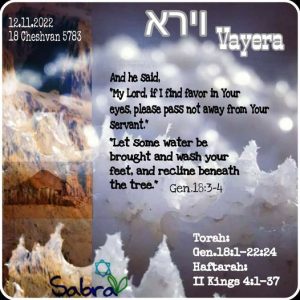
VA’YERA (And He Appeared) Gen.18:1–22:24; 2 Kings 4:1–37; Lk.2:1–38
By Raphael ben Levi
“The LORD appeared [vayera] to Abraham near the great trees of Mamre while he was sitting at the entrance to his tent in the heat of the day.” (Gen.18:1)
The ‘great trees of Mamre’ referred to were oak trees based in Hebron that was a Canaanite shrine dedicated to their sky god named, ‘Elyon.’ The oak in Scripture is a symbol of strength and a long life, but here it is different because God commands us to separate ourselves from everything that’s counterfeit. Satan loves to defile what God has created and here we see just one of many examples of this. And so we see how Abram disassociated himself from something that would stain and hinder his walk with the Lord and positioned himself away from the trees of Mamre rather than in their midst.
The Amorites’ principal god, “ELYON” was a distortion of the One true and Most High God! Both names are identical yet each are fundamentally different – Elyon, the Most High God, contrasted with a pagan counterfeit who was supposedly the god of the sky.
Satan often appears as an “Angel of Light” so we need to distinguish and separate between what is true and what is false, particularly when the counterfeit can appear outwardly appealing. The fact that Abraham was sitting close to these trees implies that he had removed himself from something he had once been associated with. Abraham replaced the false god ELYON who the pagans worshipped with the one true God, ELYON – identical names. One was genuine and the other was counterfeit. This I why Paul instructs us in 1Thes.5:21-22 to “…Take a close look at everything, test it, then cling to what is good.” And in 1Jn.4:1 we read, “Beloved, do not believe every spirit, but test the spirits to see whether they are from God, for many false prophets have gone out into the world.”
In these end times we are living in, deception is on the rise exponentially so that Yeshua warned us that if it were possible the very elect would be deceived. And sadly the reality is that much of it is coming from within rather than externally. Scri[pture informs us that our covering does not lie within our abilities or our knowledge; neither does it lie in any performance related paradigm even though they may play a part, but within the spiritual covering God provides for those who walk in the footsteps of the Master. The closer we walk with God the easier it becomes to differentiate between truth and deception whose Holy Spirit leads us into all truth! (Jn.16:13) The more embedded we are in God’s Word, the better equipped we will be to rightly divide Scripture. This is the second point.
Scripture states that, “For the weapons of our warfare are not carnal but mighty in God for pulling down strongholds, casting down arguments and every high thing that exalts itself against the knowledge of God, bringing every thought into captivity to the obedience of Christ”. (2 Cor.10:4,5) – walking close to God; dividing the Word of God correctly and putting on the whole armour of God are three things that keep us from being deceived by Satan.
Abram met with three people but although the word used in Hebrew for the visitors is ‘anashim’ (men), we can ascertain in context that two were angels and the one who was the spokesman was Yeshua.
Sarah prepared food for the guests — bread, curd, milk, and a calf that was eaten together at the same meal (Gen.18:8) and what we notice here is that it is considered by orthodox Jews non-kosher to eat dairy and meat products together based on the command in Deut.14:21: “Do not cook a young goat in its mother’s milk.” I share this only to highlight that a substantial portion of kosher dietary laws are derived from the Oral Law based upon the sages interpretation of Scripture from this one verse in Deut.14. It’s an example of several extra-Biblical traditions (known as Halakhah), that observant Jews follow which we should respect but are not obligated to follow as they do.
The first message shared by the visitors was a promise regarding Abram’s offspring. The second, was their intention to destroy the wicked people of Sodom and Gomorrah. The first promise highlighted God’s faithfulness; the second of God’s impending wrath against Sodom and Gomorrah that was saturated in wickedness. God’s mercy was reflected in the manner He allowed Abram to test the boundaries of His mercy. In ch.18:23-25 Abram had the chutzpa to challenge Him: “Will you really sweep away the righteous with the wicked? 24 Suppose there are fifty righteous within the city. Will you really sweep away and not spare the place for the sake of fifty righteous who are in it? 25 Far be it from You to do such a thing—to cause the righteous to die with the wicked, so that the righteous and the wicked share the same fate! Far be it from You! Shall the Judge of the whole world not exercise justice?”
The Bible says in Deut. 32:30, “one man will chase a thousand and two put ten thousand to flight”. Just a handful of righteous people can put to flight a vast army! This is the principle of the gematria of 10 for the people who can decree in faith, “If God be for us who can be against us” (Rom.8) no matter how bleak the odds may appear.
The Talmud calls to attention the fact that there are 10 different Hebrew words for idols. Therefore, 10 “righteous people” was the minimum number needed to counteract the manifest types of idolatry represented in Sodom and Gomorrah. The math here is amazing. The Bible says in Deut.32:30, “one man will chase a thousand and two put ten thousand to flight”. Just a handful of righteous people can put to flight a vast army! This is the principle of 10 for the people who can decree in faith, “If God be for us who can be against us” (Rom. 8) that is a bridal identifier of the overcomer who experiences the reality that God is our refuge and strength and a very present help in times of trouble. (Ps. 46)
Abram was willing to risk incurring the wrath of God by challenging Him to a debate because he was acquainted with the merciful heart of God. His nephew Lot and wider family were foremost in his mind but his motivation went beyond this in the hope that the inhabitants of Sodom and Gomorrah would repent and be spared.
But there is more. Three times Noah obeyed God without question or comment. He simply “did as God commanded him” (Gen.6:22; 7:5; 7:9) and accepted God’s verdict upon humanity, but Abraham challenged it because he understood the principle of collective responsibility that’s embedded in Judaism from Scripture. The entire community is held responsible for the failure of another. In contrast to Noah, Abram took collective responsibility for two entire pagan cities (Sodom and Gomorrah) even though they were completely disconnected from the Hebrew people, with the exception of his nephew Lot and his family who resided there.
Abram bargained hard for God to preserve them all for the sake of his one nephew. In the same way, Yeshua took upon Himself the collective responsibility of our sin and would have done the some had it only been for one person within all of humanity past and present – He would have taken collective responsibility for the one. Instead He did so for the many! “How great the love of God that while we were sinners Messiah Yeshua died for us“ (Rom.5:8)
Abram extended generous hospitality towards the 3 messengers because this was the custom of the time – no differentiation between strangers whoever they may be. Abraham knew that to live the life of faith is to see the fingerprints of God in the face of the stranger. To differentiate between two people, one who has status and another who has none is like a slap in the face of God.
Sometimes Yeshua may appear to us disguised as it was with Abram, as one among the three passers-by. He understood that serving God and offering hospitality to strangers were not two things but one. As written in Heb.13:2-4, we are “…not (to) forget to entertain strangers, for by so doing some have unwittingly entertained angels (maybe even Yeshua Himself.)”
Here is an account from a rabbi who described something related to this:
“My father was a regal man. He was the type who wouldn’t walk to the corner without wearing a tie and jacket, without combing his beard. He was truly a prince from head to toe.
How do most people treat a shlepper (person of low estate, loser)? Most treat him as an inferior.
Whenever a person, any person, even the lowest shlepper, came to see my father, he would first put on a tie and jacket, comb his beard and then greet the person. He would always say, ‘How wonderful it is to see you!’
Once a thief came under the guise of collecting for a yeshiva. My father greeted him in his accustomed manner. After the thief left, I asked my father, ‘Aren’t you overdoing it, treating a known thief in such a manner?’ He answered, ‘All the kavod (honour) in the world is not enough for the lowest person in the world.’”
Serving God and offering hospitality even to strangers is the same when we see others through God’s lens.
This Torah portion is ‘named Va’era’ (and He appeared). God can speak to us in an infinite variety of ways, from His creation, through other people – a friend or a stranger, through circumstance directly or indirectly, through dreams and visions, through a Rhema word in Scripture. He can utilise any means crafted in ways that may be unexpected such as in a rushing wind or a still small voice. God never deals us a poor hand and He never short-changes us. At every moment in time He remains faithful and true to His word.
For example, Sarah was barren: no child, no inheritance, no hope. The world condemned her as a dismal failure. And yet God demonstrated His faithfulness to her despite her unbelief with a promise and gave them a child who she named, ‘Isaac (‘laughter’) She bore a son when Abram was aged 100, 14 yrs after Hagar had borne him a son, Ishmael. (2 x 7)
It is sometimes easier to trust God for a promise than to wait patiently for its fulfilment. And while we are waiting it is easy to try and give God a helping hand and manipulate His perfect timings as Abram and Sarai did and then end up facing many Ishmael’s in our lives.
It may seem puzzling how all four matriarchs found themselves barren and unable to conceive for many years except finally through a miracle of Divine intervention rather than the natural outcome of a biological process. And this is how we make sense of something that outwardly makes no sense. Does it make God any the less faithful when we experience things that seem to go against everything we know about the character go God? God forbid! God is faithful!
Yet there is more. Believing God for His promise to bear him a child was one thing. But the climax of Abram’s life and the supreme test of his faith would come around 35 years later in the incident known as the “Akedah” (the binding of Isaac). We cherish what we most risk losing and in this case Abram believed that God might be taking from him the most precious treasure he possessed on earth. The things that must have gone through his mind! “Surely God would never have told me to call this child Isaac, (meaning “he will laugh”) if His intention was to make me weep and mourn inconsolably?”
Why would Abram, who had challenged God on the fate of Sodom, now make no protest regarding something he cherished above all else in life? I shared a little about this last Shabbat and we noted that some things in life are negotiable and others are not, and when we examine the Akedah in terms of types and shadows it helps for things to become clear. Yeshua could have negotiated HIs way out of offering Himself as a sacrifice for our sins but He didn’t because Divine love is not negotiable – it is a gift of God we choose to either accept or reject. Some things in life are non-negotiable and we need the wisdom to distinguish between the two.
But things were complicated for Abram since the gravest sin against God was to commit child sacrifice, something commonly practised among the surrounding pagan nations. But God didn’t want Abraham to sacrifice his child but to renounce ownership. This was his supreme test. So when the angel intervened at the moment of sacrifice, he told Abraham “You have not withheld from Me your son, your only one.”
God creates us with a space – one that exists between parent and child that He alone can fill. It is when we allow Him this space when we form an unbreakable chain. It is no different with marriage. In Eccles.4:12: is written, “…though a man might prevail against one who is alone, two will withstand him—but a threefold cord is not quickly broken.”
Abraham understood these things and it was this that qualified him to become the ‘Father of many Nations,’ – Avraham. Two things were at play: faith and obedience. If Abraham had chosen against placing his full trust in God, his future path in life would have been crooked rather than straight.
God has given each of us the potential to change the world as “Tikkun Olam” (repairers of the world) when we place our trust in Him unconditionally. We should never underestimate our destiny, for God seeks to change us even even as He did with Abram
In Judaism, observant Jews recite two short prayers every morning known as the ‘Akedah’. It is a reminder of both the mercy and judgment of God. “Remember in our favour, O Lord our God, the oath which You swore to our father Abraham on Mount Moriah; consider the binding of his son Isaac upon the altar when he suppressed his love in order to do Thy will with a whole heart! Thus may Your love suppress Your wrath against us, and through Your great goodness may the heat of Your anger be turned away from Your people, Your city, and Your heritage! . . . Remember to-day in mercy in favour of his seed the binding of Isaac.”
There is a story regarding a group of chassidim (pious ones) who served the Baal Shem Tov, founder of the Chassidic movement. One night they raised a question among themselves. “What was so special about the test of the Akedah (binding)? If God had revealed Himself to us and commanded us to sacrifice our only son, how would we have responded?”
The first one replied: “If God told me to sacrifice my only son, I would delay my doing so for a while, to keep him with me for a few days. Abraham’s greatness lay in that he arose early in the morning to immediately fulfil the Divine command.”
The second one said: “If God told me to sacrifice my only son, I too would waste not a moment to carry out His command. But I would do so with a heavy heart. Abraham’s greatness lay in that he went to the akedah with a heart full of joy over the opportunity to fulfil God’s will.”
Said the third: “I, too, would carry out God’s will with joy. I think that Abraham’s uniqueness lies in his reaction upon finding out that it was all a test. When God commanded him, ‘Do not touch the child, and do nothing to him,’ Abraham was overjoyed—not because his only child would not die, but because he was being given the opportunity to carry out another command of God.”
Maimonides suggested that God did not need Abraham to prove his love for Him. Rather the test was meant to establish how far his fear and love for God could be extended? As with Abram, so too for us – to love God beyond all our hearts…
The binding of Isaac was a full expression of faith, obedience and devotion to God in action and through it Abram became a hero of faith with a name change – Abram to Abraham.
For us the Akedah on Mount Moriah represents a perfect illustration of Yeshua’s sacrifice for our sins:
- Isaac carried the wood for the sacrifice – Yeshua carried the cross-beam to the place of His sacrifice:
- Isaac cried out to his father – Yeshua cried out to His father
- Isaac escaped death after 3 days (22:4) – Yeshua was raise from the dead after the 3rd day
- Abraham indicated that God would provide a lamb for Isaac – Yeshua became the Lamb of God for us
- The ram was caught in a thicket of thorns – Yeshua wore a crown of thorns
2 Chron,3:1 refers to Mt. Moriah being the mountain on which the Temple was built, and further explains the site of the Temple in Jerusalem. By building the Temple in the exact place of the Akedah is a reminder that God remembers Abraham’s faithfulness to His eternal covenant towards the Jewish people. The sounding of the shofar, (representative of the goat caught in the thicket) also brings this to remembrance. And here we see an amazing parallel: Abraham came to offer a sacrifice on Mt. Moriah in the exact location where Yeshua was crucified outside the city walls.
This weeks Haftarah portion is from 2Kings.4:1–37 that mirrors in many ways the story of Abraham and Isaac. God used Elisha to bring life and hope to a woman who was a widow and placed in a hopeless predicament. She had been the wife of one of Israel’s prophets, who had lived a godly life yet was reduced to nothing with the death of her husband and at the point of starvation with her creditors ready to take all the little that remained and taking her two sons as slaves for collateral. She had faithfully served God without ever seeking a reward, but now she was at the point where God seemed to have abandoned her. The people who surrounded her cruelly criticised her by saying that her situation must have been the result of sin in her life rather than supporting her.
The prophet Elisha invited himself to her place for a meal even though all she had left was a small cruse of oil. Now she had a difficult choice to make. The key element at play here was the woman’s obedience to Elisha’a request. What a miracle of God’s provision! Scripture states that “..the just shall live by faith” (Rom.1:17) Most believers are spared being placed in extreme situations as was Abram and the widow but it challenges us to reflect how we would respond should we ever be placed in similar circumstances? But following this incident, we immediately encounter another story.
“8 Now it happened one day that Elisha went to Shunem, where there was a [a]notable woman, and she [b]persuaded him to eat some food. So it was, as often as he passed by, he would turn in there to eat some food. 9 And she said to her husband, “Look now, I know that this is a holy man of God, who passes by us regularly. 10 Please, let us make a small upper room on the wall; and let us put a bed for him there, and a table and a chair and a lampstand; so it will be, whenever he comes to us, he can turn in there.”
11 And it happened one day that he came there, and he turned in to the upper room and lay down there. 12 Then he said to Gehazi his servant, “Call this Shunammite woman.” When he had called her, she stood before him. 13 And he said to him, “Say now to her, ‘Look, you have been concerned for us with all this care. What can I do for you? Do you want me to speak on your behalf to the king or to the commander of the army?’ ”
She answered, “I dwell among my own people.”
14 So he said, “What then is to be done for her?”
And Gehazi answered, “Actually, she has no son, and her husband is old.”
15 So he said, “Call her.” When he had called her, she stood in the doorway. 16 Then he said, “About this time next year you shall embrace a son.”
And she said, “No, my lord. Man of God, do not lie to your maidservant!”
17 But the woman conceived, and bore a son when the appointed time had come, of which Elisha had told her.
Just like Abram and Sarai, the woman must have felt isolated and worthless. Everyone condemned her for being barren, but God miraculously gave her a son. We find the story in (2Kings 4:4-7)
But that was not the end. The child grew and one day went out to his father and the harvesters. Suddenly he complained that he had a fever and the next moment he was dead. It was a calamity among calamities!
But, instead of giving up hope, she immediately journeyed to Elisha in Mount Carmel where she begged him to pray for God to resurrect her son. Elisha arrived at the house and discovered the boy lying dead on his bed. He prayed for healing and her son was resurrected, the first recorded instance of resurrection in Scripture.
The woman experienced the death of an only son given to her by God after being barren at an age well beyond the age of child bearing. God demonstrated to both Abram and the Shunnamite woman that He is the Resurrection and the Life. And in the fullness of time God sent His only begotten Son into the world for humanity to demonstrate that He is the same yesterday, today and forever – He is indeed the resurrection and the Life for all who embrace Him as their Saviour and Lord! And Paul encourages us with the words, “31 What then shall we say to these things? If God is for us, who can be against us? 32 He who did not spare His own Son, but delivered Him up for us all, how shall He not with Him also freely give us all things? 33 Who shall bring a charge against God’s elect? It is God who justifies. 34 Who is he who condemns? It is Christ who died, and furthermore is also risen, who is even at the right hand of God, who also makes intercession for us. 35 Who shall separate us from the love of Christ? Shall tribulation, or distress, or persecution, or famine, or nakedness, or peril, or sword? 36 As it is written:
“For Your sake we are killed all day long;
We are accounted as sheep for the slaughter.”
37 Yet in all these things we are more than conquerors through Him who loved us. 38 For I am persuaded that neither death nor life, nor angels nor principalities nor powers, nor things present nor things to come, 39 nor height nor depth, nor any other created thing, shall be able to separate us from the love of God which is in Christ Jesus our Lord.”