Lev1:1–5:26; Isa 43:21–44:23; Mark 7:1–30;
Vayikra (Leviticus) is the third book of the Torah and unlike Exodus it contains no narrative concerning journeys. The book’s entire focus spans over a period of just one single month and in one place – Sinai. Yet it’s here that we find the substance of Israel’s calling as “a kingdom of priests and a holy nation,” that in the NT the Book of Hebrews discusses in light of the finished work of Yeshua – also in Rev.1:6 stating that God has us made us “kings and priests unto God” and in 1Peter 2:5 where every believer is described as being a part of “a holy priesthood, (who) offer up spiritual sacrifices, acceptable to God by Messiah Yeshua.” What does this mean for us as believers? It goes far beyond any status we may have been afforded through the precious blood of our Messiah. God is looking for our response for the miracle of salvation. The greatest sacrifice we can ever offer Him is merely our reasonable duty (Rom.12:1-2) when we understand things properly in perspective. C. H. Spurgeon wrote:
“If I can bring Him nothing but my tears, He will put them with His own tears in His own bottle, for He once wept; if I can bring Him nothing but my groans and sighs, He will accept these as an acceptable sacrifice, for He once was broken in heart and sighed heavily in spirit. I myself, standing in Him, am accepted in the Beloved; and all my polluted works, though in themselves only objects of divine displeasure, are so received that God smells a sweet savor. He is content, and I am blessed. Consider, then, the position of the Christian—“a priest . . . standing before the throne of God.”
Leviticus is the least read and least preached book in the Church although in biblical times it was the first one memorised by children in its entirety. Why? Because holiness is the main thread running through the book, the sole means by which relationship with God can be built. (Lev 11:44 “…I am the LORD your God. Consecrate yourselves therefore, and be holy, for I am holy”) – something mandated in the NT for all believers: (1Pet.1:14-16) “Like obedient children, do not be shaped by the cravings you had formerly in your ignorance. Instead, just like the Holy One who called you, be holy yourselves also in everything you do. For it is written, “Kedoshim (WHOLLY CONSECRATED) you shall be, for I am kadosh.”
One of the key attributes of God is His holiness. Nothing in all creation can compare to Him. He is the sovereign Creator who is distinct, different and separate from all others. God’s holiness is, set apart, clean, pure, undefiled, spotless, flawless; glorious, magnificent and awesome and strikingly beautiful! Yeshua Himself clearly stated at the outset of His public ministry that without holiness no-one can see God (i.e., abide in relationship).
The greatest impediment of unredeemed humanity is spiritual blindness that morphs into every expression of unholiness. And, sadly it is not always confined to the world but has proven the ability to destroy even the redeemed of the Lord and whole congregations. It is our choice and determination to live a holy life in alignment with the Word of God that keeps us from falling, by the grace of God not through merit, motivated by our passion and first love for Yeshua! Holiness is the glue that holds all godly desires intact. We want to be holy because He is holy!
The perfect holiness of God characterises His nature. He alone is ‘Kadosh, Kadosh, Kadosh!’ In the Hebrew, the repetition of a word is a literary devise of emphasis, but when, as occurs only rarely in Scripture, it’s repeated 3 times in succession it becomes a superlative to the power of 3 in every sense of magnitude and importance. So it comes as no surprise that we who wear His signet ring we become partakers of His holiness that is a bridal identifier of who we become in Yeshua (Ps.1). Scripture provides no middle ground. Compromising one’s faith is a bad option because it contains no safety net.
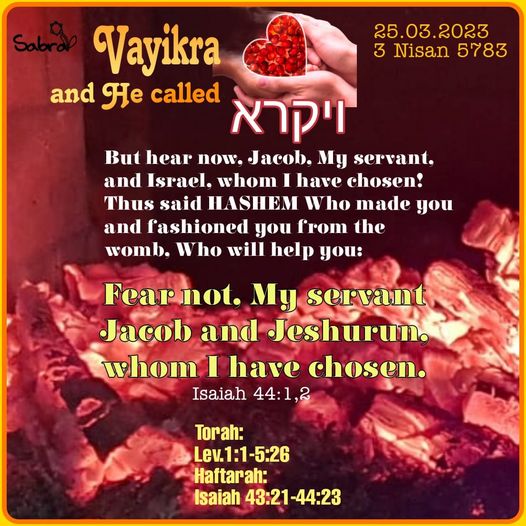
Lev. ch.1 opens with the following words: “And He called (Vayikra) to Moses, and God spoke (ve-daber) to him from the Tent of Meeting, saying …” The sages question why, when God spoke to Moses, He also added the phrase “And He called?” (“The Lord called to Moses and spoke to him from the tent of meeting.”)
Rashi, one of the greatest Jewish sages, explained that every time God communicated with Moses using the words] ““and He said”, or “and He commanded”, God spoke to him by name first. For whenever God calls someone by name, it is an expression of His love. (2Chron.14:7)
History began with God speaking to Adam and Eve in the Garden of Eden after they had sinned, calling out to them, “Where are you?” Jewish history began with God’s call to Abraham, to leave his land and family. God called to Moses and the prophets. So too with the boy Samuel. (1Sam 3).
In Heb.9:15, “For this reason He (Yeshua) is the mediator of a new covenant, so that … those who have been called may receive the promise of the eternal inheritance.” No-one can come to Yeshua until they are called. “No one can come to Me unless the Father who sent Me draws him,” (John 6:44) emphasising man’s helplessness and utter inability to respond to Him apart from God’s sovereign call. Unbelievers are unable to come to Yeshua on their own initiative. Listen to these words of encouragement from Isa.43: “Thus says Adonai—… “Fear not, for I have redeemed you, I have called you by name, you are Mine. When you pass through the waters, I will be with you, or through the rivers, they will not overflow you. When you walk through the fire, you will not be burned, nor will the flame burn you. For I am Adonai your God, the Holy One of Israel, your Saviour.”
Sadly, though many are called, few are chosen because few choose the pathway that leads to eternal life. (Matt. 22:14) And as believers we have been bought with a price that humanity could not afford, to live a life worthy of His calling: “Therefore I, the prisoner of the Lord, implore you to walk in a manner worthy of the calling with which you have been called…” (Eph. 4:1) This is not an easy thing to do and the reason why God made provision for the Israelites when they sinned, through a substitutionary sacrifice with the shedding of blood.
The word korban, “an offering” comes from the root word ‘karov’ meaning to ‘draw close’ because the sacrifices would restore closeness with Him. Moses was given instructions and details of 5 types of sacrifices that would offered up to God, performed by the priesthood: a. Ascending offering (olah); b. 5 varieties of meal offerings (mincha); c. Peace offerings (Shl’amim); d. Sin Offering (chatat) by sins committed by an individual, group or whole community; e. Guilt offering (asham)
The sacrificial system is difficult for modern Jewry to relate to. It has been almost 2000 years since the Temple was destroyed in 70 AD. Rabbinic Judaism replaced the Temple priesthood and blood sacrifices were soon forgotten. This was a serious mistake as things deteriorated from bad to worse.
In light of this, biblical passages concerning a “Suffering” Saviour (e.g., Isa. 53) that specifically pointed to One who would offer Himself as a sacrifice for sin became something that was re-interpreted. Rabbinic Judaism replaced it with: 1.observance of Torah, 2. Tzedakah and 3. prayer as the primary means for obtaining righteousness – no sacrifices and no assurance of salvation because there was none. The rabbis rationalise it by saying that Judaism focuses on the here-and-now rather than on the world to come. Although Judaism can offer many things it ultimately remains a religion devoid of a living hope.
The Temple is a central feature in Scripture and one-third of all Torah commandments relate directly to it. The Bible describes it as the spiritual centre of the world and the focal point in the coming Millennium age. The Temple Institute, has for many years been preparing to replace the Dome of the Rock with a 3rd Temple, whenever the ‘right time’ arrives, with fully trained priests, Temple furniture and utensils all at the ready including Red Heifers necessary for the purification rites. The Red Heifer’s (parah adumah), ashes were used in the purification rites for one who had been contaminated through having come into contact with a corpse or removing ritual defilement through taking the spoils of war. But again, (Num.19:9) Heb.9:11-14 clearly states that it is impossible for the ashes of a heifer to purify our consciences before God. Only the blood of Yeshua can do this.
The Jewish people are awaiting for what they believe is the imminent coming of the Messiah and are ready at this moment to start rebuilding a Temple as a necessary pre-requisite for His return. Should we be excited? Yes and no! The difference is they believe He will come for the first time having missed it 2000 years ago. We also believe that Messiah’s return is imminent but His coming will be for the second time around, this time as the Lion of Judah not the Suffering Messiah, to judge all flesh and usher in the Millennium kingdom. Post-Temple Judaism faces an irreconcilable dilemma because it has rejected the one person who proved in every way to be the true Messiah – Yeshua the Suffering Servant (Rev. 5). Scripture tells us that the person they will initially embrace as Messiah will be a counterfeit known as the Anti-Christ leading into the Time of Jacob’s Trouble, an unprecedented time of suffering never before experienced in the history of Jewry.
Haggai gave one of the most spectacular prophecies of the Old Testament. In it, he declared that the glory of the latter Temple would be greater than that of the former:
“For thus says the Lord of hosts: ‘Yet once more, in a little while, I will shake and make tremble the [starry] Heavens, the Earth, the sea, and the dry land; 7 And I will shake all nations and the desire and the precious things of all nations shall come in, and I will fill this house with splendour, says the Lord of hosts. The latter glory of this house [with its successor, to which Jesus came]shall be greater than the former, says the Lord of hosts; and in this place will I give peace and prosperity, says’ the Lord of hosts.’” (Hag. 2: 6-7;9)
The Talmud states that daily miracles ceased throughout the period of the Second Temple. Ezra, the priest, recorded how only 56,000 Jews returned from Babylon and he lacked all the silver and gold which was used to build the 1st Temple. Due to its fairly unimpressive appearance gave King Herod an incentive to devote 46 years remodelling it.
Why was the glory of the 2nd Temple greater than the first since Solomon’s Temple was regarded as the 8th wonder of the ancient world? It is clear from Haggai that the 2nd Temple, (whose glory would be greater than the former one built by Solomon), referred prophetically to a Temple of flesh identified in the person of Yeshua. When he was challenged by what authority He operated under, and what miracle He could perform to endorse His messianic claims Yeshua responded in John 2:19-21: “Destroy this temple, and in three days I will raise it up again.” The Judeans said, “It took 46 years to build this Temple, and you’re going to raise it in three days?” But the “temple” he had spoken of was his body.”
The opening chapters of Leviticus that link the Temple with sacrifices offered for sins, emphasises the severity of transgression from God’s perspective. Sin brings separation from God and the wages of sin is death. But Yeshua has become the perfect blood sacrifice and atonement for the whosoever for the remission of sins.
We see from this Torah portion how God provides us with the means for entering a right relationship with Him through Yeshua. In Lev.1:5 the high priest was commanded to sacrifice a young bull before the LORD and then Aaron’s sons would offer up the blood and sprinkle it around on the altar at the doorway of the tabernacle. But, he not only sprinkled the blood around the altar, he dipped his finger in it and sprinkled it 7 times before the Lord, in front of the veil. (Lev 4:17)
So too, the blood of Yeshua, our ‘Great High Priest’ was also sprinkled 7 times on different occasions in the last moments before His crucifixion. Isaiah revealed that God planned to lay all our sins upon the Messiah and His sacrifice provides us with full salvation by which we can live holy lives that brings glory to His name!
So, may our offerings of sacrifice and worship unto the Lord be like a sweet smelling incense perfumed in holiness. In Rev.8:8 John saw the angels holding golden bowls filled with incense representing the prayers of the saints. May they reflect the words of Scripture in 2Cor.2:15 “… a sweet fragrance of Messiah [which ascends] to God, [discernible] among those who are being saved. What kind of spiritual fragrance do we present?
I once had a dream and saw the Lord cradling a large, solid gold book encrusted with jewels that shimmered in the midst of His glory. By His side appeared a corridor of library shelves filled with endless rows of other books which extended far beyond into the horizon. I marvelled at their beauty, yet noticed how those closest to Him were the ones holding a brilliance that outshone those that were positioned further away. So again, may we spread His spiritual fragrance that permeates our lives – the sacrifice of a life lived in holiness and purity unto Him, befitting those who are called as Kings and priests of the living God.
Falling. By ullie-kaye
If we only knew then what we know now. that love conquers everything. that faith can move mountains. that good things happen to bad people and bad things happen to good people. that loud doesn’t mean strong and quiet doesn’t mean weak. that closed hearts are often hurt hearts that have yet to unfold. that silence can be both beautiful and terrifying. that healing takes time and time moves both quickly and unbearably slowly. that one step in any direction can change the course of your life forever. that bliss is sometimes just loving what you already have rather than wanting what you wish you had. that you will have days where you feel on top of the world and days where you feel like you have hit rock bottom. and that rising from the ashes requires going through the flames. and that falling was part of it all.
But in all of it, God is changing us from glory to glory by His Spirit that dwells within us. It is a reward well worth the cost of pursuing like a pearl of great price of infinite worth!
www.mekudeshet.co.za