Behar (On the Mountain) by Raphael ben Levi
Lev 25:1–26:34; Jer 16:19–17:14; Matt.21:33–46
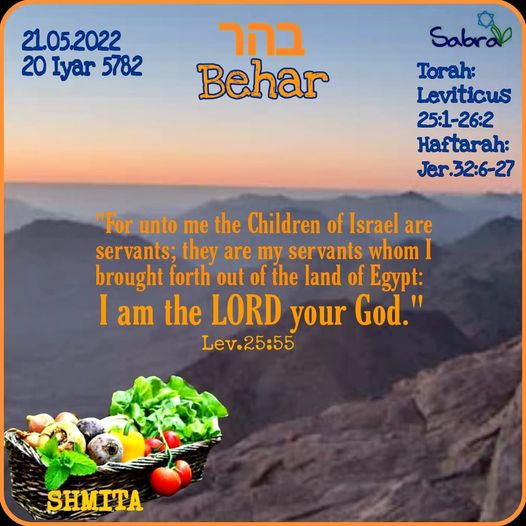
This is the last portion in the Book of Leviticus that begins with the opening words in Lev. 25:1-2 “The LORD said to Moses at Mount Sinai, ‘Speak to the Israelites and say to them: When you enter the Land I am giving you, the Land itself is to observe a shabbat rest for Adonai.’”
The ‘Land’ in this verse refers specifically to the Land of Israel and the ‘shabbat rest’ to the shabbat of years known as the shemitah (release). Though technically this instruction is directed solely to the people of Israel, its application holds great relevance for all believers everywhere. People had their debts forgiven and slaves were released a picture that presents us with a perfect type and shadow of Yeshua who took our debt of sin upon Himself and sets us free from the slavery of sin. There are at least two elements to this. First, it speaks of the promise of eternal salvation for every true believer.“If you confess with your mouth that “Jesus is Lord,” and believe in your heart that God raised him from the dead, you will be saved.” (Rom.10:9) “As far as the East is from the West…” (Ps.103:12); (2Cor.5:17; Jn.3:16). And the evidence of our salvation is through our fruit (Gal.5: Jn.14).
The second element relates to living a sanctified life unto God. This is the process of allowing the Holy Spirit into every part of our lives, not as a one-off event but as a moment to moment lifestyle that the Bible calls “sanctification” – being purified in the refiner’s fire. A refiner’s fire melts down a metal, such as gold or silver, for purification. Once a metal is melted, the dross rises to the top and then removed from the metal before it cools. God spoke this analogy through the prophet Malachi to describe how He purifies our hearts. The apostle Paul speaks of this as “being transformed into his image with ever-increasing glory…” (2Cor 3:18).
Sometimes, believers resist the working of God in their lives through all manner of different reasons. No-one ever said it was an easy thing to do and oftentimes takes great strength and courage for everyone but especially from those who have experienced in their lives trauma such as abuse, fear, rejection; or have occult connections or simply have made poor choices in life and are suffering the consequences with accompanying regret but additionally levels of bitterness, hatred and unforgiveness – natural human emotions, but ones that leave one crippled and debilitated – bound and enslaved by the events that have overtaken their lives – that can be manifested both physically such as in sicknesses, and ailments which can be generational, or spiritual through bondages or various addictions. Sometimes, it can be hidden from others and kept secret where people present a squeaky clean public image whose true identity is opposite behind closed doors: the public image; the private image and the secret image…
In all of these, Yeshua has come to set the captives free. What is impossible for man is possible for God. Nothing is beyond the scope of His redemption whilst breath remains in our mortal bodies. (King David who committed murder and adultery could cry out in total desperation “Wash me clean of my iniquity and cleanse me from my sin” (Ps.19:12) with the confidence that despite the consequences he faced through his sinful actions, yet the God who he served who is compassionate and filled with mercy would forgive him in the knowledge that he immortalised in Ps.51, his song of repentance: “…the sacrifices of God are a broken spirit: a broken and a contrite heart, oh God you will not despise.” (vs.17) . And I want to make it very clear now that those who may be suffering physical or emotional illnesses or disabilities is not by any means necessarily a consequence of sin or due to a lack of faith – such a thing is an abomination to God. Paul himself experienced a ’thorn in the flesh’ – most probably a physical affliction – which he begged God to remove from him and God answered, “My grace is sufficient for you for My strength is made perfect through weakness” (2Cor.12:9).
But, the fact remains, (and I have seen this in ministry on many occasions), where sometimes there is a connection between the two – a link, maybe just a doorway that gave the demonic realm an opening to have a legal right and access into a life of a person. There could also be links connected with one’s family history such as the occult or secret societies such as Freemasonry. But, the message that I want to convey to us that is clearly backed up by Scripture – the good news – whatever the root cause may be Yeshua desires to set the captives free!
And here is an important message conveyed to us through this week’s parsha: when we align ourselves fully and commit ourselves unreservedly to follow God’s ways as revealed through His Word, we possess the rights to receive His blessings and walk in His freedom exponentially in full measure (vs’21-22). “21 I will send you such a blessing in the sixth year that the land will yield enough for three years. 22 While you plant during the eighth year, you will eat from the old crop and will continue to eat from it until the harvest of the ninth year comes in.”
God’s earnest desire for us is to walk in abundance. Even as during the Shemitah year no-one went hungry (for the poor could pick the produce that grew without the land being worked) and debts were forgiven, so too we can experience the reality of the Shemita year in our walk with Yeshua each moment continuously without restriction!
In Lev. 26, it defines the blessings for the Israelites who obeyed His commandments. There are 11 verses speaking about all the good things promised to those who keep His commandments and 33 verses describing the bad things for anyone who chose to disregard them because of humanity’s inclination towards sin rather than godliness (two-thirds are warnings of cursing compared to one-third for blessings!)
We need to see these things in context with the nature of God. Divine judgement is only reserved for people (those who claim to be believers) who pursue sin thinking they hold no accountability to God – a ‘cheap grace’ Gospel where salvation is reduced to nothing more than an insurance policy.
Yeshua made things clear in Jn.14: “If you love me, hold on to my commands”. Another translation puts it this way: “Loving me empowers you to obey my commands.” Yeshua continued: “And the one who loves me will be loved by my Father. I too will love him and show myself to him.” Three times in this short passage, Yeshua repeated, “If you love me hold on to my commandments” a literary device of emphasis underlining its importance.
The greatest investment in life is to pursue wholeheartedly God’s love and allow it to permeate our lives. But it comes as a direct consequence of walking in obedience, transparency, integrity and with faithful intent. How much do we love Him? This is a very important question we should ask ourselves for those who seek to deepen their relationship with Him. And the more we love Him, the better we will be protected from every satanic attack .
Scripture defines such a person as a good steward of God’s riches (1Tim. 6:17-21) guarding the treasure entrusted to us (2Tim.1:14). This is a central focus of the parsha. Rabbi Shlomo Carlebach, put it eloquently linking our fallen nature with brokenness leading to redemption:
“Let me tell you something so beautiful. The Ten Commandments are a whole shekel, and the broken commandments are half a shekel, it is a broken thing.
You know, every person has whole commandments which he didn’t break yet, and then everybody has little broken commandments deep down in their souls.
And you know what a good friend is? Somebody who puts his broken tablets and my broken tablets together.
To a lot of people I often openly show my good commandments, but the broken tablets I’m afraid to show. But then between such good friends, we share our broken commandments. Some day the world will be so close we’ll tell each other we all fell. We all broke the commandments.
What do you do when something breaks your heart – you close your eyes: can’t see it, don’t want to see it – it’s too deep.
You know, when you kiss somebody, you know what you tell them – I love you so much – but I love you so much, it breaks my heart.
Why do children close their eyes when they are born? They want to know how much their parents love them even when they don’t see them.
You know why the Jewish people count after the moon? The sun is beautiful, the sun is always whole. The real light is the moon – its full, and its also broken.
You know the Talmud begins with page two. Page one – the blank paper – its a broken page – nothing’s written on it. And you know when you finish learning, when you learn a little bit, when you study with the deepest depths of your heart and your soul – you kiss the blank paper. Because real learning, the real understanding is so deep.”
King David, wrote the following words after he had committed a grievous sin in the sight of God: “My sacrifice to you is a broken spirit; God, you won’t spurn a broken, chastened heart.” (Ps.51:18-19) But to live in denial is perhaps the most dangerous weapon we possess.
I would urge us to live in the fullness and abundance which God has provided for us through Yeshua, free from all encumbrances that tie us up in knots and keep us enslaved. Brokenness is the starting point because it humbles us and causes us to take our eyes off ourselves and focus upon Him. It is at the point when we gaze into the eye of Yeshua that we fall in love with Him and are ruined for life. Nothing from that point on will ever remain the same again.
And in our brokenness and vulnerability let’s allow God to have His perfect way in our lives and yield to Him our imperfections, that we might be changed from glory to glory by His Spirit.
We all need to experience the ambulance not the machine guns if we are to walk in true unity together because we are all in the same mess as those saved by grace.
www.mekudeshet.co.zaIn the second portion known as ‘Bechukotai’ (By My Statutes), we continue with the theme of blessings and curses.
We must keep in mind that God does not willingly afflict or grieve us; He only does so when it is necessary to get our attention and attend to the error of our ways and, place us back on the right path. God seeks to purge us of all unrighteousness so that we might enjoy the full benefits of His salvation. In the Book of Lamentations 3:32-33, the prophet Jeremiah observed that,
“For if He (God) causes grief, then He will have compassion according to His abundant lovingkindness. For He does not afflict willingly nor grieve the children of men.”
As we have seen, God clearly specified His terms under the covenant: blessings of Divine favour when they kept His commands, but the consequences for failure to honour Him both individually and as a holy nation were terrifying. God holds us accountable for our actions and choices. Look at the shattering consequences that faced Israel should they refuse to abide by the terms of His covenant:
“But if you will not listen to me and carry out all these commands … I will bring upon you sudden terror, wasting diseases and fever that will destroy your sight and drain away your life. You will plant seed in vain, because your enemies will eat it … If after all this you will not listen to me, I will punish you for your sins seven times over. I will break down your stubborn pride and make the sky above you like iron and the ground beneath you like bronze … I will turn your cities into ruins and lay waste your sanctuaries, and I will take no delight in the pleasing aroma of your offerings. I will lay waste the land, so that your enemies who live there will be appalled … As for those of you who are left, I will make their hearts so fearful in the lands of their enemies that the sound of a windblown leaf will put them to flight. They will run as though fleeing from the sword, and they will fall, even though no one is pursuing them. (Lev. 26:14-36)
From this one might quite reasonably conclude that it would have been unthinkable to do anything other than faithfully follow the pathways that lead to God’s blessings? Not so! Israel’s chequered history bears witness to that. Yet in all of this, we see that the curses end with the profound promise of ultimate restoration because, as we have said before and should emphasise the point, despite everything God will not break His covenant with His people.
However bad things may look, history has demonstrated the inviability of this fact. The Jewish race has suffered more than any other people on the face of the earth, but God will never allow them to be destroyed. They would undergo exile following the destruction of the 1st Temple in 586 BC and return to become a nation again two centuries later only to face the destruction of their 2nd Temple in AD 70 followed by a further 2000 years of exile. The 9th of Av known as ‘Tisah B’Av is where World Jewry mourns the destruction of these two temples, but it was not the end. Out of the ashes of the Holocaust the nation of Israel was reborn on May 14th 1948. ‘Am Israel Chai, Od Aveynu Chai!’ (The people of Israel live because our Father lives!)
Twenty-five hundred years after God brought back the Jewish exiles from Babylon to the Land of Israel, He is doing it again gathering them from the four corners of the earth. But that is still not the end of the matter! God has preserved the modern state of Israel that has included miraculous and breathtaking victories since the 1948 War for independence in 1948, the Six Day War in 1967, the Yom Kippur war in 1973, the various intifadas through to the present time.
Despite rampant expressions of vicious anti-Semitism anti-Zionism globally, Israel remains alive and vibrant, and continues to be a blessing to the world despite the volume of hatred extended towards her since her re-establishment as a sovereign state.
Israel is unique among the nations. They do not see their history as a matter of growth and decline like every other empire down through the ages. Instead, it is fully dependent upon the conditions laid out here in this parasha in chapter 26. If Israel would stay true to its mission, it would flourish. If it drifted away and rebelled, it would suffer defeat after defeat but never be entirely cast down. And ultimately, the ending will be good – Scripture also makes that very clear!
What we see in chapter 26 is an application to a nation the words that God spoke to an individual near the very beginning of creation found in the 4th chapter of Genesis:
“Then the Lord said to Cain, “Why are you angry? Why is your face downcast? If you do what is right, will you not be accepted? But if you do not do what is right, sin is crouching at your door; it desires to have you, but you must master it.” (Gen. 4:6-7)
Some scholars understand the word “Chattat” translated as “sin” would be more accurately translated in this place as “Sin offering.” Throughout the Tanakh we see this word sometimes translated as “sin” and sometimes as “sin offering”. This would change the whole meaning by incorporating both senses of the meaning:
“”Why are you angry? Why is your face downcast? If you do what is right, will you not be accepted? But if you do not do what is right, a sin offering is crouching at your door;; it desires to have you, (i.e., sin) but you must master it.”
God reminded the Israelites on various occasions that He was their God who brought them out from slavery to freedom who now empowers them to experience freedom in its truest sense. 1500 years later, Yeshua put it this way: “I have come that you may have life and life in abundance.” And “Whosoever the Son shall set free shall be free indeed!”
In the face of suffering and loss, there are two fundamentally different questions an individual or nation can ask, that lead to different outcomes. The first is, “What did I, or we, do wrong?” The second is, “Who did this to us?” This is the fundamental choice governing the destinies of all people.
Within the terms set by covenant, the outcome depended on the choice Moses was later to define with the words in Deut. 30:19:
“This day I call heaven and earth as witnesses against you that I have set before you life and death, blessings and curses. Now choose life, so that you and your children may live.”
When we examine all the “independent” events culminating in the formation of an independent Jewish state, we see that God will never allow the Jewish people to be destroyed, and neither will He ever break His covenants with them.
Despite there being severe consequences for neglecting God’s statutes, He promised to have mercy on the Jewish people even during their periods of exile; for He remembers His covenant with Abraham, Isaac and Jacob:
“Yet in spite of this, when they are in the land of their enemies, I will not reject them or abhor them so as to destroy them completely, breaking My covenant with them. I am the Lord their God. But for their sake I will remember the covenant with their ancestors whom I brought out of Egypt in the sight of the nations to be their God. I am the Lord.’” (Leviticus 26:44–45)
The Haftarah (prophetic portion) for this week (Jeremiah 16:19–17:14) follows the theme of promised blessings for obedience and punishment for disobedience.
Because God alone is the One who grants blessings in accordance with His covenant promises, the prophet Jeremiah promised that those who place their trust in man instead of God will reap the consequences. Interestingly, in contrast to the portion in Leviticus, Jeremiah opens with specifying the negative consequences of disobedience and then follows with the promise of blessings for righteous living. In chapter 17:5-6, he wrote,
“Cursed is he who trusts in man, who makes mere flesh his strength, and turns his thoughts from the Lord. He shall be like a bush in the desert.”
Then, he follows on with the statement, “Blessed is the one who trusts in the LORD, whose confidence is in Him. They will be like a tree planted by the water that sends out its roots by the stream. It does not fear when heat comes; its leaves are always green. It has no worries in a year of drought and never fails to bear fruit.” (v’s 7–8)
The Haftarah ends with the beautiful proclamation that God alone is the hope of Israel, source of life-giving water, our healer and Saviour. We too, when we place our trust fully upon God and walk in His ways, He will never fail us. And Jeremiah wrote in conclusion (v’s. 13-14):
“LORD, you are the hope of Israel; all who forsake you will be put to shame. Those who turn away from you will be written in the dust because they have forsaken the LORD, the spring of living water. Heal me, LORD, and I will be healed; save me and I will be saved, for you are the one I praise.”
A central focus of this parasha is what it means to be a good custodian of God’s word – the treasure of treasures. So then, how can one best describe it? One of my favourite Rebbe’s, Shlomo Carlebach, put it this way:
“Let me tell you something so beautiful. The ten Commandments are a whole shekel, and the broken commandments are half a shekel, it is a broken thing.
You know, every person has whole commandments which he didn’t break yet, and then everybody has little broken commandments deep down in their souls.
And you know what a good friend is? Somebody who puts his broken tablets and my broken tablets together.
To a lot of people I often openly show my good commandments, but the broken tablets I’m afraid to show. But then between such good friends, we share our broken commandments. Some day the world will be so close we’ll tell each other we all fell. We all broke the commandments.
What do you do when something breaks your heart – you close your eyes: can’t see it, don’t want to see it – it’s too deep.
You know, when you kiss somebody, you know what you tell them – I love you so much – but I love you so much, it breaks my heart.
Why do children close their eyes when they are born? They want to know how much their parents love them even when they don’t see them.
You know why the Jewish people count after the moon? The sun is beautiful, the sun is always whole. The real light is the moon – its full, and its also broken.
You know the Talmud begins with page two. Page one – the blank paper – its a broken page – nothing’s written on it. And you know when you finish learning, when you learn a little bit, when you study with the deepest depths of your heart and your soul – you kiss the blank paper. Because real learning, the real understanding is so deep,
Want you to know: Once a year there was a collection for the sacrifice of the Holy Temple. And everybody was giving half a shekel – a broken shekel. And this is how we kept the Holy Temple going.”
King David, the psalmist wrote the following words after he had committed a grievous sin in the sight of God: “My sacrifice to you is a broken spirit; God, you won’t spurn a broken, chastened heart.” (Psalm 51 18-19)
Dear friend, I would exhort each one of us to make wise choices and live in the fullness and abundance as a child of God, set free from all encumbrances that tie us up in knots. So, be a good custodian! God in His mercy, who is faithful and true to His word has provided us with a means of reconciliation through Yeshua. If we say we have no sin we deceive ourselves, but if we confess our sins He is faithful and just to cleanse us from all iniquity! God has provided us with the means, through Yeshua, to live a life filled with abundance.
And so, you see how brokenness is the starting point for learning to become a good custodian. The heart of fidelity is most precious in the sight of God, but it comes at a price. Are you willing to pay that price today?
This ends our reflection for this parasha and concludes the book of Leviticus. Let us say the traditional blessing after finishing a book in the Torah:
“Chazak chazak v’nitchazek” (“Be strong, be strong, and let us be strengthened”)
Raphael ben Levi